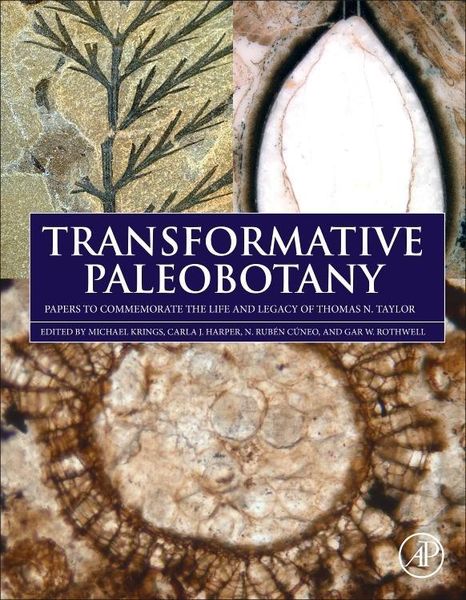
Produktbild: Transformative Paleobotany

Transformative Paleobotany Papers to Commemorate the Life and Legacy of Thomas N. Taylor

155,99 €

inkl. gesetzl. MwSt., Versandkostenfrei

Lieferung nach Hause

Beschreibung

Produktdetails

Einband

Gebundene Ausgabe

Erscheinungsdatum

27.07.2018

Herausgeber

Michael Krings + weitere

Verlag

Academic Press

Seitenzahl

732

Maße (L/B/H)

28,4/22,8/4,3 cm

Gewicht

2241 g

Sprache

Englisch

ISBN

978-0-12-813012-4

Beschreibung

Produktdetails

Einband

Gebundene Ausgabe

Erscheinungsdatum

27.07.2018

Herausgeber

Verlag

Academic Press

Seitenzahl

732

Maße (L/B/H)

28,4/22,8/4,3 cm

Gewicht

2241 g

Sprache

Englisch

ISBN

978-0-12-813012-4

Herstelleradresse

Libri GmbH
Europaallee 1
36244 Bad Hersfeld
DE

Email: [email protected]

Kundinnen und Kunden meinen

0 Bewertungen

Informationen zu Bewertungen

Zur Abgabe einer Bewertung ist eine Anmeldung im Konto notwendig. Die Authentizität der Bewertungen wird von uns nicht überprüft. Wir behalten uns vor, Bewertungstexte, die unseren Richtlinien widersprechen, entsprechend zu kürzen oder zu löschen.

Die Bewertungen sind nach Format, Anzahl Sterne und Datum sortiert.

Verfassen Sie die erste Bewertung zu diesem Artikel

Helfen Sie anderen Kund*innen durch Ihre Meinung

Kundinnen und Kunden meinen

0 Bewertungen filtern

  • Produktbild: Transformative Paleobotany
  • EARLY LAND PLANTS: INNOVATIONS AND ADAPTATIONS
    1. The evolutionary origin of the plant spore in relation to the antithetic origin of the plant sporophyte
    2. Early Devonian woody plants and implications for the early evolution of vascular cambia
    3. Using architecture modeling of the Devonian tree Pseudosporochnus to compute its biomass
    4. The advantages and frustrations of a plant Lagerstätte as illustrated by a new taxon from the Lower Devonian of the Welsh Borderland, UK
    5. Early Tracheophyte Phylogeny: A Preliminary Assessment of Homologies

    LATE PALEOZOIC AND MESOZOIC PLANTS AND FLORAS
    6. Lower Permian flora of the Sanzenbacher Ranch, Clay County, Texas
    7. Permian ginkgophytes of Angaraland
    8. Glossopterid plant remains in permineralization: What do they tell us?
    9. Pachytestopsis tayloriorum gen. et sp. nov., an anatomically preserved glossopterid seed from the Lopingian of Queensland, Australia
    10. A Triassic Mystery Solved: Fertile Pekinopteris from the Triassic of North Carolina, U.S.A.
    11. Enigmatic, structurally preserved stems from the Triassic of central Europe: A fern or not a fern?

    PALEOBIOGEOGRAPHY, BIOLOGY, AND PHYLOGENETIC RELATIONSHIPS OF PLANTS
    12. A comprehensive assessment of the fossil record of liverworts in amber
    13. Aerodynamics of Fossil Pollen: Implications for Understanding Pollination Biology in Extinct Plants
    14. Escapia gen. nov.: Morphological evolution, paleogeographic diversification, and the environmental distribution of marattialean ferns through time
    15. Heterosporous ferns from Patagonia: The case of Azolla
    16. Why are bryophytes so rare in the fossil record?  A spotlight on taphonomy and fossil preservation
    17. Fossil seeds with affinities to Austrobaileyales and Nymphaeales from the Early Cretaceous (early to middle Albian) of Virginia and Maryland, U.S.A: new evidence for extensive extinction near the base of the angiosperm tree

    FOSSIL MICROORGANISMS
    18. Reactive Oxygen Defense Against Cellular Endoparasites and the Origin of Eukaryotes
    19. Fossils of arbuscular mycorrhizal fungi give insights into the history of a successful partnership with plants
    20. Looking for arbuscular mycorrhizal fungi (AMF) in the fossil record - an illustrated guide
    21. Exceptional preservation of sessile, long-stalked microorganisms in the Lower Devonian Windyfield chert (Scotland)
    22. Morphological convergence in forest microfungi provides a proxy for Paleogene forest structure
    23. Ediacarans, protolichens, and lichen-derived Penicillium: A critical reassessment of the evolution of lichenization in fungi

    ANTARCTIC PALEOBOTANY
    24. Polar Regions of the Mesozoic-Paleogene greenhouse world as refugia for relict plant groups
    25. Leaf venation density and calculated physiological characteristics of fossil leaves from the Permian of Gondwana
    26. Functional significance of cambial development in Vertebraria roots: How do unusual xylem traits serve life at a high latitude?
    27. Cretaceous to Paleogene vegetation transition in Antarctica