KI-Beratung Beta

Gutscheinbedingungen

**Gültig vom 23.11. bis 30.11.2026 | Gültig für nicht preisgebundene fremdsprachige Bücher | Einzelne Artikel können ausgeschlossen sein | Online auf www.bücher.de einlösbar | Click & Collect nur mit Online-Zahlung (Paypal/Kreditkarte) vorab | Nicht kombinierbar mit anderen Gutscheinen oder Preisaktionen | Nur einmal pro Einkauf einlösbar | Gutschein wird auf max. 500€ Bestellwert angerechnet | Keine Barauszahlung | Nicht gültig für Versandkosten und Services

Produktbild: The Robot Factory

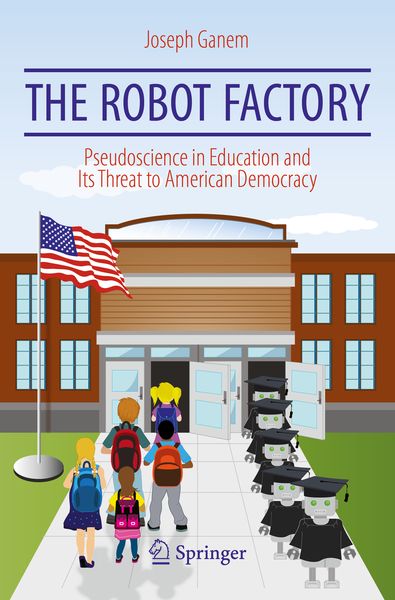
The Robot Factory Pseudoscience in Education and Its Threat to American Democracy

35,99 €

inkl. gesetzl. MwSt., Versandkostenfrei


Beschreibung

This book exposes a disturbing misuse of the scientific method to advance policies and agendas that are in fact detrimental to both science and education. The author, a physics professor, examines two related trends in education – the practice of “data-driven” reform and the disparaging of the traditional...

Beschreibung

This book exposes a disturbing misuse of the scientific method to advance policies and agendas that are in fact detrimental to both science and education. The author, a physics professor, examines two related trends in education – the practice of “data-driven” reform and the disparaging of the traditional liberal arts in favor of programs with a heavy emphasis on science and technology. Many of the reforms being foisted on educators have more in common with pseudo-science than real science. The reduction of education to a commodity, and the shilling of science as a means to enhance corporate profits, lead to an impoverished and stunted understanding of science in particular, and of education in general.
How is it possible for: • schools with all students learning at grade-level to be rated as failing?• teachers to be rated as ineffective after all their students meet their learning outcomes?• rising grade-school math standards to result in more college students needing remedial math?• politicians to disparage scientists and their results but argue that more students should study science?
These bizarre outcomes have happened and are the result of an education system that misuses and misrepresents math and science in the classroom and in crafting education policies. This book exposes the flawed and fallacious thinking that is damaging education at all levels throughout the United States, and makes a compelling case for rethinking the standardized, optimized, and quantified approaches in vogue in education today to accommodate the different needs of individual teachers and students.

Produktdetails

Einband

Taschenbuch

Erscheinungsdatum

10.09.2018

Abbildungen

XXVII, 255 p. 1 illus.

Verlag Springer

Produktdetails

Einband

Taschenbuch

Erscheinungsdatum

10.09.2018

Abbildungen

XXVII, 255 p. 1 illus.

Verlag Springer
Seitenzahl

255

Maße (L/B/H)

23,5/15,5/1,6 cm

Gewicht

435 g

Auflage

1st ed. 2018

Sprache

Englisch

ISBN

978-3-319-77859-4

Herstelleradresse

Springer-Verlag KG
Sachsenplatz 4-6
1201 Wien
AT

Email: ProductSafety@springernature.com

Noch keine Bewertungen vorhanden

Verfassen Sie die erste Bewertung zu diesem Artikel

Helfen Sie anderen Kundinnen und Kunden durch Ihre Meinung.

Kundinnen und Kunden meinen

Bewertungen (0)

  • Produktbild: The Robot Factory
  • Introduction.- Why I Would Fail Third Grade Math: A Multitude of Problems in One Brief Lesson.- Data-Driven Education Reform: A New Pseudo-science.- Science: Motivation, Measurement, and Meaning.- The Scientific Method Misapplied to Education.- The “Mathematical Intimidation” of Teachers.- The Statistical Impossibility of Adequate Yearly Progress in Schools.- The SAT: Promoting equal opportunity or perpetuating a hierarchy?.- The Accountability Hoax.- Facts versus Stories.- Why Our Kids Don’t Get Math.- The Widening Gap Between High School and College Math.- The Disconnect Between the Math Curriculum and Professional Practitioners.- Making Math Relevant: Assessing reading comprehension or math?.- The “Chinese Room”.- Misunderstanding Science Education.- Why Science is Hard.- Science as a Noun.- Science as a Question.- Science as a Conversation.- Science as a Guide.- Science as a Verb.- The Limits of Science.- Having It Both Ways.- Teachers are Real Human Beings (Not Idealized Fantasy People).- The Teacher-Student Relationship.- The Opposite of Science: Elevating Complexity.- Impossible Expectations.- Across Time and Space: The complex web of human relatedness.- Do Adults Model the Educational Values They Espouse?.- False Choice: The dark side of storytelling.- Schools are not Cultural Islands.- Dismembering Literature to Avoid its Truths.- The Fallacy of Market-based Education Reforms.- Markets: Meaning and Morality.- Education Markets: The Higher-Ed debacle.- The Charter School Movement.- The Logical Fallacies Embedded in the “Business Model”.- The Paradox of Wealth: Towards an Expanded Understanding of Self-Interest.- Rethinking Education.- Back to the Future: The “Deficit Model” of Education.- Transformative Education.- Beyond the Business Model.- Rethinking College: Preparing for the Unimagined.- The Expectations Trap.- The Limits of Education.- The Overlooked Role of Questions and Reflection.- Being Educated.- Knowing and Understanding.- Do Computers Understand?.- Relatedness.- The Real Crisis.- A Call to Action.