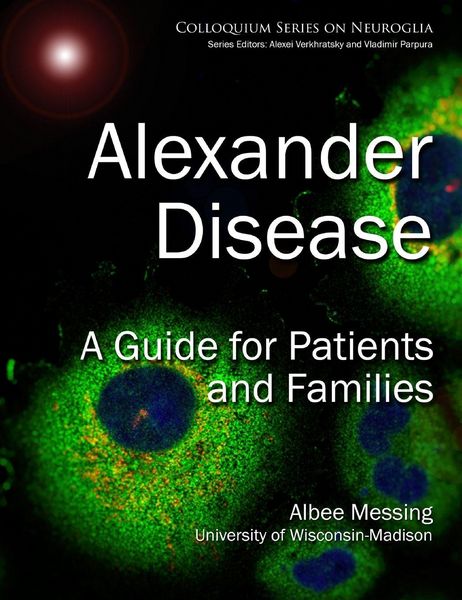
Alexander Disease A Guide for Patients and Families
-
- Englisch ausgewählt
71,99 €
inkl. gesetzl. MwSt.,
Beschreibung
Produktdetails
Einband
Gebundene Ausgabe
Erscheinungsdatum
14.11.2017
Herausgeber
Alexei Verkhratsky + weitereVerlag
Morgan & ClaypoolSeitenzahl
104
Maße (L/B/H)
24,1/19,6/1 cm
Gewicht
405 g
Sprache
Englisch
ISBN
978-1-61504-764-2
This book offers a comprehensive overview of Alexander disease, a rare and devastating neurological disorder that often affects the white matter of the brain and spinal cord.
Its distinctive neuropathology consists of abundant Rosenthal fibers within astrocytes (one of the four major cell types of the central nervous system). Nearly all cases are caused by variants in the gene encoding the intermediate filament protein GFAP, but how these changes in GFAP lead to the widespread manifestations of disease is poorly understood.
Astrocytes, while discovered over a century ago, are themselves still much of a mystery. They exhibit considerable diversity, defy precise definition, and yet actively regulate many aspects of nervous system functioning.
We also have incomplete understanding of Rosenthal fibers, odd structures that contain GFAP as just one of many components. Whether they are toxic or protective is unknown. Moreover, Rosenthal fibers are not absolutely unique to Alexander disease, and are seen sporadically in a wide variety of other conditions, including brain tumors and multiple sclerosis.
GFAP is the third unknown. It is an ancient protein, arising early in the evolution of vertebrates, but its role in normal biology is still a matter of debate. Yet Alexander disease shows, without a doubt, that changing just a single of its 432 amino acids can lead to catastrophe, not just in the astrocytes where GFAP is produced but also in the other cells with which astrocytes interact.
Despite all of the unknowns, much has been learned in the past 20 years, and it is time to share this knowledge. This book is intended for recently diagnosed patients and families, as well as non-specialist researchers interested in this neurological disease. It covers historical origins, the state of current knowledge, and prospects for what lies ahead, with citations to the primary literature given throughout.
Noch keine Bewertungen vorhanden
Verfassen Sie die erste Bewertung zu diesem Artikel
Helfen Sie anderen Kundinnen und Kunden durch Ihre Meinung.
Kurze Frage zu unserer Seite
Vielen Dank für dein Feedback
Wir nutzen dein Feedback, um unsere Produktseiten zu verbessern. Bitte habe Verständnis, dass wir dir keine Rückmeldung geben können. Falls du Kontakt mit uns aufnehmen möchtest, kannst du dich aber gerne an unseren Kund*innenservice wenden.
zum Kundenservice