KI-Beratung Beta

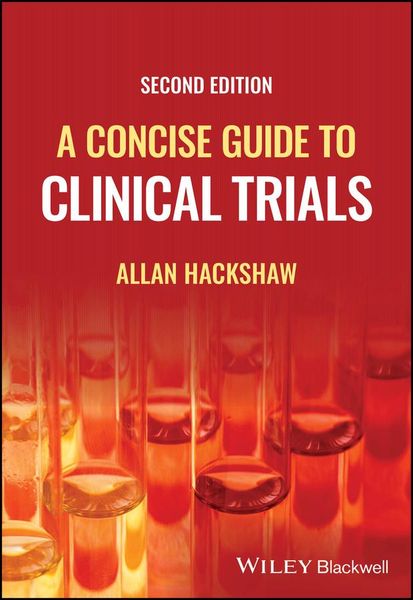
Produktbild: A Concise Guide to Clinical Trials

A Concise Guide to Clinical Trials

71,99 €

inkl. gesetzl. MwSt., Versandkostenfrei


Beschreibung

Produktdetails

Einband

Taschenbuch

Erscheinungsdatum

17.06.2024

Verlag

Wiley

Seitenzahl

224

Maße (L/B/H)

24,2/16,9/1,4 cm

Gewicht

410 g

Auflage

2nd edition

Sprache

Englisch

ISBN

978-1-119-50280-7

Beschreibung

Produktdetails

Einband

Taschenbuch

Erscheinungsdatum

17.06.2024

Verlag

Wiley

Seitenzahl

224

Maße (L/B/H)

24,2/16,9/1,4 cm

Gewicht

410 g

Auflage

2nd edition

Sprache

Englisch

ISBN

978-1-119-50280-7

Herstelleradresse

Libri GmbH
Europaallee 1
36244 Bad Hersfeld
DE

Email: gpsr@libri.de

Noch keine Bewertungen vorhanden

Verfassen Sie die erste Bewertung zu diesem Artikel

Helfen Sie anderen Kundinnen und Kunden durch Ihre Meinung.

Kundinnen und Kunden meinen

Bewertungen (0)

Die Leseprobe wird geladen.
  • Produktbild: A Concise Guide to Clinical Trials
  • Preface ix

    Foreword xi

    1 Fundamental concepts 1

    1.1 What is a clinical trial? 1

    1.2 Early trials 2

    1.3 Why clinical trials are needed 3

    1.4 Alternatives to clinical trials 3

    1.5 Types of clinical trials 5

    1.6 Key design features 7

    1.7 Summary points 13

    2 Types of outcome measures and understanding them 15

    2.1 Clinical trial outcome measures (endpoints) 15

    2.2 'True' versus surrogate outcome measures 16

    2.3 Types of outcomes 18

    2.4 Counting people 18

    2.5 Taking measurements on people 19

    2.6 Time-to-event measures 21

    2.7 Patient-reported outcome measures (PROMs) 25

    2.8 Summary points 27

    3 Phase I trials 29

    3.1 Trial objectives 29

    3.2 Types of participants 30

    3.3 Outcome measures 30

    3.4 Designs 32

    3.5 Conducting the trial 37

    3.6 Statistical analysis and reporting the trial results 37

    3.7 Summary points 39

    4 Phase II trials 41

    4.1 Trial objectives 41

    4.2 Designs 41

    4.3 Outcome measures 48

    4.4 Estimating study size 48

    4.5 Stopping early for toxicity 50

    4.6 Statistical analyses 51

    4.7 Interpreting phase II studies 55

    4.8 Summary points 56

    5 Phase III trials: design 59

    5.1 Trial objectives 59

    5.2 Designs 59

    5.3 Inclusion and exclusion criteria 62

    5.4 Experimental/investigational treatment group 64

    5.5 Control (comparator) group 64

    5.6 Randomisation and allocating participants 65

    5.7 Blinding (placebo) 66

    5.8 Outcome measures 66

    5.9 Participant follow-up 68

    5.10 Estimating study size 69

    5.11 Non-inferiority and equivalence 72

    5.12 Multiplicity: multiple treatment arms or multiple outcome measures 74

    5.13 Participants who switch trial interventions (crossover) 75

    5.14 Summary points 76

    6 Phase III trials - fundamental aspects of analysis and interpretation 79

    6.1 Efficacy 79

    6.2 Safety toxicity and adverse events 96

    6.3 Adherence (compliance) 98

    6.4 Health¿related quality of life (QoL) 99

    6.5 Intention¿tötreat and per¿protocol analyses 102

    6.6 Summary points 103

    7 Randomised trials - additional aspects of analysis and interpretation 107

    7.1 Non-inferiority and equivalence trials 107

    7.2 Composite outcome measures 110

    7.3 Subgroup (subset) analyses 111

    7.4 Crossover trials 115

    7.5 Factorial trials 115

    7.6 Cluster randomised trial 117

    7.7 Repeated measures 117

    7.8 Multiple endpoints 117

    7.9 Dealing with missing outcome data 119

    7.10 Translational research 120

    8 Commercial trials of medicinal products; other types of interventions; health economic analysis 127

    8.1 Commercial trials of medicines (drugs) 127

    8.2 Other types of interventions 135

    Surgical techniques 137

    Radiotherapy and radioactive substances 139

    Behavioural/lifestyle interventions 139

    Medical devices 141

    Cell and gene therapy 142

    8.3 Health economic analyses 144

    9 Systematic reviews and meta-analyses; and real-world evidence 147

    9.1 Systematic reviews of randomised controlled trials (direct comparisons) 147

    9.2 Meta-analyses based on indirect comparisons 154

    9.3 Real-world evidence and real-world data 159

    9.4 Summary points 166

    10 Conducting and reporting trials 169

    10.1 Working group and key roles 169

    10.2 Estimate and secure funding 170

    10.3 Patient and Public Involvement and Engagement (PPIE) 171

    10.4 Essential trial documents 171

    Trial protocol 171

    Participant/Patient Information Sheet (PIS) and Consent Form 172

    Case report forms (CRFs) 175

    Electronic database (randomisation system) 176

    Standard operating procedures (SOPs) 176

    Investigator's Brochure (IB) 177

    Trial Master File (TMF) 177

    10.5 Ethics and regulatory approvals 177

    10.6 Trial set up 179

    Register the trial 179

    Contracts and agreements 179

    Assess site feasibility 181

    Site initiation and activation 181

    Handling and distribution of trial drugs 181

    Handling and shipping of biospecimens or imaging scans 182

    10.7 Conducting the trial 182

    10.8 Monitoring the trial and suspension/early stopping 184

    Safety monitoring and reporting 185

    10.9 End of trial 188

    10.10 Reporting and publishing trials 190

    10.11 Regulations and guidance associated with conducting trials 191

    10.12 Why trials 'fail' 194

    Clinical trial critical appraisal checklist 199

    Glossary of abbreviations used in clinical trials 201

    Further reading 205

    Index 207