KI-Beratung Beta

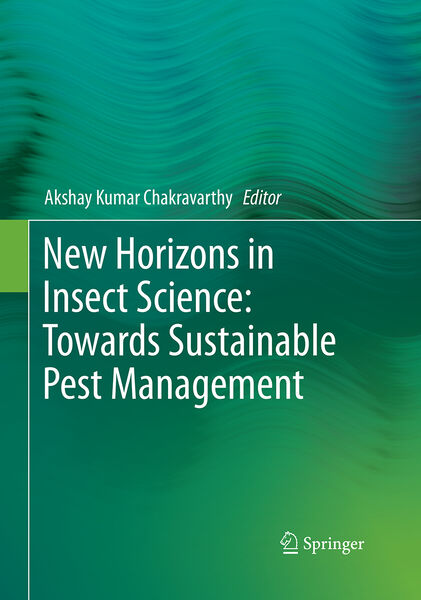
Produktbild: New Horizons in Insect Science: Towards Sustainable Pest Management
- 12%

New Horizons in Insect Science: Towards Sustainable Pest Management

12% sparen

139,99 € UVP 160,49 €

inkl. gesetzl. MwSt., Versandkostenfrei


Beschreibung

Produktdetails

Einband

Taschenbuch

Erscheinungsdatum

23.10.2016

Abbildungen

XXVII, 431 p. 93 illus., 43 illus. in color.

Herausgeber

Akshay Kumar Chakravarthy

Verlag

Springer India

Seitenzahl

431

Maße (L/B/H)

25,4/17,8/2,4 cm

Gewicht

962 g

Auflage

Softcover reprint of the original 1st ed. 2015

Sprache

Englisch

ISBN

978-81-322-2935-3

Beschreibung

Rezension

“This text is organized into seven sections covering
insect taxonomy, physiology, toxicology, vectors, molecular science, chemical
ecology, and management programs. … Summing Up: Recommended. Graduate students,
researchers/faculty, and professionals/practitioners.” (M. K. Harris, Choice, Vol.
53 (2), October, 2015)

Portrait


Dr. A. K. Chakravarthy is the Professor, University of Agricultural Sciences, GKVK, Bangalore. With over three decades of experience of teaching, research and extension, Dr. Chakravarthy has been the investigator for over 30 research projects and has guided more than 20 students for post graduation. A Ph.D. from Punjab Agricultural University and Fellow from IARI, New Delhi. He is a member of several National and International scientific academia, an advisor, a panelist, a referee, reviewer, editor and is associated with publication of thirty national and international journals worldwide. A field oriented, widely travelled biologist, he is actively working on novel approaches in Integrated Pest Management, Host Plant Interaction, Vertebrate Pest Management, Biodiversity and environmental conservation issues.

Produktdetails

Einband

Taschenbuch

Erscheinungsdatum

23.10.2016

Abbildungen

XXVII, 431 p. 93 illus., 43 illus. in color.

Herausgeber

Akshay Kumar Chakravarthy

Verlag

Springer India

Seitenzahl

431

Maße (L/B/H)

25,4/17,8/2,4 cm

Gewicht

962 g

Auflage

Softcover reprint of the original 1st ed. 2015

Sprache

Englisch

ISBN

978-81-322-2935-3

Herstelleradresse

Springer-Verlag KG
Sachsenplatz 4-6
1201 Wien
AT

Email: ProductSafety@springernature.com

Noch keine Bewertungen vorhanden

Verfassen Sie die erste Bewertung zu diesem Artikel

Helfen Sie anderen Kundinnen und Kunden durch Ihre Meinung.

Kundinnen und Kunden meinen

Bewertungen (0)

  • Produktbild: New Horizons in Insect Science: Towards Sustainable Pest Management

  • Section I – Insect Taxonomy.- 1.
    Insect Taxonomy – Basic to Barcoding.- 2. DNA Barcoding for Identification of Agriculturally Important Insects.-
    Section II – Insect Physiology.- 3.
    Changes in body melanisation and not body size affect mating success in
    Drosophila immigrans.- 4.
    Do Size and Age of Female
    Trichopria
    sp. Influence Longevity, Reproductive Performance and Sex Ratio?.- 5. Impact of Adult Size and Sib, Conspecific and Random Mating in
    Trichopria
    Sp. on Progeny Production and Sex Ratio.- 6. Importance of Formic Acid in Ethological States of
    Oecophylla smaragdina
    (Fabricius). 7. Identification of Gut Bacterial Community and the Impact of Bacteria Added Adult Diets on the Ovariole Number of the Pumpkin Fruit Fly,
    Bactrocera tau
      (Walker) (Diptera: Tephritidae).- 8. Metabolites of
    Pseudomonads
    : A New Avenue of Plant Health Management.- 9. Chitinase Expressed as an Inducible Trait in
    Pseudomonas aeruginosa
    P-15.- 10. Insect Resistance to
    Bt
    Transgenic Crops and its Management.-
    Section III – Insect Toxicology.- 11.
    Carboxylesterase and Glutathione-S-Transferase Quantification Mediating Resistance in Populations of Rice Leaf Folder,
    Cnaphalocrocis medinalis
    (Guenee).- 12. Bioassay of Rongbao (Active Ingredients of Calcium Cyanamide) against Housefly Maggots.- 13. Nanomaterials: A review of their action and application in pest management and evaluation of DNA tagged particles.- 14. Fumigant Toxicity of Essential Oil from Nutmeg Seeds (
    Myristica fragrans
    Houtt.) (MF, Myristicaceae) against Cowpea Weevil,
    Callosobruchus maculatus
    F. (Coleoptera : Bruchidae).-
    Section IV – Insect Vectors.- 15.
    Identification of Putative Vectors of Weligama Coconut Leaf Wilt Disease in Sri Lanka.- 16. Plant Virus Disease Spread through Insect Vectors and their Management.- 17. Vectors of Plant Viruses of Crop Plants in South East Asia.- 
    Section V – Insect Molecular Biology.- 18.
    Molecular Approaches for the Improvement of
    Bacillus thuringiensis
    against Pests.- 19. Diapause Related Gene Expression in Eggs of Multivoltine
    Bombyx mori
    L. Silkworm Races.- 20. Role of RNA interference in Pest Management.- 21. Molecular characterization and Management of shoot and fruit borer
    Conogethes punctiferalis
    Guenee (Crambidae: Lepidoptera) Populations infesting Cardamom, Castor and other hosts.-
    Section VI – Insect Semiochemicals.- 22.
    Use of Insect Pheromones in Vegetable Pest Management: Successes and Struggles.- 23. Glimpses of Semiochemical Research applications in Indian Horticulture: Present Status and Future Perspectives.-
    Section VII – Insect Pest Management: Using Host Plant Resistance, Biological Control.- 24.
    Impact of Gall Midge,
    Orseolia

    oryzae
    (Wood-Mason) Infestation on total Phenols, Proline and Indole Acetic Acid in Paddy (
    Oryza

    sativa
    Linn.) Genotypes.- 25. Antixenosis and AntibiosisComponent of Rice Resistance to Asian Rice Gall midge,
    Orseolia

    oryzae
    (Wood-Mason).- 26. Integrated Management of Insect-induced Reddening in
    Bt
    Cotton Hybrids.- 27. Inducing Resistance in Sesamum Accessions against Shoot Webber and Capsule Borer,
    Antigastra catalaunalis
    Duponchel through Mutation Breeding.- 28. Redesigning Research on Crop Resistance to Insects: Experiences with Tomato.- 29. Role of parasitoids and predators in management of insect pests.- 30. Development, characterization and field assessment of multiple insecticides and high temperature tolerant strain of an egg parasitoid,
    Trichogramma chilonis
    Ishii against crop pests.- 31. Reproductive Alterations by
    Wolbachia
    in the Braconid
    Cotesia vestalis
    (Haliday).- 32. Influence of Herbivores on the Biology of
    Chrysoperla carnea
    Stephens.- 33. Status and Management of Three Major Insect Pests of Coconut in the Tropics  and Subtropics.- 34. Area-wide Integrated Pest Management in Pigeonpea.- 35. Sustainable management of Tea mosquito bug
    Helopeltis antonii
    Signoret (Miridae:Hemiptera) on Cashew.- 36. Integrated Pest Management (IPM) for Reducing Pesticide Residues in Crops and Natural Resources.- 37. Biological Consequences of Climate Change on Arthropod Biodiversity and Pest Management.- 38. Temperature-Based Phenology Modeling and GIS-Based Risk Mapping: A Tool for Forecasting Potential Changes in the Abundance of Mealybug
    Phenacoccus solenopsis
    Tinsley (Hemiptera: Pseudococcidae).