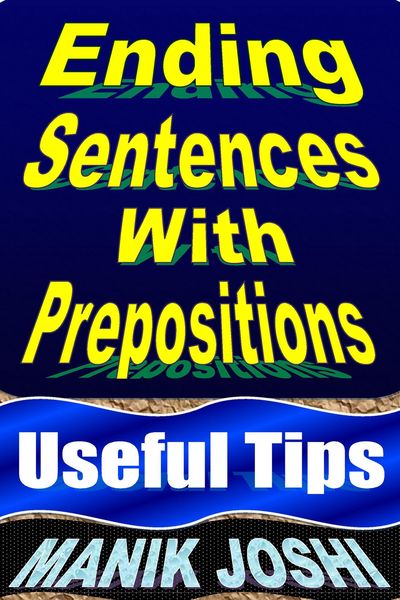
Ending Sentences with Prepositions: Useful Tips (English Daily Use, #23)
-
- Einzelkauf Download ausgewählt
-
Sprache:Englisch
0,99 €
inkl. gesetzl. MwSt.Beschreibung
Produktdetails
Format
ePUB
Kopierschutz
Ja
Family Sharing
Ja
Text-to-Speech
Ja
Erscheinungsdatum
15.09.2013
Verlag
Manik JoshiSeitenzahl
42 (Printausgabe)
Dateigröße
241 KB
Sprache
Englisch
EAN
9781301071753
This Book Covers The Following Topics: A Big Myth List of Prepositions Ending a sentence with a preposition - About, Against, At, By, For, From, In, Into, Of, On, Out, To, Upon, With - Example Sentences When to End a Sentence with a Preposition Situation - 01 - Interrogative Sentences Situation - 02 - Passive Voice Sentences Situation - 03 - Infinitive Structures Situation - 04 - Relative Clauses Situation - 05 - Phrasal Verbs How to Avoid Ending a Sentence with a Preposition Option - 01 - Restructuring the Sentence Option - 02 - Using a Different Word Avoid Unnecessary Use of Prepositions Additional Examples Exercises: 1(A) and 1(B) Exercises: 2(A) and 2(B) Sample This: It is said we should avoid ending a sentence with a preposition. A preposition should be placed before a noun or a pronoun. The word preposition expresses "position before" so it is improper to place a preposition at the end! This is, however, not a rule. You can use a preposition to end a sentence with. Here, you will learn when you can use a preposition at the end of a sentence and how you can avoid using a preposition at the end of a sentence. As there is no hard and fast rule regarding the use of a preposition at the end of a sentence, so whether you use it or not at the end of a sentence, it is your choice. But as most people avoid 'excessive' use of prepositions at the end of sentences, you can follow suit and may use them only when they give strength to your language. Some words (on, off, over, etc.) may be used as both prepositions and adverbs. However, everyone can't easily differentiate between a preposition and an adverb. So, whenever they see these words at the end of sentences, they think that they are prepositions. As most people are averse to the idea of using prepositions at the end of sentences, they even don't use these words as adverbs at the end of sentences. Actually, it is a myth that you shouldn't use a preposition at the end of a sentence. Using a preposition at the end of a sentence is not grammatically incorrect. You can end your sentences with prepositions. Sometimes, using a preposition at the end of a sentence seems better than using it in the middle or beginning of a sentence. Ending a Sentence with a Preposition - ABOUT An ad agency's job is to take a brand to consumers and communicate the proposition well to them so that they understand what the brand is all about. Could you tell me what he was on about? For the last 5 years, he has been part of the corruption in our country that we are angry about. Governor said even clerical staff could easily address some of the complaints that students were approaching him about. He warned her against commenting on things he is not authorized to speak about. Her success is all everybody in the town is talking about. How did the company come about? How did this all come about? I decided to leave my career, and concentrate my energies in an area that I was passionate about. I do not know which video you are talking about. Intimate details of his life have been flung about. There are many healthcare centers worth talking about. This is the player I told you about. This is what the fight is about. What are all these girls doing about? What are you getting upset about? What are you thinking about? What did you want to read about? What do they want to talk about?
Kundinnen und Kunden meinen
Verfassen Sie die erste Bewertung zu diesem Artikel
Helfen Sie anderen Kund*innen durch Ihre Meinung
Kurze Frage zu unserer Seite
Vielen Dank für dein Feedback
Wir nutzen dein Feedback, um unsere Produktseiten zu verbessern. Bitte habe Verständnis, dass wir dir keine Rückmeldung geben können. Falls du Kontakt mit uns aufnehmen möchtest, kannst du dich aber gerne an unseren Kund*innenservice wenden.
zum Kundenservice