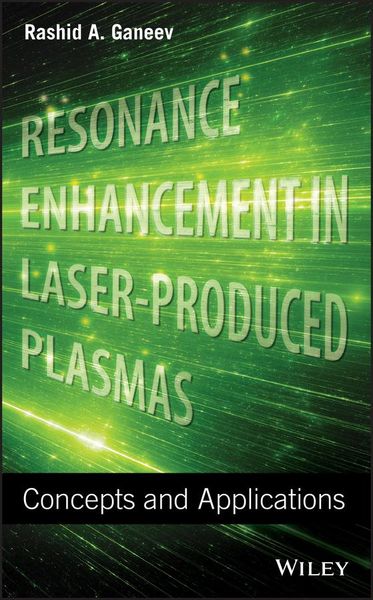
Resonance Enhancement in Laser-Produced Plasmas Concepts and Applications
209,99 €
inkl. gesetzl. MwSt.,
Beschreibung
Produktdetails
Einband
Gebundene Ausgabe
Erscheinungsdatum
21.08.2018
Verlag
John Wiley & SonsSeitenzahl
368
Maße (L/B/H)
23,1/15,5/2,3 cm
Gewicht
757 g
Auflage
1. Auflage
Sprache
Englisch
ISBN
978-1-119-47224-7
Resonance Enhancement in Laser-Produced Plasmas offers a guide to the most recent findings in the newly emerged field of resonance-enhanced high-order harmonic generation using the laser pulses propagating through the narrow and extended laser-produced plasma plumes. The author--a noted expert in the field--presents an introduction and the theory that underpin the roles of resonances in harmonic generation. The book also contains a review of the most advanced methods of plasma harmonics generation at the conditions of coincidence of some harmonics, autoionizing states, and some ionic transitions possessing strong oscillator strengths.
Comprehensive in scope, this text clearly demonstrates the importance of resonance-enhanced nonlinear optical effects leading to formation of efficient sources of coherent extreme ultraviolet radiation that can be practically applied. This important resource:
* Puts the focuses on novel applications of laser-plasma physics, such as the development of ultrashort-wavelength coherent light sources
* Details both the theoretical and experimental aspects of higher-order harmonic generation in laser-produced plasmas
* Contains information on early studies of resonance enhancement of harmonics in metal-ablated plasmas
* Analyzes the drawbacks of different theories of resonant high order harmonic generation
* Includes a discussion of the quasi-phase-matching and properties of semiconductor plasmas
Written for researchers and students in the fields of physics, materials science, and electrical engineering who are interested in laser physics and optics, Resonance Enhancement in Laser-Produced Plasmas offers an introduction to the topic and covers recent experimental studies of various resonance processes in plasmas leading to enhancement of single harmonic.
Noch keine Bewertungen vorhanden
Verfassen Sie die erste Bewertung zu diesem Artikel
Helfen Sie anderen Kundinnen und Kunden durch Ihre Meinung.
Kurze Frage zu unserer Seite
Vielen Dank für dein Feedback
Wir nutzen dein Feedback, um unsere Produktseiten zu verbessern. Bitte habe Verständnis, dass wir dir keine Rückmeldung geben können. Falls du Kontakt mit uns aufnehmen möchtest, kannst du dich aber gerne an unseren Kund*innenservice wenden.
zum Kundenservice