
Nonlinearities and Synchronization in Musical Acoustics and Music Psychology
-
- Hardcover
- Taschenbuch ausgewählt
- eBook
-
Sprache:Englisch
143,99 €
UVP
160,49 €
inkl. gesetzl. MwSt.,
Beschreibung
Produktdetails
Einband
Taschenbuch
Erscheinungsdatum
07.03.2015
Abbildungen
XXXI, 458 p. 202 illus., 28 illus. in color.
Verlag
Springer BerlinSeitenzahl
458
Maße (L/B/H)
23,5/15,5/2,7 cm
Gewicht
739 g
Auflage
2013
Sprache
Englisch
ISBN
978-3-642-43024-4
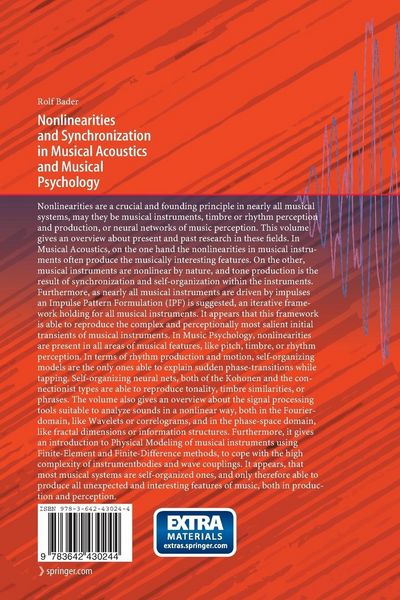
Nonlinearities are a crucial and founding principle in nearly all musical systems, may they be musical instruments, timbre or rhythm perception and production, or neural networks of music perception. This volume gives an overview about present and past research in these fields. In Musical Acoustics, on the one hand the nonlinearities in musical instruments often produce the musically interesting features. On the other, musical instruments are nonlinear by nature, and tone production is the result of synchronization and self-organization within the instruments. Furthermore, as nearly all musical instruments are driven by impulses an Impulse Pattern Formulation (IPF) is suggested, an iterative framework holding for all musical instruments. It appears that this framework is able to reproduce the complex and perceptionally most salient initial transients of musical instruments. In Music Psychology, nonlinearities are present in all areas of musical features, like pitch, timbre, or rhythm perception. In terms of rhythm production and motion, self-organizing models are the only ones able to explain sudden phase-transitions while tapping. Self-organizing neural nets, both of the Kohonen and the connectionist types are able to reproduce tonality, timbre similarities, or phrases. The volume also gives an overview about the signal processing tools suitable to analyze sounds in a nonlinear way, both in the Fourier-domain, like Wavelets or correlograms, and in the phase-space domain, like fractal dimensions or information structures. Furthermore, it gives an introduction to Physical Modeling of musical instruments using Finite-Element and Finite-Difference methods, to cope with the high complexity of instrument bodies and wave couplings. It appears, that most musical systems are self-organized ones, and only therefore able to produce all unexpected and interesting features of music, both in production and perception.
Noch keine Bewertungen vorhanden
Verfassen Sie die erste Bewertung zu diesem Artikel
Helfen Sie anderen Kundinnen und Kunden durch Ihre Meinung.
Kurze Frage zu unserer Seite
Vielen Dank für dein Feedback
Wir nutzen dein Feedback, um unsere Produktseiten zu verbessern. Bitte habe Verständnis, dass wir dir keine Rückmeldung geben können. Falls du Kontakt mit uns aufnehmen möchtest, kannst du dich aber gerne an unseren Kund*innenservice wenden.
zum Kundenservice