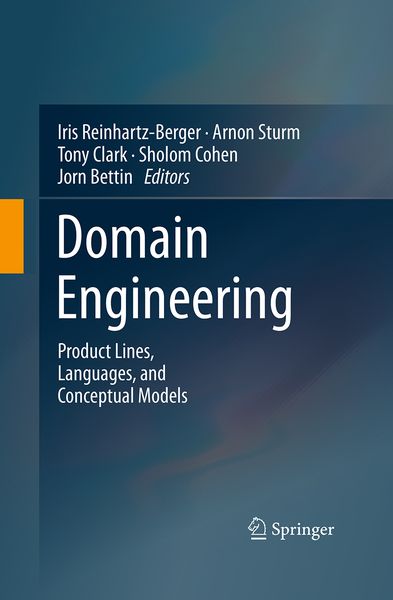
Domain Engineering Product Lines, Languages, and Conceptual Models
-
- Hardcover
- Taschenbuch ausgewählt
- eBook
-
Sprache:Englisch
49,99 €
inkl. gesetzl. MwSt.,
Lieferung nach Hause
Beschreibung
Produktdetails
Einband
Taschenbuch
Erscheinungsdatum
26.08.2015
Herausgeber
Iris Reinhartz-Berger + weitereVerlag
Springer BerlinSeitenzahl
404
Maße (L/B/H)
23,5/15,5/2,3 cm
Gewicht
633 g
Auflage
Softcover reprint of the original 1st edition 2013
Sprache
Englisch
ISBN
978-3-642-43184-5
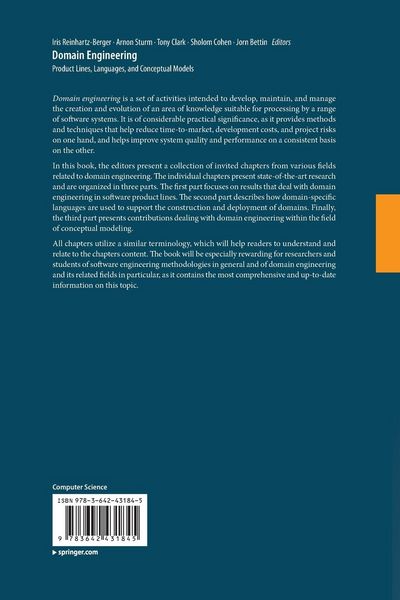
Domain engineering is a set of activities intended to develop, maintain, and manage the creation and evolution of an area of knowledge suitable for processing by a range of software systems. It is of considerable practical significance, as it provides methods and techniques that help reduce time-to-market, development costs, and project risks on one hand, and helps improve system quality and performance on a consistent basis on the other.
In this book, the editors present a collection of invited chapters from various fields related to domain engineering. The individual chapters present state-of-the-art research and are organized in three parts. The first part focuses on results that deal with domain engineering in software product lines. The second part describes how domain-specific languages are used to support the construction and deployment of domains. Finally, the third part presents contributions dealing with domain engineering within the field of conceptual modeling.
All chapters utilize a similar terminology, which will help readers to understand and relate to the chapters content. The book will be especially rewarding for researchers and students of software engineering methodologies in general and of domain engineering and its related fields in particular, as it contains the most comprehensive and up-to-date information on this topic.
Noch keine Bewertungen vorhanden
Verfassen Sie die erste Bewertung zu diesem Artikel
Helfen Sie anderen Kundinnen und Kunden durch Ihre Meinung.
Kurze Frage zu unserer Seite
Vielen Dank für dein Feedback
Wir nutzen dein Feedback, um unsere Produktseiten zu verbessern. Bitte habe Verständnis, dass wir dir keine Rückmeldung geben können. Falls du Kontakt mit uns aufnehmen möchtest, kannst du dich aber gerne an unseren Kund*innenservice wenden.
zum Kundenservice