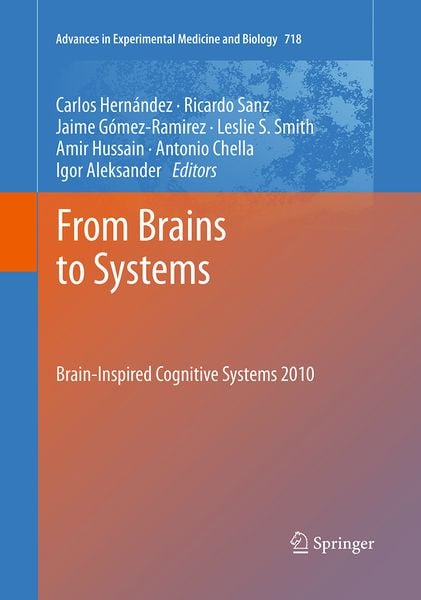
From Brains to Systems Brain-Inspired Cognitive Systems 2010
-
- Hardcover
- Taschenbuch ausgewählt
- eBook
-
Sprache:Englisch
249,99 €
inkl. gesetzl. MwSt.,
Beschreibung
Produktdetails
Einband
Taschenbuch
Erscheinungsdatum
23.08.2016
Abbildungen
XV, 253 p. 111 illus., 53 illus. in color.
Herausgeber
Carlos Hernández + weitereVerlag
Springer UsSeitenzahl
253
Maße (L/B/H)
25,4/17,8/1,5 cm
Gewicht
518 g
Auflage
Softcover reprint of the original 1st ed. 2011
Sprache
Englisch
ISBN
978-1-4939-4066-0
Brain Inspired Cognitive Systems - BICS 2010 aims to bring together leading scientists and engineers who use analytic and synthetic methods both to understand the astonishing processing properties of biological systems and specifically of the brain, and to exploit such knowledge to advance engineering methods to build artificial systems with higher levels of cognitive competence.
BICS is a meeting point of brain scientists and cognitive systems engineers where cross-domain ideas are fostered in the hope of getting emerging insights on the nature, operation and extractable capabilities of brains. This multiple approach is necessary because the progressively more accurate data about the brain is producing a growing need of a quantitative understanding and an associated capacity to manipulate this data and translate it into engineering applications rooted in sound theories.
BICS 2010 is intended for both researchers that aim to build brain inspired systems with higher cognitive competences, and for life scientists who use and develop mathematical and engineering approaches for a better understanding of complex biological systems like the brain.
Four major interlaced focal symposia are planned for this conference and these are organized into patterns that encourage cross-fertilization across the symposia topics. This emphasizes the role of BICS as a major meeting point for researchers and practitioners in the areas of biological and artificial cognitive systems. Debates across disciplines will enrich researchers with complementary perspectives from diverse scientific fields.
BICS 2010 will take place July 14-16, 2010, in Madrid, Spain.
Noch keine Bewertungen vorhanden
Verfassen Sie die erste Bewertung zu diesem Artikel
Helfen Sie anderen Kundinnen und Kunden durch Ihre Meinung.
Kurze Frage zu unserer Seite
Vielen Dank für dein Feedback
Wir nutzen dein Feedback, um unsere Produktseiten zu verbessern. Bitte habe Verständnis, dass wir dir keine Rückmeldung geben können. Falls du Kontakt mit uns aufnehmen möchtest, kannst du dich aber gerne an unseren Kund*innenservice wenden.
zum Kundenservice