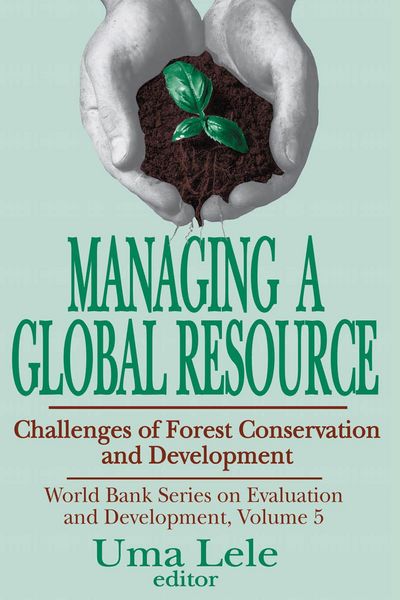
Managing a Global Resource Challenges of Forest Conservation and Development
-
- Hardcover
- Taschenbuch
- eBook ausgewählt
-
Form:Einzelkauf Download
-
Sprache:Englisch
-
eBook Format:PDF
- PDF 68,99 € ausgewählt
- ePUB 68,99 €
68,99 €
inkl. gesetzl. MwSt.Beschreibung
Produktdetails
Format
Kopierschutz
Ja
Family Sharing
Nein
Text-to-Speech
Nein
Erscheinungsdatum
12.07.2017
Herausgeber
Uma J. LeleVerlag
Taylor & Francis eBooksSeitenzahl
312 (Printausgabe)
Dateigröße
2173 KB
Sprache
Englisch
EAN
9781351507318
The rapid loss of tropical forests, particularly in the developing world, has been a global concern since the late 1980s and has prompted a variety of international initiatives to save the forests. In 1991, the World Bank responded to global concerns and to criticism by nongovernmental organizations by forming a conservation-oriented forest strategy. Managing a Global Resource is an outgrowth of the independent evaluation conducted by the World Bank's Operations Evaluation Department and discusses how effectively that strategy was implemented. In this detailed investigation, Uma J. Lele explores why the loss of forests and biodiversity has been so rapid in some developing countries (Brazil, Indonesia, and Cameroon) and not in others (China, India, and Costa Rica). She assesses future prospects for conservation in these six countries by critically examining their policies, institutional arrangements, and emerging national and international instruments to conserve forests and biodiversity. Together these six countries account for 25 percent of the world's forest cover and 44 percent of the world's population. Managing a Global Resource presents case studies of the forest sectors of each country in the context of overall development policies, interest groups, and governance issues. Lele's investigation finds a fundamental divergence in forest-rich countries between the global objectives of conservation and the local objectives of development and private profit. In some forest-poor countries, in contrast, natural resource loss has led the countries on their own accord to adopt a variety of conservation-oriented policies and programs. Despite the greater congruence between the global and national objectives in these forest-poor countries, competing demands on their resources and the constraints on their policies, institutions, and human capital make it difficult for them to affect forest and biodiversity conservation. This volume makes it clear that
Noch keine Bewertungen vorhanden
Verfassen Sie die erste Bewertung zu diesem Artikel
Helfen Sie anderen Kundinnen und Kunden durch Ihre Meinung.
Kurze Frage zu unserer Seite
Vielen Dank für dein Feedback
Wir nutzen dein Feedback, um unsere Produktseiten zu verbessern. Bitte habe Verständnis, dass wir dir keine Rückmeldung geben können. Falls du Kontakt mit uns aufnehmen möchtest, kannst du dich aber gerne an unseren Kund*innenservice wenden.
zum Kundenservice