Beschreibung
Produktdetails
Einband
Taschenbuch
Erscheinungsdatum
29.05.2018
Verlag
TalonbooksSeitenzahl
112
Maße (L/B/H)
21,3/13,7/1 cm
Gewicht
159 g
Sprache
Englisch
ISBN
978-1-77201-199-9
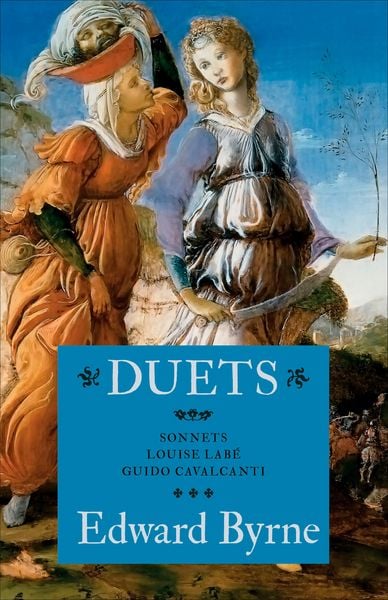
Edward Byrne's Duets consists of interpretative translations of sonnets by Louise Labé, who lived and wrote in sixteenth-century Lyon, and those by thirteenth-century Florentine Guido Cavalcanti.
In the case of Labé, the twenty-four sonnets - twenty-three in French, one in Italian - constitute a narrative sequence chronicling the duration of an intense love affair. In the case of Cavalcanti, the sonnets are not sequential, but have been selected from the most explicitly philosophical of his sonnets - those which demonstrate his "radical Aristotelianism." In both cases, one of a pre-Petrarchan poet, the other post-Petrarchan, love is represented as both a wildness, madness, or malady and as something that gives rise to speculation regarding the relationship between body and intellect.
The reader will find herein ninety poems, equally "translations" of Labé and Cavalcanti and "versions" authored by Byrne. Each sonnet is made up of nine lines, each line, in turn, made up of nine syllables. The work's main body is written in the manner of the serial poem, a practice whereby the composing mind passes from room to room - and from stanza to stanza - in a kind of trance, forgetting and remembering. A distant but undeniable antecedent to this practice, in the context of translation, can be found in Robin Blaser's masterful translation of Gérard de Nerval's Les Chimères. The second version of Louise Labé's sonnet sequence was translated from Rilke's German version, using Labé's Middle French text as a 'pony.' Interspersed within, or intervening in, the translations are "sonnets" by Michel Foucault, Julia Kristeva, Marcel Proust, and Jacques Lacan. Between the main translations, readers will discover a sequence of wild sonnets, or nonets, taken from a separate collaboration of Byrne's with Kim Minkus, and a handful of sonnets by Labé's contemporaneous admirers - members of her salon, such as Maurice Scève and Clément Marot.
Noch keine Bewertungen vorhanden
Verfassen Sie die erste Bewertung zu diesem Artikel
Helfen Sie anderen Kundinnen und Kunden durch Ihre Meinung.
Kurze Frage zu unserer Seite
Vielen Dank für dein Feedback
Wir nutzen dein Feedback, um unsere Produktseiten zu verbessern. Bitte habe Verständnis, dass wir dir keine Rückmeldung geben können. Falls du Kontakt mit uns aufnehmen möchtest, kannst du dich aber gerne an unseren Kund*innenservice wenden.
zum Kundenservice