KI-Beratung Beta

Gutscheinbedingungen

**Gültig vom 23.11. bis 30.11.2026 | Gültig für nicht preisgebundene fremdsprachige Bücher | Einzelne Artikel können ausgeschlossen sein | Online auf www.bücher.de einlösbar | Click & Collect nur mit Online-Zahlung (Paypal/Kreditkarte) vorab | Nicht kombinierbar mit anderen Gutscheinen oder Preisaktionen | Nur einmal pro Einkauf einlösbar | Gutschein wird auf max. 500€ Bestellwert angerechnet | Keine Barauszahlung | Nicht gültig für Versandkosten und Services

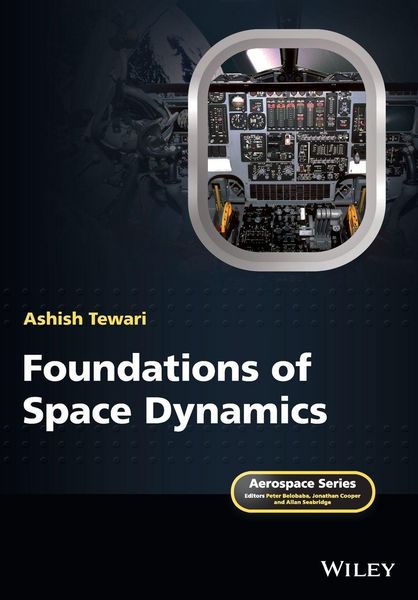
Produktbild: Foundations of Space Dynamics

Foundations of Space Dynamics

Aus der Reihe Aerospace Series

111,99 €

inkl. gesetzl. MwSt., Versandkostenfrei


Beschreibung

An introduction to orbital mechanics and spacecraft attitude dynamics

Foundations of Space Dynamics offers an authoritative text that combines a comprehensive review of both orbital mechanics and dynamics. The author a noted expert in the field covers up-to-date topics including: orbital perturbations,...

Beschreibung

An introduction to orbital mechanics and spacecraft attitude dynamics

Foundations of Space Dynamics offers an authoritative text that combines a comprehensive review of both orbital mechanics and dynamics. The author a noted expert in the field covers up-to-date topics including: orbital perturbations, Lambert's transfer, formation flying, and gravity-gradient stabilization. The text provides an introduction to space dynamics in its entirety, including important analytical derivations and practical space flight examples.

Written in an accessible and concise style, Foundations of Space Dynamics highlights analytical development and rigor, rather than numerical solutions via ready-made computer codes. To enhance learning, the book is filled with helpful tables, figures, exercises, and solved examples.

This important book:

  • Covers space dynamics with a systematic and comprehensive approach
  • Is designed to be a practical text filled with real-world examples
  • Contains information on the most current applications
  • Includes up-to-date topics from orbital perturbations to gravity- gradient stabilization
  • Offers a deep understanding of space dynamics often lacking in other textbooks

Written for undergraduate and graduate students and professionals in aerospace engineering, Foundations of Space Dynamics offers an introduction to the most current information on orbital mechanics and dynamics.

Produktdetails

Einband

Taschenbuch

Erscheinungsdatum

30.12.2020

Herausgeber Peter Belobaba + weitere
Verlag John Wiley & Sons Inc

Produktdetails

Einband

Taschenbuch

Erscheinungsdatum

30.12.2020

Herausgeber
Verlag John Wiley & Sons Inc
Seitenzahl

368

Maße (L/B/H)

27,4/21,3/1,8 cm

Gewicht

816 g

Auflage

1. Auflage

Sprache

Englisch

ISBN

978-1-119-45534-9

Herstelleradresse

Libri GmbH
Europaallee 1
36244 Bad Hersfeld
DE

Email: gpsr@libri.de

Noch keine Bewertungen vorhanden

Verfassen Sie die erste Bewertung zu diesem Artikel

Helfen Sie anderen Kundinnen und Kunden durch Ihre Meinung.

Kundinnen und Kunden meinen

Bewertungen (0)

Die Leseprobe wird geladen.
  • Produktbild: Foundations of Space Dynamics
  • Preface xiii

    1 Introduction 1

    1.1 Space Flight 1

    1.1.1 Atmosphere as Perturbing Environment 1

    1.1.2 Gravity as the Governing Force 4

    1.1.3 Topics in Space Dynamics 5

    1.2 Reference Frames and Time Scales 5

    1.2.1 Sidereal Frame 5

    1.2.2 Celestial Frame 8

    1.2.3 Synodic Frame 8

    1.2.4 Julian Date 8

    1.3 Classification of Space Missions 10

    Exercises 10

    References 11

    2 Dynamics 13

    2.1 Notation and Basics 13

    2.2 Plane Kinematics 14

    2.3 Newton's Laws 16

    2.4 Particle Dynamics 17

    2.5 The n-Body Problem 20

    2.6 Dynamics of a Body 24

    2.7 Gravity Field of a Body 27

    2.7.1 Legendre Polynomials 29

    2.7.2 Spherical Coordinates 31

    2.7.3 Axisymmetric Body 34

    2.7.4 Spherical Body with Radially Symmetric Mass Distribution 37

    Exercises 37

    References 40

    3 Keplerian Motion 41

    3.1 The Two-Body Problem 41

    3.2 Orbital Angular Momentum 43

    3.3 Orbital Energy Integral 45

    3.4 Orbital Eccentricity 46

    3.5 Orbit Equation 49

    3.5.1 Elliptic Orbit 53

    3.5.2 Parabolic Orbit 56

    3.5.3 Hyperbolic Orbit 56

    3.5.4 Rectilinear Motion 58

    3.6 Orbital Velocity and Flight Path Angle 60

    3.7 Perifocal Frame and Lagrange's Coefficients 63

    Exercises 65

    4 Time in Orbit 69

    4.1 Position and Velocity in an Elliptic Orbit 70

    4.2 Solution to Kepler's Equation 75

    4.2.1 Newton's Method 76

    4.2.2 Solution by Bessel Functions 78

    4.3 Position and Velocity in a Hyperbolic Orbit 80

    4.4 Position and Velocity in a Parabolic Orbit 84

    4.5 Universal Variable for Keplerian Motion 86

    Exercises 88

    References 89

    5 Orbital Plane 91

    5.1 Rotation Matrix 91

    5.2 Euler Axis and Principal Angle 94

    5.3 Elementary Rotations and Euler Angles 97

    5.4 Euler-Angle Representation of the Orbital Plane 101

    5.4.1 Celestial Reference Frame 103

    5.4.2 Local-Horizon Frame 104

    5.4.3 Classical Euler Angles 106

    5.5 Planet-Fixed Coordinate System 111

    Exercises 114

    6 Orbital Manoeuvres 117

    6.1 Single-Impulse Orbital Manoeuvres 119

    6.2 Multi-impulse Orbital Transfer 123

    6.2.1 Hohmann Transfer 124

    6.2.2 Rendezvous in Circular Orbit 127

    6.2.3 Outer Bi-elliptic Transfer 130

    6.3 Continuous Thrust Manoeuvres 133

    6.3.1 Planar Manoeuvres 134

    6.3.2 Constant Radial Acceleration from Circular Orbit 135

    6.3.3 Constant Circumferential Acceleration from Circular Orbit 136

    6.3.4 Constant Tangential Acceleration from Circular Orbit 139

    Exercises 141

    References 143

    7 Relative Motion in Orbit 145

    7.1 Hill-Clohessy-Wiltshire Equations 148

    7.2 Linear State-Space Model 151

    7.3 Impulsive Manoeuvres About a Circular Orbit 153

    7.3.1 Orbital Rendezvous 153

    7.4 Keplerian Relative Motion 155

    Exercises 158

    8 Lambert's Problem 161

    8.1 Two-Point Orbital Transfer 161

    8.1.1 Transfer Triangle and Terminal Velocity Vectors 162

    8.2 Elliptic Transfer 164

    8.2.1 Locus of the Vacant Focii 165

    8.2.2 Minimum-Energy and Minimum-Eccentricity Transfers 166

    8.3 Lambert's Theorem 168

    8.3.1 Time in Elliptic Transfer 169

    8.3.2 Time in Hyperbolic Transfer 173

    8.3.3 Time in Parabolic Transfer 175

    8.4 Solution to Lambert's Problem 177

    8.4.1 Parameter of Transfer Orbit 178

    8.4.2 Stumpff Function Method 179

    8.4.3 Hypergeometric Function Method 185

    Exercises 188

    References 190

    9 Orbital Perturbations 191

    9.1 Perturbing Acceleration 191

    9.2 Osculating Orbit 192

    9.3 Variation of Parameters 194

    9.3.1 Lagrange Brackets 197