Application of Uncertainty Analysis to Ecological Risks of Pesticides
-
- Hardcover
- Taschenbuch ausgewählt
- eBook
-
Sprache:Englisch
121,99 €
inkl. gesetzl. MwSt.,
Beschreibung
Produktdetails
Einband
Taschenbuch
Erscheinungsdatum
31.05.2017
Abbildungen
46 SW-Abb., 6 Tabellen
Herausgeber
William J. Warren-Hicks + weitereVerlag
Taylor & FrancisSeitenzahl
230
Maße (L/B/H)
23,4/15,6/1,3 cm
Gewicht
357 g
Sprache
Englisch
ISBN
978-1-138-11481-4
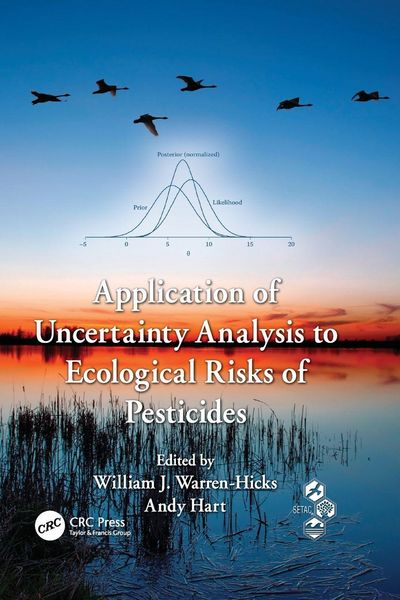
While current methods used in ecological risk assessments for pesticides are largely deterministic, probabilistic methods that aim to quantify variability and uncertainty in exposure and effects are attracting growing interest from industries and governments. Probabilistic methods offer more realistic and meaningful estimates of risk and hence, potentially, a better basis for decision-making. Application of Uncertainty Analysis to Ecological Risks of Pesticides examines the applicability of probabilistic methods for ecological risk assessment for pesticides and explores their appropriateness for general use.
The book presents specific methods leading to probabilistic decisions concerning the registration and application of pesticides and includes case studies illustrating the application of statistical methods. The authors discuss Bayesian inference, first-order error analysis, first-order (non-hierarchical) Monte Carlo methods, second-order Bayesian and Monte Carlo methods, interval analysis, and probability bounds analysis. They then examine how these methods can be used in assessments for other environmental stressors and contaminants.
There are many methods of analyzing variability and uncertainty and many ways of presenting the results. Inappropriate use of these methods leads to misleading results, and experts differ on what is appropriate. Disagreement about which methods are appropriate will result in wasted resources, conflict over findings, and reduced credibility with decision makers and the public. There is, therefore, a need to reach a consensus on how to choose and use appropriate methods, and to present this in the form of guidance for prospective users. Written in a clear and concise style, the book examines how to use probabilistic methods within a risk-based decision paradigm.
Noch keine Bewertungen vorhanden
Verfassen Sie die erste Bewertung zu diesem Artikel
Helfen Sie anderen Kundinnen und Kunden durch Ihre Meinung.
Kurze Frage zu unserer Seite
Vielen Dank für dein Feedback
Wir nutzen dein Feedback, um unsere Produktseiten zu verbessern. Bitte habe Verständnis, dass wir dir keine Rückmeldung geben können. Falls du Kontakt mit uns aufnehmen möchtest, kannst du dich aber gerne an unseren Kund*innenservice wenden.
zum Kundenservice