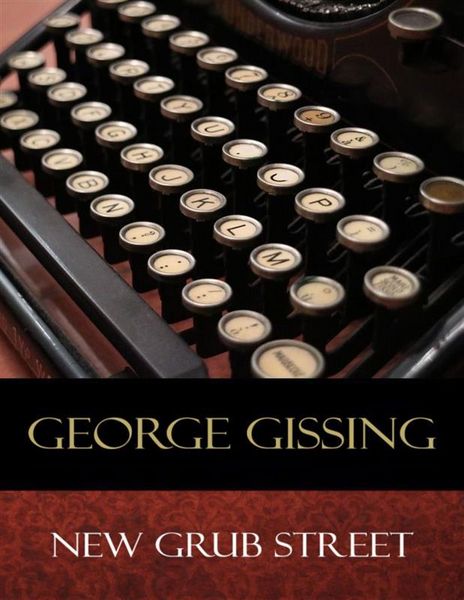
New Grub Street
-
- Hardcover
- Taschenbuch
- eBook ausgewählt
-
Form:Einzelkauf Download
-
Sprache:Englisch
-
eBook Format:ePUB
- PDF 2,99 €
- ePUB 1,49 € ausgewählt
-
Verlag:BertaBooks
- Charles River Editors 1,82 €
- BertaBooks 1,49 € ausgewählt
- True Sign Publishing House 0,99 €
- Andrews UK 1,99 €
- Krill Press 1,82 €
- Simon + Schuster LLC 1,97 €
- Seltzer Books 0,91 €
- Booklassic 0,88 €
- Copycat 2,13 €
- The Floating Press 2,99 €
- Good Press 0,99 €
- Musaicum Books 0,99 €
- E-artnow 0,49 €
- Bu Classics Books 1,99 €
- Random House Publishing Group 4,49 €
- Penguin Books Ltd 6,99 €
- Double 9 Books 0,99 €
- DigiCat 0,99 €
1,49 €
inkl. gesetzl. MwSt.Beschreibung
Produktdetails
Format
ePUB
Kopierschutz
Nein
Family Sharing
Ja
Text-to-Speech
Ja
Erscheinungsdatum
05.06.2017
Verlag
BertaBooksSeitenzahl
(Printausgabe)
Dateigröße
483 KB
Sprache
Englisch
EAN
9788826448381
New Grub Street is a novel by George Gissing published in 1891, which is set in the literary and journalistic circles of 1880s London. Gissing revised and shortened the novel for a French edition of 1901.
The story deals with the literary world that Gissing himself had experienced. Its title refers to the London street, Grub Street, which in the 18th century became synonymous with hack literature; by Gissing's time, Grub Street itself no longer existed, though hack-writing certainly did. Its two central characters are a sharply contrasted pair of writers: Edwin Reardon, a novelist of some talent but limited commercial prospects, and a shy, cerebral man; and Jasper Milvain, a young journalist, hard-working and capable of generosity, but cynical and only semi-scrupulous about writing and its purpose in the modern world.
New Grub Street opens with Milvain, an "alarmingly modern young man" driven by pure financial ambition in navigating his literary career. He accepts that he will "always despise the people [he] write[s] for," networks within the appropriate social circle to create opportunity, and authors articles for popular periodicals. Reardon, on the other hand, prefers to write novels of a more literary bent and refuses to pander to contemporary tastes until, as a last-gasp measure against financial ruin, he attempts a popular novel. At this venture, he is of course too good to succeed, and he's driven to separate from his wife, Amy Reardon, née Yule, who cannot accept her husband's inflexibly high standards-and consequent poverty.
In New Grub Street George Gissing re-created a microcosm of London's literary society as he had experienced it. His novel is at once a major social document and a story that draws us irresistibly into the twilit world of Edwin Reardon, a struggling novelist, and his friends and acquaintances in Grub Street including Jasper Milvain, an ambitious journalist, and Alfred Yule, an embittered critic. Here Gissing brings to life the bitter battles (fought out in obscure garrets or in the Reading Room of the British Museum) between integrity and the dictates of the market place, the miseries of genteel poverty and the damage that failure and hardship do to human personality and relationships.
The Yule family includes Amy's two uncles-John, a wealthy invalid, and Alfred, a species of critic-and Alfred's daughter, and research assistant, Marian. The friendship that develops between Marian and Milvain's sisters, who move to London following their mother's death, provides opportunity for the former to meet and fall in love with Milvain. However much Milvain respects Marian's intellectual capabilities and strength of personality, the crucial element (according to him) for marriage is missing: money. Marrying a rich woman, after all, is the most convenient way to speed his career. Indeed, Milvain slights romantic love as a key to marriage:
As a rule, marriage is the result of a mild preference, encouraged by circumstances, and deliberately heightened into strong sexual feeling. You, of all men, know well enough that the same kind of feeling could be produced for almost any woman who wasn't repulsive.
The BBC Radio 4 sitcom Ed Reardon's Week contains characters loosely suggested by the novel.
The story deals with the literary world that Gissing himself had experienced. Its title refers to the London street, Grub Street, which in the 18th century became synonymous with hack literature; by Gissing's time, Grub Street itself no longer existed, though hack-writing certainly did. Its two central characters are a sharply contrasted pair of writers: Edwin Reardon, a novelist of some talent but limited commercial prospects, and a shy, cerebral man; and Jasper Milvain, a young journalist, hard-working and capable of generosity, but cynical and only semi-scrupulous about writing and its purpose in the modern world.
New Grub Street opens with Milvain, an "alarmingly modern young man" driven by pure financial ambition in navigating his literary career. He accepts that he will "always despise the people [he] write[s] for," networks within the appropriate social circle to create opportunity, and authors articles for popular periodicals. Reardon, on the other hand, prefers to write novels of a more literary bent and refuses to pander to contemporary tastes until, as a last-gasp measure against financial ruin, he attempts a popular novel. At this venture, he is of course too good to succeed, and he's driven to separate from his wife, Amy Reardon, née Yule, who cannot accept her husband's inflexibly high standards-and consequent poverty.
In New Grub Street George Gissing re-created a microcosm of London's literary society as he had experienced it. His novel is at once a major social document and a story that draws us irresistibly into the twilit world of Edwin Reardon, a struggling novelist, and his friends and acquaintances in Grub Street including Jasper Milvain, an ambitious journalist, and Alfred Yule, an embittered critic. Here Gissing brings to life the bitter battles (fought out in obscure garrets or in the Reading Room of the British Museum) between integrity and the dictates of the market place, the miseries of genteel poverty and the damage that failure and hardship do to human personality and relationships.
The Yule family includes Amy's two uncles-John, a wealthy invalid, and Alfred, a species of critic-and Alfred's daughter, and research assistant, Marian. The friendship that develops between Marian and Milvain's sisters, who move to London following their mother's death, provides opportunity for the former to meet and fall in love with Milvain. However much Milvain respects Marian's intellectual capabilities and strength of personality, the crucial element (according to him) for marriage is missing: money. Marrying a rich woman, after all, is the most convenient way to speed his career. Indeed, Milvain slights romantic love as a key to marriage:
As a rule, marriage is the result of a mild preference, encouraged by circumstances, and deliberately heightened into strong sexual feeling. You, of all men, know well enough that the same kind of feeling could be produced for almost any woman who wasn't repulsive.
The BBC Radio 4 sitcom Ed Reardon's Week contains characters loosely suggested by the novel.
Noch keine Bewertungen vorhanden
Verfassen Sie die erste Bewertung zu diesem Artikel
Helfen Sie anderen Kundinnen und Kunden durch Ihre Meinung.
Kurze Frage zu unserer Seite
Vielen Dank für dein Feedback
Wir nutzen dein Feedback, um unsere Produktseiten zu verbessern. Bitte habe Verständnis, dass wir dir keine Rückmeldung geben können. Falls du Kontakt mit uns aufnehmen möchtest, kannst du dich aber gerne an unseren Kund*innenservice wenden.
zum Kundenservice