KI-Beratung Beta

  • Produktbild: Nanocomposites for Visible Light-induced Photocatalysis
  • Produktbild: Nanocomposites for Visible Light-induced Photocatalysis
- 10%

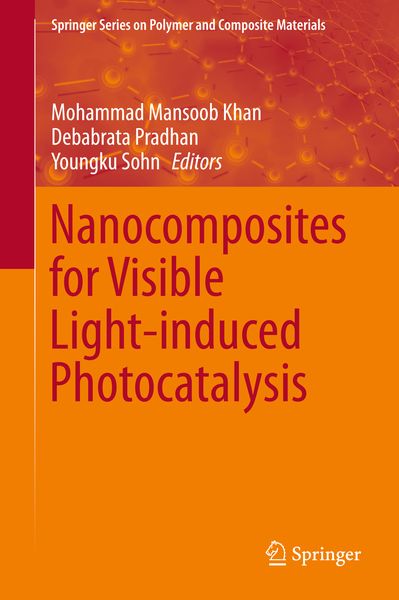
Nanocomposites for Visible Light-induced Photocatalysis

10% sparen

143,99 € UVP 160,49 €

inkl. gesetzl. MwSt., Versandkostenfrei


Beschreibung

Produktdetails

Einband

Gebundene Ausgabe

Erscheinungsdatum

15.09.2017

Abbildungen

X, 400 p. 219 illus., 165 illus. in color.

Herausgeber

Mohammad Mansoob Khan + weitere

Verlag

Springer

Seitenzahl

400

Maße (L/B/H)

24,1/16/2,8 cm

Gewicht

730 g

Auflage

17001 Auflage 1st edition 2017

Sprache

Englisch

ISBN

978-3-319-62445-7

Beschreibung

Portrait

Dr. Mohammad Mansoob Khan is a Professor (Senior Assistant) at Chemical Sciences, Faculty of Science, Universiti Brunei Darussalam. He earned his PhD from Aligarh Muslim University, India in 2002. Afterwards he has worked as researcher, lecturer and Professor at different universities in India, Ethiopia, Oman, and South Korea. Since 2015 he is working as a Professor (Senior Assistant) at Universiti Brunei Darussalam. His main research interests are in the field of nanosciences, nanotechnology and nanomaterials, especially green syntheses of metal nanoparticles, inorganic nanohybrid and nanocomposite materials for Energy and Environment applications such as catalysis, photocatalysis, optoelectronic devices, hydrogen production and sensing.


Dr. Debabrata Pradhan has a position as Associate Professor at the Materials Science Center of the Indian Institute of Technology, Kharagpur. He received a PhD in Chemistry from the Indian Institute of Technology in Mumbai in 2003. After postdoctoral research in Taiwan (Tamkang University) and Canada (Univ. of Waterloo) he joined the Indian Institute of Technology in Kharagpur in 2010, first as Assistant Professor, and since 2015 as Associate Professor. His research interests are in nanotechnology, especially the synthesis, characterization, and applications of nanomaterials including metallic and semiconducting nanostructures and their structure-property correlations.

Dr. Youngku Sohn is an Associate Professor in the Department of Chemistry at Chungnam National University in South Korea. He received his PhD from the University of British Columbia in Canada in 2004. Afterwards he spent some time as postdoctoral researcher at the same university, before moving to the University of Texas in Austin (USA) in 2005 and then to the University of Waterloo, Canada in 2007. From 2008 to 2017 he held a faculty position at Yeungam University. Since 2017 he has a position as Associate Professor atChungnam National University with broad research interests in Physical Chemistry, Spectroscopy, Surface Chemistry, Catalysis, Energy and Environments. 

Produktdetails

Einband

Gebundene Ausgabe

Erscheinungsdatum

15.09.2017

Abbildungen

X, 400 p. 219 illus., 165 illus. in color.

Herausgeber

Verlag

Springer

Seitenzahl

400

Maße (L/B/H)

24,1/16/2,8 cm

Gewicht

730 g

Auflage

17001 Auflage 1st edition 2017

Sprache

Englisch

ISBN

978-3-319-62445-7

Herstelleradresse

Springer-Verlag KG
Sachsenplatz 4-6
1201 Wien
AT

Email: ProductSafety@springernature.com

Noch keine Bewertungen vorhanden

Verfassen Sie die erste Bewertung zu diesem Artikel

Helfen Sie anderen Kundinnen und Kunden durch Ihre Meinung.

Kundinnen und Kunden meinen

Bewertungen (0)

  • Produktbild: Nanocomposites for Visible Light-induced Photocatalysis
  • Produktbild: Nanocomposites for Visible Light-induced Photocatalysis
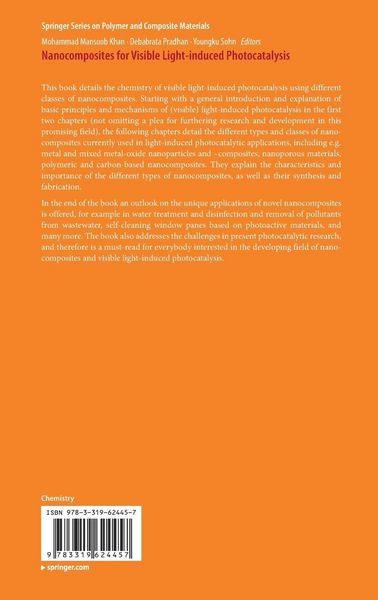
  • Introduction.- Basic principles, mechanism, and challenges of photocatalysis.- Nanocomposites and their importance in photocatalysis.- Role of metal nanoparticles and their surface plasmon activity on nanocomposites for visible light-induced catalysis.- Mixed metal-oxides nanocomposites for visible light-induced photocatalysis.- Nanoporous nanocomposite materials for photocatalysis.- Polymeric nanocomposites for visible light-induced photocatalysis.- Carbon-based nanocomposites for visible light induced photocatalysis.- Novel applications and future perspectives of nanocomposites.