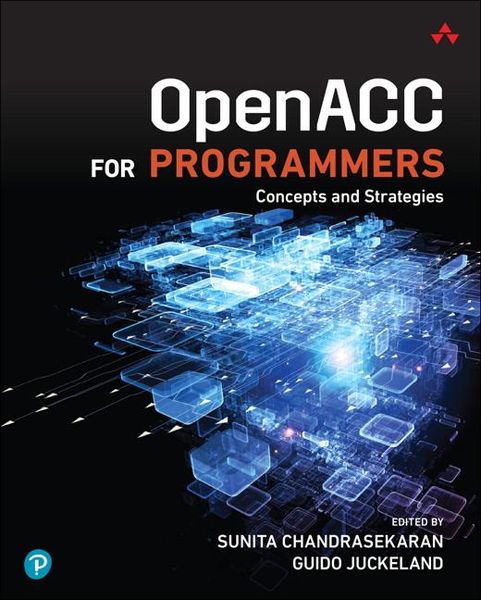
Openacc for Programmers Concepts and Strategies
-
- Taschenbuch ausgewählt
- eBook
-
Sprache:Englisch
59,99 €
inkl. gesetzl. MwSt.,
Lieferung nach Hause
Beschreibung
Produktdetails
Einband
Taschenbuch
Erscheinungsdatum
10.09.2017
Verlag
Pearson StudiumSeitenzahl
320
Maße (L/B/H)
23,1/18,9/2,2 cm
Gewicht
542 g
Sprache
Englisch
ISBN
978-0-13-469428-3
The Complete Guide to OpenACC for Massively Parallel Programming
Scientists and technical professionals can use OpenACC to leverage the immense power of modern GPUs without the complexity traditionally associated with programming them. OpenACCTM for Programmers is one of the first comprehensive and practical overviews of OpenACC for massively parallel programming.
This book integrates contributions from 19 leading parallel-programming experts from academia, public research organizations, and industry. The authors and editors explain each key concept behind OpenACC, demonstrate how to use essential OpenACC development tools, and thoroughly explore each OpenACC feature set.
Throughout, you’ll find realistic examples, hands-on exercises, and case studies showcasing the efficient use of OpenACC language constructs. You’ll discover how OpenACC’s language constructs can be translated to maximize application performance, and how its standard interface can target multiple platforms via widely used programming languages.
Each chapter builds on what you’ve already learned, helping you build practical mastery one step at a time, whether you’re a GPU programmer, scientist, engineer, or student. All example code and exercise solutions are available for download at GitHub.
- Discover how OpenACC makes scalable parallel programming easier and more practical
- Walk through the OpenACC spec and learn how OpenACC directive syntax is structured
- Get productive with OpenACC code editors, compilers, debuggers, and performance analysis tools
- Build your first real-world OpenACC programs
- Exploit loop-level parallelism in OpenACC, understand the levels of parallelism available, and maximize accuracy or performance
- Learn how OpenACC programs are compiled
- Master OpenACC programming best practices
- Overcome common performance, portability, and interoperability challenges
- Efficiently distribute tasks across multiple processors
Register your product at informit.com/register for convenient access to downloads, updates, and/or corrections as they become available.
Noch keine Bewertungen vorhanden
Verfassen Sie die erste Bewertung zu diesem Artikel
Helfen Sie anderen Kundinnen und Kunden durch Ihre Meinung.
Kurze Frage zu unserer Seite
Vielen Dank für dein Feedback
Wir nutzen dein Feedback, um unsere Produktseiten zu verbessern. Bitte habe Verständnis, dass wir dir keine Rückmeldung geben können. Falls du Kontakt mit uns aufnehmen möchtest, kannst du dich aber gerne an unseren Kund*innenservice wenden.
zum Kundenservice