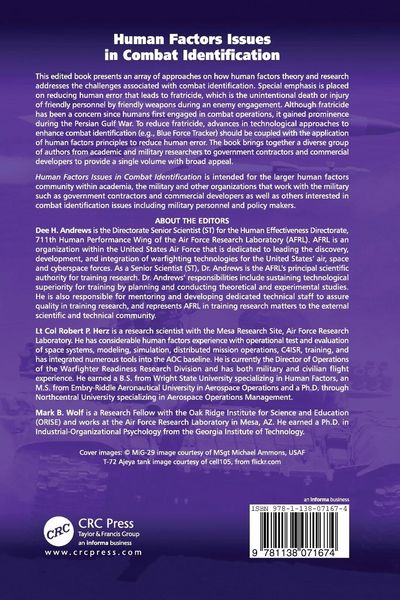
• Produktbild: Human Factors Issues in Combat Identification
  • Produktbild: Human Factors Issues in Combat Identification

Human Factors Issues in Combat Identification

109,99 €

inkl. gesetzl. MwSt., Versandkostenfrei

Lieferung nach Hause

Beschreibung

Produktdetails

Einband

Taschenbuch

Erscheinungsdatum

31.03.2017

Herausgeber

Herz Robert + weitere

Verlag

Taylor & Francis

Seitenzahl

398

Maße (L/B/H)

23,4/15,6/2,1 cm

Gewicht

740 g

Sprache

Englisch

ISBN

978-1-138-07167-4

Beschreibung

Produktdetails

Einband

Taschenbuch

Erscheinungsdatum

31.03.2017

Herausgeber

Verlag

Taylor & Francis

Seitenzahl

398

Maße (L/B/H)

23,4/15,6/2,1 cm

Gewicht

740 g

Sprache

Englisch

ISBN

978-1-138-07167-4

Kundinnen und Kunden meinen

0 Bewertungen

Informationen zu Bewertungen

Zur Abgabe einer Bewertung ist eine Anmeldung im Konto notwendig. Die Authentizität der Bewertungen wird von uns nicht überprüft. Wir behalten uns vor, Bewertungstexte, die unseren Richtlinien widersprechen, entsprechend zu kürzen oder zu löschen.

Die Bewertungen sind nach Format, Anzahl Sterne und Datum sortiert.

Verfassen Sie die erste Bewertung zu diesem Artikel

Helfen Sie anderen Kund*innen durch Ihre Meinung

Kundinnen und Kunden meinen

0 Bewertungen filtern

Die Leseprobe wird geladen.
  • Produktbild: Human Factors Issues in Combat Identification
  • Produktbild: Human Factors Issues in Combat Identification
  • Contents: Foreword; Preface; Introduction, Katherine A. Wilson, Eduardo Salas and Dee H. Andrews. Section 1 Cognitive Processes: Factors affecting speed and accuracy of response selection in operational environments, Robert W. Proctor and Motonori Yamaguchi; Measuring vigilance abilities to enhance combat identification performance, Clark Shingledecker, David E. Weldon, Kyle Behymer, Benjamin Simpkins, Elizabeth Lerner, Joel Warm, Gerald Matthews, Victore Finomore, Tyler Shaw and Jennifer S. Murphy; Dimensions of spatial ability and their influence on performance with unmanned systems, Thomas Fincannon, A. William Evans III, Florian Jentsch and Joseph Keebler. Section 2 Visual Discrimination: The effects of conjunctive search and response mappings on automatic performance in a complex visual task, Cleotilde Gonzalez, Rick P. Thomas and Poornima Madhavan; What visual discrimination of fractal textures can tell us about discrimination of camouflaged targets, Vincent A. Billock, Douglas W. Cunningham and Brian H. Tsou; A cognitive basis for friend-foe misidentification of vehicles in combat, Joseph R. Keebler, Lee W. Sciarini, Florian Jentsch, Denise Nicholson and Thomas Fincannon; Preattentive attributes in visualization design: enhancing combat identification, Scott H. Summers. Section 3 Situation Awareness: Team coordination and shared situation awareness in combat identification, Cheryl A. Bolstad, Mica R. Endsley and Haydee M. Cuevas; The use of soft sensors and I-space for improved combat ID, David L. Hall and Stan Aungst. Section 4 Teams: Training strategies to mitigate expectancy-induced response bias in combat identification: a research agenda, Frank L. Greitzer and Dee H. Andrews; Comparing individual and team judgment accuracy for target identification under heavy cognitive demand, Verlin B. Hinsz and Dana M. Wallace; A team training paradigm for better combat identification, Wayne Shebilske, Georgiy Levchuk, Jared Freeman and Kevin Gildea; Analysis of the tasks conducted by forward air controllers and pilots during simulated close air support missions: supporting the development of the INCIDER model, Beejal Mistry, Gareth Croft, David Dean, Julie Gadsden, Gareth Conway and Katherine Cornes; Team cognition during a simulated close air support exercise: results from a new behavioral rating instrument, Jerzy Jarmasz, Richard Zobarich, Lora Bruyn-Martin and Tab Lamoureux. Section 5 Automation: Evaluating reliance on combat identification systems: the role of reliability feedback, Heather F. Neyedli, Lu Wang, Greg A. Jamieson and Justin G. Hollands; The effects of automation bias on operator compliance and reliance, Stephen Rice, Krisstal Clayton and Jason McCarley; An examination of the social, cognitive, and motivational factors that affect automation reliance, Mary T. Dzindolet, Linda G. Pierce and Hall P. Beck; On fratricide and the operational reliability of target identification decision aids in combat identification, John K. Hawley, Anna L. Mares and Jessica L. Marcon; The case for active fratricide avoidance in Net-Centric C2 systems, John Barnett; Mitigating friendly fire casualties through enhanced battle command capabilities, Jean W. Pharaon; Index.