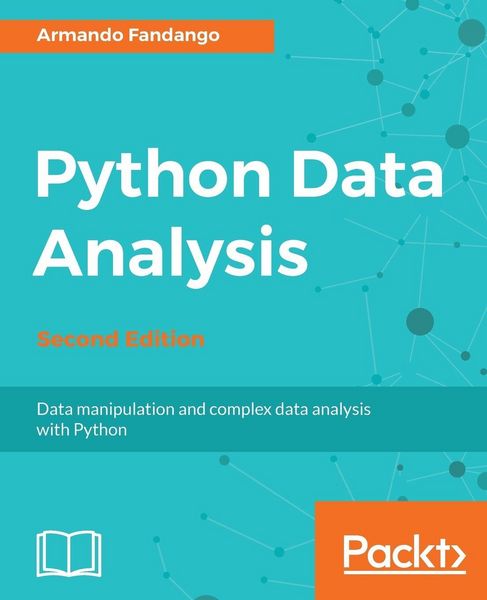
Python Data Analysis - Second Edition Data manipulation and complex data analysis with Python
-
- Englisch ausgewählt
71,99 €
inkl. gesetzl. MwSt.,
Beschreibung
Produktdetails
Einband
Taschenbuch
Erscheinungsdatum
30.03.2017
Verlag
Packt PublishingSeitenzahl
330
Maße (L/B/H)
23,5/19,1/1,8 cm
Gewicht
618 g
Sprache
Englisch
ISBN
978-1-78712-748-7
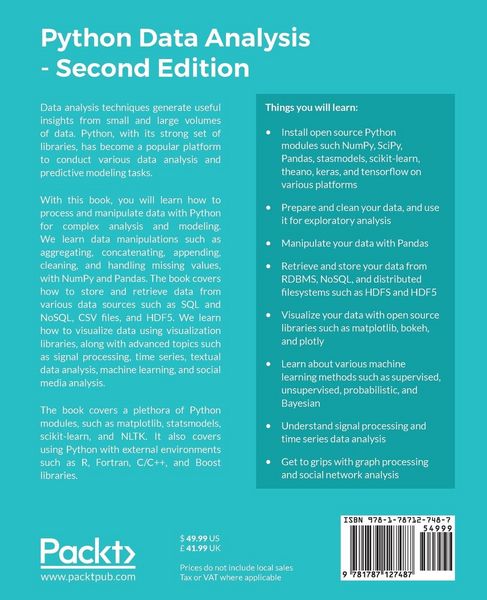
Learn how to apply powerful data analysis techniques with popular open source Python modules Key Features Find, manipulate, and analyze your data using the Python 3.5 libraries Perform advanced, high-performance linear algebra and mathematical calculations with clean and efficient Python code An easy-to-follow guide with realistic examples that are frequently used in real-world data analysis projects. Book Description Data analysis techniques generate useful insights from small and large volumes of data. Python, with its strong set of libraries, has become a popular platform to conduct various data analysis and predictive modeling tasks. With this book, you will learn how to process and manipulate data with Python for complex analysis and modeling. We learn data manipulations such as aggregating, concatenating, appending, cleaning, and handling missing values, with NumPy and Pandas. The book covers how to store and retrieve data from various data sources such as SQL and NoSQL, CSV fies, and HDF5. We learn how to visualize data using visualization libraries, along with advanced topics such as signal processing, time series, textual data analysis, machine learning, and social media analysis. The book covers a plethora of Python modules, such as matplotlib, statsmodels, scikit-learn, and NLTK. It also covers using Python with external environments such as R, Fortran, C/C++, and Boost libraries. What you will learn Install open source Python modules such NumPy, SciPy, Pandas, stasmodels, scikit-learn,theano, keras, and tensorflow on various platforms Prepare and clean your data, and use it for exploratory analysis Manipulate your data with Pandas Retrieve and store your data from RDBMS, NoSQL, and distributed filesystems such as HDFS and HDF5 Visualize your data with open source libraries such as matplotlib, bokeh, and plotly Learn about various machine learning methods such as supervised, unsupervised, probabilistic, and Bayesian Understand signal processing and time series data analysis Get to grips with graph processing and social network analysis
Noch keine Bewertungen vorhanden
Verfassen Sie die erste Bewertung zu diesem Artikel
Helfen Sie anderen Kundinnen und Kunden durch Ihre Meinung.
Kurze Frage zu unserer Seite
Vielen Dank für dein Feedback
Wir nutzen dein Feedback, um unsere Produktseiten zu verbessern. Bitte habe Verständnis, dass wir dir keine Rückmeldung geben können. Falls du Kontakt mit uns aufnehmen möchtest, kannst du dich aber gerne an unseren Kund*innenservice wenden.
zum Kundenservice