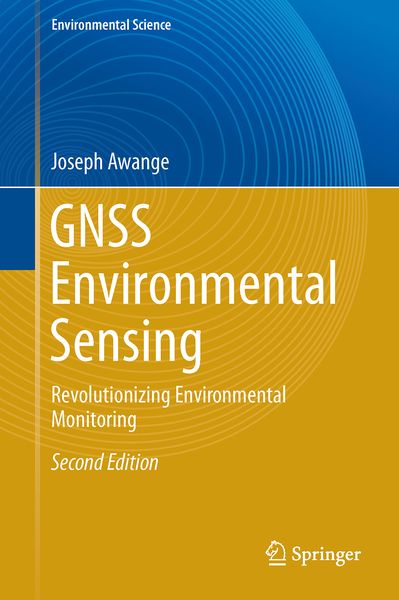
GNSS Environmental Sensing Revolutionizing Environmental Monitoring
-
- Hardcover ausgewählt
- Taschenbuch
- eBook
-
Sprache:Englisch
162,99 €
UVP
181,89 €
inkl. gesetzl. MwSt.,
Beschreibung
Produktdetails
Einband
Gebundene Ausgabe
Erscheinungsdatum
12.09.2017
Abbildungen
XXII, 452 p. 190 illus., 180 illus. in color.
Verlag
SpringerSeitenzahl
452
Maße (L/B/H)
24,1/16/3,1 cm
Gewicht
823 g
Auflage
2nd ed. 2018
Sprache
Englisch
ISBN
978-3-319-58417-1
This book is the second edition of Environmental Monitoring using GNSS and highlights the latest developments in global navigation satellite systems (GNSS). It features a completely new title and additional chapters that present emerging challenges to environmental monitoring—“climate variability/change and food insecurity.”
Since the publication of the first edition, much has changed in both the development and applications of GNSS, a satellite microwave remote sensing technique. It is the first tool to span all four dimensions of relevance to humans (position, navigation, timing and the environment), and it has widely been used for positioning (both by military and civilians), navigation and timing. Its increasing use is leading to a new era of remote sensing that is now revolutionizing the art of monitoring our environment in ways never imagined before.
On the one hand, nearly all GNSS satellites (Global Positioning System (GPS), Global Navigation Satellite System (GLONASS), Galileo and Beidou) have become operational, thereby providing high-precision, continuous, all-weather and near real- time remote sensing multi-signals beneficial to environmental monitoring. On the other hand, the emerging challenges of precisely monitoring climate change and the demand for the production of sufficient food for ever-increasing populations are pushing traditional monitoring methods to their limits.
In this regard, refracted GNSS signals (i.e., occulted GNSS signals or GNSS meteorology) are now emerging as sensors of climate variability, while the reflected signals (GNSS reflectometry or GNSS-R) are increasingly finding applications in determining, e.g., soil moisture content, ice and snow thickness, ocean heights, and wind speed and direction, among others. Furthermore, the increasing recognition and application of GNSS-supported unmanned aircraft vehicles (UAV)/drones in agriculture (e.g., through the determination of water holding capacity of soil) highlights the new challenges facing GNSS.
As such, this new edition three new chapters address GNSS reflectometry and applications; GNSS sensing of climate variability; and the applications in UAV/drones. Moreover, it explores the application of GNSS to support integrated coastal zone management.
Noch keine Bewertungen vorhanden
Verfassen Sie die erste Bewertung zu diesem Artikel
Helfen Sie anderen Kundinnen und Kunden durch Ihre Meinung.
Kurze Frage zu unserer Seite
Vielen Dank für dein Feedback
Wir nutzen dein Feedback, um unsere Produktseiten zu verbessern. Bitte habe Verständnis, dass wir dir keine Rückmeldung geben können. Falls du Kontakt mit uns aufnehmen möchtest, kannst du dich aber gerne an unseren Kund*innenservice wenden.
zum Kundenservice