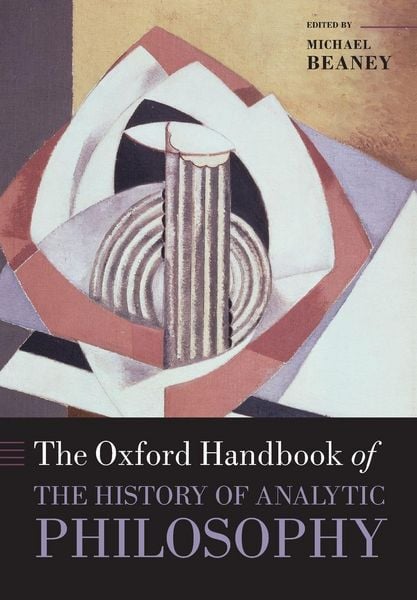
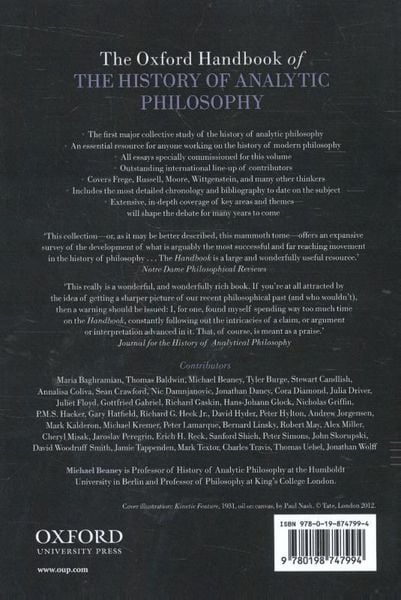
• Produktbild: The Oxford Handbook of The History of Analytic Philosophy
  • Produktbild: The Oxford Handbook of The History of Analytic Philosophy

The Oxford Handbook of The History of Analytic Philosophy

107,99 €

inkl. gesetzl. MwSt., Versandkostenfrei

Lieferung nach Hause

Beschreibung

Produktdetails

Einband

Taschenbuch

Erscheinungsdatum

10.09.2015

Herausgeber

Beaney Michael

Verlag

KNV Besorgung

Seitenzahl

1182

Maße (L/B/H)

24,4/17/6,3 cm

Gewicht

1942 g

Sprache

Englisch

ISBN

978-0-19-874799-4

Beschreibung

Produktdetails

Einband

Taschenbuch

Erscheinungsdatum

10.09.2015

Herausgeber

Beaney Michael

Verlag

KNV Besorgung

Seitenzahl

1182

Maße (L/B/H)

24,4/17/6,3 cm

Gewicht

1942 g

Sprache

Englisch

ISBN

978-0-19-874799-4

Herstelleradresse

Libri GmbH
Europaallee 1
36244 Bad Hersfeld
DE

Email: gpsr@libri.de

Kundinnen und Kunden meinen

0 Bewertungen

Informationen zu Bewertungen

Zur Abgabe einer Bewertung ist eine Anmeldung im Konto notwendig. Die Authentizität der Bewertungen wird von uns nicht überprüft. Wir behalten uns vor, Bewertungstexte, die unseren Richtlinien widersprechen, entsprechend zu kürzen oder zu löschen.

Die Bewertungen sind nach Format, Anzahl Sterne und Datum sortiert.

Verfassen Sie die erste Bewertung zu diesem Artikel

Helfen Sie anderen Kund*innen durch Ihre Meinung

Kundinnen und Kunden meinen

0 Bewertungen filtern

  • Produktbild: The Oxford Handbook of The History of Analytic Philosophy
  • Produktbild: The Oxford Handbook of The History of Analytic Philosophy
    • Introduction: Analytic Philosophy and its Historiography

    • 1: Michael Beaney: What is analytic philosophy?

    • 2: Michael Beaney: The historiography of analytic philosophy

    • 3: Michael Beaney: Chronology of analytic philosophy and its historiography

    • 4: Michael Beaney: Bibliography of analytic philosophy and its historiography

    • Part One: The Origins of Analytic Philosophy

    • 5: Mark Textor: Bolzano's anti-Kantianism: from a priori cognitions to conceptual truths

    • 6: David Hyder: Time, norms, and structure in nineteenth-century German philosophy of science

    • 7: Gottfried Gabriel: Frege and the German background to analytic philosophy

    • 8: John Skorupski: Analytic philosophy, the Analytic school, and British philosophy

    • 9: Jamie Tappenden: The mathematical and logical background to analytic philosophy

    • 10: Tyler Burge: Gottlob Frege: some forms of influence

    • 11: Nicholas Griffin: Russell and Moore's revolt against British idealism

    • 12: Bernard Linsky: Russell's theory of descriptions and the idea of logical construction

    • 13: Thomas Baldwin: G. E. Moore and the Cambridge School of Analysis

    • 14: Michael Kremer: The whole meaning of a book of nonsense: reading Wittgenstein's Tractatus

    • Part Two: The Development of Analytic Philosophy

    • 15: Charles Travis and Mark Kalderon: Oxford realism

    • 16: Thomas Uebel: Early logical empiricism and its reception: the case of the Vienna Circle

    • 17: Erich H. Reck: Developments in logic: Carnap, Gödel and Tarski

    • 18: Hans-Johann Glock: Wittgenstein's later philosophy

    • 19: Maria Baghramian and Andrew Jorgensen: Quine, Kripke, and Putnam

    • 20: Sean Crawford: The myth of logical behaviourism and the origins of the identity theory

    • 21: Alex Miller: The development of theories of meaning: from Frege to McDowell and beyond

    • 22: Stewart Candlish and Nic Damnjanovic: Reason, action and the will: the fall and rise of causalism

    • 23: Peter Simons: Metaphysics in analytic philosophy

    • 24: Jonathan Dancy: Meta-ethics in the twentieth century

    • 25: Julia Driver: Normative ethical theory in the twentieth century

    • 26: Peter Lamarque: Analytic aesthetics

    • 27: Jonathan Wolff: Analytic political philosophy

    • Part Three: Themes in the History of Analytic Philosophy

    • 28: Richard G. Heck, Jr., and Robert May: The function is unsaturated

    • 29: Richard Gaskin: When logical atomism met the Theaetetus: Ryle on Naming and Saying

    • 30: Cora Diamond: Reading the Tractatus with G. E. M. Anscombe

    • 31: Peter Hylton: Ideas of a logically perfect language in analytic philosophy

    • 32: P. M. S. Hacker: The linguistic turn in analytic philosophy

    • 33: Gary Hatfield: Perception and sense data

    • 34: Annalisa Coliva: Scepticism and knowledge: Moore's proof of an external world

    • 35: Juliet Floyd: The varieties of rigorous experience

    • 36: Sanford Shieh: Modality

    • 37: Jaroslav Peregrin: Inferentialism and normativity

    • 38: Cheryl Misak: Pragmatism and analytic philosophy

    • 39: David Woodruff Smith: The role of phenomenology in analytic philosophy