KI-Beratung Beta

Gutscheinbedingungen

**Gültig vom 02.11.2026 bis 04.11.2026 | Gültig für nicht preisgebundene fremdsprachige Bücher | Einzelne Artikel können ausgeschlossen sein | Online auf www.bücher.de einlösbar | Click & Collect nur mit Online-Zahlung (Paypal/Kreditkarte) vorab | Nicht kombinierbar mit anderen Gutscheinen oder Preisaktionen | Nur einmal pro Einkauf einlösbar | Gutschein wird auf max. 500€ Bestellwert angerechnet | Keine Barauszahlung | Nicht gültig für Versandkosten und Services

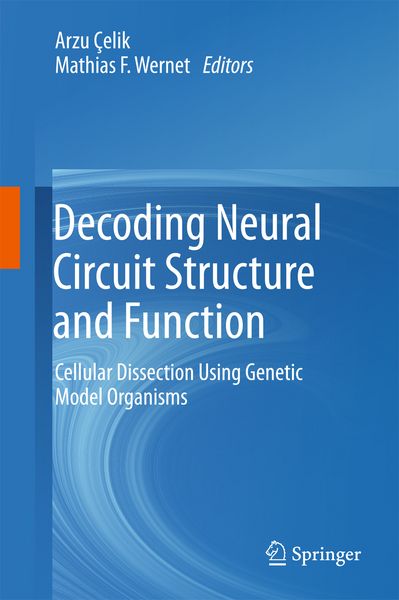
Produktbild: Decoding Neural Circuit Structure and Function
- 10%

Decoding Neural Circuit Structure and Function Cellular Dissection Using Genetic Model Organisms

10% sparen

143,99 € UVP 160,49 €

inkl. gesetzl. MwSt., Versandkostenfrei


Beschreibung

Produktdetails

Einband

Gebundene Ausgabe

Erscheinungsdatum

09.08.2017

Abbildungen

XIII, 518 p. 92 illus., 81 illus. in color.

Herausgeber

Arzu Çelik + weitere

Verlag

Springer

Seitenzahl

518

Maße (L/B/H)

24,1/16/3,3 cm

Gewicht

1009 g

Auflage

17001 Auflage 1st edition 2017

Sprache

Englisch

ISBN

978-3-319-57362-5

Beschreibung

Portrait


Mathias Wernet is currently a professor of Neurobiology at the Freie University of Berlin. His current research deals with the neural circuitry underlying visual behaviors in Drosophila melanogaster and integrates studies spanning anatomy, behavior, and physiology.


Arzu Celik is a professor of Developmental Neurobiology at Bogazici University in Istanbul, Turkey. Her research focuses on the generation of neuronal diversity and mechanisms of axon guidance in the visual and olfactory systems of Drosophila melanogaster.

Produktdetails

Einband

Gebundene Ausgabe

Erscheinungsdatum

09.08.2017

Abbildungen

XIII, 518 p. 92 illus., 81 illus. in color.

Herausgeber

Verlag

Springer

Seitenzahl

518

Maße (L/B/H)

24,1/16/3,3 cm

Gewicht

1009 g

Auflage

17001 Auflage 1st edition 2017

Sprache

Englisch

ISBN

978-3-319-57362-5

Herstelleradresse

Springer-Verlag GmbH
Europaplatz 3
69115 Heidelberg
DE

Email: ProductSafety@springernature.com

Noch keine Bewertungen vorhanden

Verfassen Sie die erste Bewertung zu diesem Artikel

Helfen Sie anderen Kundinnen und Kunden durch Ihre Meinung.

Kundinnen und Kunden meinen

Bewertungen (0)

  • Produktbild: Decoding Neural Circuit Structure and Function
  • 1. Note from the editors.- 2. Overview: The current state of neural circuit dissection in genetic model organisms.- Part I: High-resultion Neuroanatomy using molecular-genetic tools.- 3. Neuroanatomical techniques in invertebrate model organisms (flies, worms).- 4. Neuroanatomical techniques in vertebrate model systems (mice, monkeys).- 5. The current state of whole-brain connectomics in invertebrates.- 6. The progress in large-scale connectomics in vertebrates.- 7. Establishing synaptic connection the invertebrate brain (neural superposition?).- 8. Target selection and synaptogenesis in vertebrate models.- Part II: The behavioral contributions of identified circuit elements.- 9. Behavioral paradigms for dissecting neural circuitry in invertebrates.- 10. Behavioral paradigms for dissecting neural circuitry in vertebrates.- 11. Targeted disruption of neuronal activity in behaving invertebrate models.- 12. Circuit breaking and optogenetics in vertebrates.- 13. Modeling of neural circuits in invertebrates.- 14. Modeling of neural circuits in vertebrates.- Part III:  The functional contribution of identified cells to the circuit.- 15. The electrophysiological characterization of identified invertebrate circuit elements.- 16. Electrophysiology in combination with molecular genetic tools in vertebrates.- 17. Genetically encoded activity sensors in invertebrates.- 18. Genetically encoded activity sensors in vertebrates.- 19. Combining circuit breaking tools and the visualization of activity in invertebrates.- 20. Visualization of neuronal activity while circuit breaking in vertebrates.- Part IV:  Molecular determinants of cell type diversity.- 21. The developmental origin of cell type diversity in invertebrate brains.- 22. The development of neuronal cell type diversity in the vertebrate brain.- 23. Transcriptional profiling of identified circuit elements in invertebrates.- 24. Transcriptional profiling in neural circuits in vertebrates.