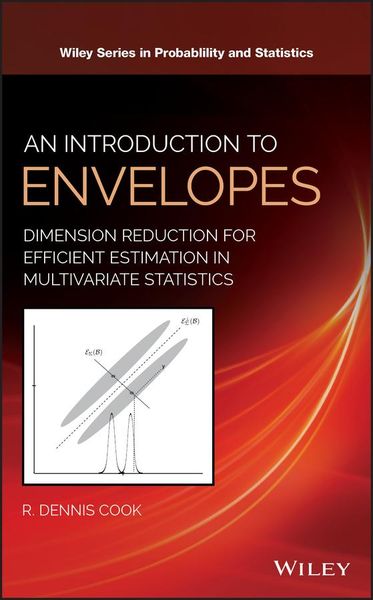
An Introduction to Envelopes Dimension Reduction for Efficient Estimation in Multivariate Statistics
179,99 €
inkl. gesetzl. MwSt.,
Beschreibung
Produktdetails
Einband
Gebundene Ausgabe
Erscheinungsdatum
09.10.2018
Verlag
John Wiley & SonsSeitenzahl
320
Maße (L/B/H)
23,1/15,7/2 cm
Gewicht
635 g
Auflage
1. Auflage
Sprache
Englisch
ISBN
978-1-119-42293-8
An Introduction to Envelopes provides an overview of the theory and methods of envelopes, a class of procedures for increasing efficiency in multivariate analyses without altering traditional objectives. The author offers a balance between foundations and methodology by integrating illustrative examples that show how envelopes can be used in practice. He discusses how to use envelopes to target selected coefficients and explores predictor envelopes and their connection with partial least squares regression. The book reveals the potential for envelope methodology to improve estimation of a multivariate mean.
The text also includes information on how envelopes can be used in generalized linear models, regressions with a matrix-valued response, and reviews work on sparse and Bayesian response envelopes. In addition, the text explores relationships between envelopes and other dimension reduction methods, including canonical correlations, reduced-rank regression, supervised singular value decomposition, sufficient dimension reduction, principal components, and principal fitted components. This important resource:
* Offers a text written by the leading expert in this field
* Describes groundbreaking work that puts the focus on this burgeoning area of study
* Covers the important new developments in the field and highlights the most important directions
* Discusses the underlying mathematics and linear algebra
* Includes an online companion site with both R and Matlab support
Written for researchers and graduate students in multivariate analysis and dimension reduction, as well as practitioners interested in statistical methodology, An Introduction to Envelopes offers the first book on the theory and methods of envelopes.
Noch keine Bewertungen vorhanden
Verfassen Sie die erste Bewertung zu diesem Artikel
Helfen Sie anderen Kundinnen und Kunden durch Ihre Meinung.
Kurze Frage zu unserer Seite
Vielen Dank für dein Feedback
Wir nutzen dein Feedback, um unsere Produktseiten zu verbessern. Bitte habe Verständnis, dass wir dir keine Rückmeldung geben können. Falls du Kontakt mit uns aufnehmen möchtest, kannst du dich aber gerne an unseren Kund*innenservice wenden.
zum Kundenservice