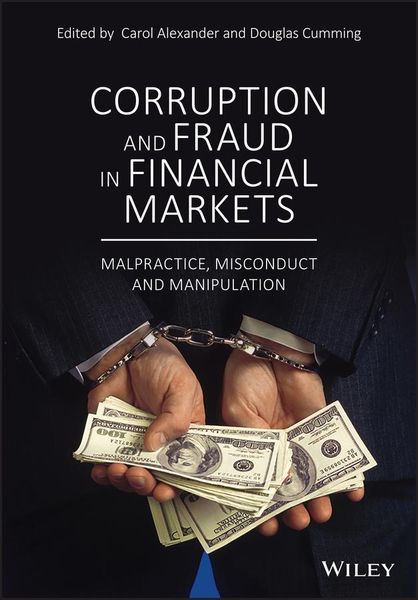
Produktbild: Corruption and Fraud in Financial Markets

Corruption and Fraud in Financial Markets Malpractice, Misconduct and Manipulation

95,99 €

inkl. gesetzl. MwSt., Versandkostenfrei

Lieferung nach Hause

Beschreibung

Produktdetails

Einband

Gebundene Ausgabe

Erscheinungsdatum

22.06.2020

Herausgeber

Carol Alexander + weitere

Verlag

John Wiley & Sons Inc

Seitenzahl

624

Maße (L/B/H)

25,1/17,3/4,3 cm

Gewicht

1206 g

Auflage

1. Auflage

Sprache

Englisch

ISBN

978-1-119-42177-1

Beschreibung

Produktdetails

Einband

Gebundene Ausgabe

Erscheinungsdatum

22.06.2020

Herausgeber

Verlag

John Wiley & Sons Inc

Seitenzahl

624

Maße (L/B/H)

25,1/17,3/4,3 cm

Gewicht

1206 g

Auflage

1. Auflage

Sprache

Englisch

ISBN

978-1-119-42177-1

Herstelleradresse

Libri GmbH
Europaallee 1
36244 Bad Hersfeld
DE

Email: gpsr@libri.de

Kundinnen und Kunden meinen

0 Bewertungen

Informationen zu Bewertungen

Zur Abgabe einer Bewertung ist eine Anmeldung im Konto notwendig. Die Authentizität der Bewertungen wird von uns nicht überprüft. Wir behalten uns vor, Bewertungstexte, die unseren Richtlinien widersprechen, entsprechend zu kürzen oder zu löschen.

Die Bewertungen sind nach Format, Anzahl Sterne und Datum sortiert.

Verfassen Sie die erste Bewertung zu diesem Artikel

Helfen Sie anderen Kund*innen durch Ihre Meinung

Kundinnen und Kunden meinen

0 Bewertungen filtern

Die Leseprobe wird geladen.
  • Produktbild: Corruption and Fraud in Financial Markets
  • About the Editors xv

    List of Contributors xvii

    Foreword xix

    Acknowledgements xxi

    Chapter 1: Introduction 1
    Carol Alexander and Douglas Cumming

    Part I What are Manipulation and Fraud and Why Do They Matter? 11

    Chapter 2: An Overview of Market Manipulation 13
    T¿lis J. Putni¿š

    2.1 Introduction 14

    2.2 Definitions of Market Manipulation 16

    2.2.1 Legal Interpretation and Provisions against Market Manipulation 16

    2.2.2 Economics and Legal Studies Perspective 18

    2.3 A Taxonomy of the Types of Market Manipulation 19

    2.3.1 Categories of Market Manipulation 19

    2.3.2 Market Manipulation Techniques 22

    2.4 Research on Market Manipulation 26

    2.4.1 Theoretical Literature 27

    2.4.2 Empirical Literature 30

    2.4.3 Conclusions from the Research on Market Manipulation 35

    2.5 Summary and Conclusions 39

    References 40

    Chapter 3: A Taxonomy of Financial Market Misconduct 45
    Ai Deng and Priyank Gandhi

    3.1 Introduction 46

    3.2 Challenges in Research on Financial Market Misconduct 50

    3.3 Defining Financial Market Misconduct 51

    3.3.1 Price Manipulation 53

    3.3.2 Circular Trading 54

    3.3.3 Collusion and Information Sharing 55

    3.3.4 Inside Information 56

    3.3.5 Reference Price Influence 56

    3.3.6 Improper Order Handling 57

    3.3.7 Misleading Customers 58

    3.4 Defining Financial Fraud 59

    3.4.1 Credit Card Fraud 59

    3.4.2 Money Laundering 60

    3.4.3 Financial Statement Fraud 60

    3.4.4 Computer Intrusion Fraud 61

    3.5 Conclusion 61

    References 61

    Chapter 4: Financial Misconduct and Market-Based Penalties 65
    Chelsea Liu and Alfred Yawson

    4.1 Introduction 66

    4.2 Notable Cases of Financial Reporting Fraud 69

    4.3 Financial Reporting Misconduct and Legal Redress 70

    4.4 Evolution of US Financial Regulations 71

    4.4.1 Private Securities Litigation Reform Act (1995) 72

    4.4.2 Sarbanes-Oxley Act (2002) 72

    4.4.3 Dodd-Frank Act (2010) 73

    4.5 Legal versus Market-Based Penalties for Financial Misconduct 74

    4.5.1 Common Forms of Legal Penalties 74

    4.5.2 Role of Market-Based Penalties 75

    4.6 Firm-Level Penalties for Corporate Financial Misconduct 75

    4.6.1 Direct Economic Costs Captured in Loss of Market Value 83

    4.6.2 Loss of Firm Reputation 83

    4.6.3 Spillover of Reputational Effect 84

    4.6.4 Governance Risk and Insurance Premiums 85

    4.6.5 Reduced Liquidity 85

    4.6.6 Access to Financing 85

    4.6.7 Reduced Innovation 86

    4.6.8 Mergers and Acquisitions 86

    4.7 Individual-Level Penalties for Corporate Financial Misconduct 87

    4.7.1 Executive and Director Turnover 87

    4.7.2 Impaired Career Progression 95

    4.7.3 Loss of Reputation 96

    4.7.4 Executive Compensation 97

    4.7.5 Strengthened Monitoring 97

    4.8 Causes, Risks, and Moderators of Financial Misconduct 98

    4.8.1 Fraud Incentives 98

    4.8.2 Risk Factors 113

    4.8.3 Public Enforcement: Regulatory and Judicial Stringency 115

    4.8.4 Public Enforcement: Detection and Surveillance 116

    4.8.5 Private Enforcement 117

    4.9 Other Non-Financial Misconduct 118

    4.10 Concluding Remarks 119

    References 120

    Chapter 5: Insider Trading and Market Manipulation 135
    Jonathan A. Batten, Igor Lon¿arski, and Peter G. Szilagyi

    5.1 Introduction 135

    5.2 Regulatory Framework on Insider Trading and Market Manipulation 140

    5.3 Recent Examples of Market Manipulation and Insider Trading 145

    5.4 Conclusions 148

    References 149

    Chapter 6: Financial Fraud and Reputational Capital 153
    Jonathan M. Karpoff

    6.1 Financial Frauds in the 2000s 154

    6.2 The Effects of Fraud Revelation on Firm Value and Reputational Capital 156

    6.2.1 Market Value Losses When Financial Misconduct is Revealed 156

    6.2.2 Spillover Effects 157

    6.2.3 Reputational Losses for Financial Misconduct 158

    6.2.4 Direct Measures of Lost Reputational Capital 159

    6.2.5 Do Misconduct Firms Always Lose Reputational Capital? 160

    6.2.6 Rebuilding Reputational Capital 161

    6.3 The Effects of Fraud Revelation on Shareholders and Managers 162

    6.3.1 Should Shareholders Pay? Do Managers Pay? 162

    6.3.2 Do Shareholders Pay Twice? 162

    6.3.3 Are Firm-Level Penalties Efficient? 163

    6.3.4 Consequences for Managers and Directors 163

    6.4 Why Do Managers Do It? Motives and Constraints 165

    6.4.1 Motives for Financial Misconduct 165

    6.4.2 Constraints on Financial Misconduct 167

    6.5 Proxies and Databases Used to Identify Samples of Financial Statement Misconduct 168

    6.6 Conclusion: Reputation, Enforcement, and Culture 170

    References 171

    Part II How and Where Does Misconduct Occur? 179

    Chapter 7: Manipulative and Collusive Practices in FX Markets 181
    Alexis Stenfors

    7.1 Introduction 181

    7.2 Different Types of FX Orders 183

    7.3 The Unique FX Market Structure 184

    7.4 Examples of Manipulative and Collusive Practices in FX Markets 188

    7.4.1 Front Running 188

    7.4.2 Triggering Stop-Loss Orders 190

    7.4.3 'Banging the Close' 192

    7.4.4 Collusion and Sharing of Confidential Information 193

    7.4.5 Spoofing 195

    7.4.6 Market Abuse via Electronic Trading Platforms 196

    7.5 The Reform Process 197

    References 199

    Chapter 8: Fraud and Manipulation within Cryptocurrency Markets 205
    David Twomey and Andrew Mann

    8.1 Introduction 206

    8.2 Why Do fraud and Manipulation Occur in Cryptocurrency Markets? 212

    8.2.1 Lack of Consistent Regulation 212

    8.2.2 Relative Anonymity 213

    8.2.3 Low Barriers to Entry 214

    8.2.4 Exchange Standards and Sophistication 214

    8.3 Pump and Dumps 215

    8.3.1 Case Studies 217

    8.4 Inflated Trading Volume 217

    8.4.1 Case Study: January 2017 and PBoC Involvement 219

    8.5 Exchange DDoS Attacks 220

    8.5.1 Case Study 223

    8.6 Hacks and Exploitations 224

    8.6.1 Exchange Hacks 224

    8.6.2 Smart Contract Exploits 229

    8.6.3 Protocol Exploitation 230

    8.7 Flash Crashes 230

    8.7.1 GDAX-ETH/USD Flash Crash 234

    8.8 Order Book-Based Manipulations 235

    8.8.1 Quote Stuffing 236

    8.8.2 Order Spoofing 237

    8.9 Stablecoins and Tether 239

    8.9.1 Tether Historical Timeline 240

    8.9.2 Tether Controversy and Criticism 242

    8.9.3 Tether's Significance in Cryptocurrency Global Markets 245

    8.10 Summary and Conclusions 245

    References 249

    Chapter 9: The Integrity of Closing Prices 251
    Ryan J. Davies

    9.1 Why Closing Prices Matter 251

    9.2 Painting the Tape and Portfolio Pumping 252

    9.3 'Bang-the-Close' Manipulation: The Response of Financial Intermediaries 255

    9.4 Stock Price Pinning on Option Expiration Dates 259

    9.5 Conclusion: Lessons for the Regulation and Design of Financial Markets 263

    References 269

    Chapter 10: A Trader's Perspective on Market Abuse Regulations 275
    Sam Baker

    10.1 Introduction 275

    10.2 Getting the Trading Edge 278

    10.3 A Typical Trader's Market Window 281

    10.4 Wash Trades 282

    10.5 High Ticking/Low Ticking - Momentum Ignition 284

    10.6 Spoofing 286

    10.7 Layering 290

    10.8 Smoking 292

    10.9 Case Study: Paul Rotter a.k.a. 'The Flipper' 295

    10.10 The Innocent and the Guilty 299

    10.11 What are Exchanges Doing to Prevent Market Abuse? 301

    10.11.1 CME Group 301

    10.11.2 ICE 302

    10.12 What are Trading Companies Doing to Prevent Abuse? 302

    10.13 Will There Be an End to Market Abuse? 303

    Part III Who are These Scoundrels? 305

    Chapter 11: Misconduct in Banking: Governance and the Board of Directors 307
    Duc Duy Nguyen, Jens Hagendorff, and Arman Eshraghi

    11.1 Introduction 307

    11.2 Literature Review 311

    11.3 Research Design 312

    11.3.1 Data 312

    11.3.2 Empirical Design 313

    11.3.3 Variables 314

    11.4 Empirical Results 316

    11.4.1 Main Results 316

    11.4.2 Results for Different Classes of Enforcement Actions 320

    11.4.3 Does Better Board Quality Alleviate Shareholder Wealth Losses? 323

    11.5 Conclusion 323

    References 325

    Chapter 12: Misconduct and Fraud by Investment Managers 327
    Stephen G. Dimmock, Joseph D. Farizo, and William C. Gerken

    12.1 Introduction 327

    12.2 Related Research 329

    12.3 The Investment Advisers Act of 1940 and Mandatory Disclosures 331

    12.4 Data 332

    12.4.1 Investment Fraud 332

    12.4.2 Form ADV Data and Variables 337

    12.5 Predicting Fraud and Misconduct 340

    12.5.1 Predicting Fraud by Investment Managers 340

    12.5.2 Interpreting the Predictive Content of the Models 345

    12.5.3 K-Fold Cross-Validation Tests 346

    12.6 Predicting the Initiation vs. the Continuance of Fraud 347

    12.7 Firm-Wide Fraud vs. Fraud by a Rogue Employee 349

    12.8 Out-of-Sample Prediction and Model Stability 351

    12.9 Policy Implications and Conclusions 352

    References 355

    Chapter 13: Options Backdating and Shareholders 359
    Johan Sulaeman and Gennaro Bernile

    13.1 Introduction 359

    13.2 Stock Return Patterns around Option Grants 360

    13.3 The Backdating Practice 361

    13.4 Media Coverage, Restatement, and Investigation 362

    13.5 Stock Market Reaction to Public Revelations of Backdating 363

    13.6 Investor Reaction to (and Anticipation of) Public Revelations 364

    13.7 Other Types of Misbehaviour Related to Option Grants 365

    13.7.1 Forward Dating 365

    13.7.2 Selective Disclosure 366

    13.7.3 Option Exercise Backdating 366

    13.7.4 Independent Director Backdating 366

    13.8 Connections with Questionable Practices by Corporate Executives and Other Agents 366

    13.9 Conclusion 367

    References 368

    Chapter 14: The Strategic Behaviour of Underwriters in Valuing IPOs 371
    Stefano Paleari, Andrea Signori, and Silvio Vismara

    14.1 Valuing IPOs 371

    14.2 The Underwriter's Incentives in the Valuation of IPOs 373

    14.3 Literature Review 374

    14.4 Sample, Data, and Methodology 376

    14.4.1 Sample and Data 376

    14.4.2 Alternative Selection Criteria of Comparable Firms 380

    14.4.3 Valuation Bias and IPO Premium 380

    14.5 Results 381

    14.5.1 Algorithmic Selections 381

    14.5.2 Affiliated and Unaffiliated Analysts 386

    14.5.3 Underwriters' Selection of Comparable Firms Pre- vs. Post-IPO 390

    14.5.4 Pre- vs. Post-IPO Selections and Industry Effects 394

    14.6 Conclusions 396

    References 397

    Chapter 15: Governance of Financial Services Outsourcing: Managing Misconduct and Third-Party Risks 399
    Joseph A. McCahery and F. Alexander de Roode

    15.1 Introduction 399

    15.2 The Four Components in Outsourcing 402

    15.2.1 Efficient Outsourcing 402

    15.2.2 The Four-Factor Governance Model 404

    15.2.3 Misconduct in Outsourcing and the Ability of Financial Institutions to Monitor 407

    15.3 The Interaction between Contracting and Monitoring 408

    15.3.1 Characterization of Financial Institutions 409

    15.3.2 Risks in Outsourcing Services 412

    15.4 Governance Mechanisms to Detect Misconduct in Financial Outsourcing 413

    15.4.1 Screening and Detection 414

    15.5 Conclusion 416

    References 417

    Part IV Detection and Surveillance of Financial Misconduct 423

    Chapter 16: Identifying Security Market Manipulation 425
    Mike Aitken, Ann Leduc, and Shan Ji

    16.1 Introduction 425

    16.2 Background Legislation 427

    16.2.1 Australia 427

    16.2.2 UK 428

    16.2.3 Hong Kong 428

    16.2.4 Canada 429

    16.2.5 Singapore 430

    16.2.6 Malaysia 430

    16.2.7 New Zealand 431

    16.3 Attributes of Manipulation 431

    16.3.1 How Traders Minimize the Resources Needed for Manipulative Trading 432

    16.3.2 Difficulties in Determining Whether Trading Behaviour is Manipulative 433

    16.3.3 Surveillance Systems 434

    16.4 Detection Algorithms 436

    16.5 Conclusion 439

    Chapter 17: The Analytics of Financial Market Misconduct 441
    Ai Deng and Priyank Gandhi

    17.1 Introduction 442

    17.2 Financial Economic Analysis 446

    17.2.1 Benchmarking to Historical or Past Data 447

    17.2.2 Benchmarking to Alternate Proxies 451

    17.2.3 Benchmarking to a Model 454

    17.3 Quantitative Techniques 456

    17.3.1 The Principles of Fraud Detection 457

    17.3.2 Popular Supervised Learning Techniques for Fraud Detection 458

    17.3.3 Popular Unsupervised Learning Techniques for Fraud Detection 460

    17.3.4 Dynamic Misconduct Detection 462

    17.4 Conclusion 464

    References 466

    Chapter 18: Benford's Law and Its Application to Detecting Financial Fraud and Manipulation 473
    Christina Bannier, Corinna Ewelt-Knauer, Johannes Lips, and Peter Winker

    18.1 Introduction 474

    18.2 Benford's Law and Generalizations 476

    18.2.1 The Basic Principle of Benford's Law 476

    18.2.2 Illustration of Benford's Law 477

    18.2.3 Testing for Conformity with Benford's Law 478

    18.2.4 Considering Further Digits with Benford's Law 480

    18.2.5 When Do Data Conform to Benford's Law? 482

    18.2.6 Limitations of Using Benford's Law for Identification of Manipulations 483

    18.2.7 Generalizations of Benford's Law for Identification of Manipulations 484

    18.3 Usage of Benford's Law for Detecting Fraud and Deviant Behaviour 485

    18.3.1 Forensic Accounting in the Context of Auditing, Internal Control Systems, and Taxation 486

    18.3.2 Finance 487

    18.3.3 Surveys and Research 490

    18.4 A Case Study: Benford's Law and the LIBOR 491

    18.5 Policy Implications 498

    18.6 Summary, Limitations, and Outlook 498

    References 499

    18.A Appendix 504

    Part V Regulation and Enforcement 505

    Chapter 19: The Enforcement of Financial Market Crimes in Canada and the United Kingdom 507
    Anita Indira Anand

    19.1 Introduction 507

    19.2 Existing Scholarship 508

    19.3 Comparative Analysis 512

    19.3.1 Canada 512

    19.3.2 The United Kingdom 513

    19.4 Reform 515

    19.4.1 Resource Allocation 515

    19.4.2 Principles-Based Regulation 516

    19.4.3 Targeted Regulatory Reforms 518

    19.5 Conclusion 520

    References 520

    Chapter 20: A Pyramid or a Labyrinth? Enforcement of Registrant Misconduct Requirements in Canada 527
    Mary Condon

    20.1 Introduction 527

    20.2 Definitional and Institutional Quagmires 529

    20.3 The Compliance/Enforcement Continuum 531

    20.4 Enforcement Options Available to Sanction Registrant Misconduct 533

    20.5 Empirical Information Available about Registrant Misconduct in Canada 535

    20.5.1 Criminal Enforcement 535

    20.5.2 CSA Non-Criminal Enforcement 536

    20.5.3 Director's Decision Data in Ontario 537

    20.5.4 SRO Enforcement 538

    20.6 Analysis 538

    Chapter 21: Judicial Local Protectionism and Home Court Bias in Corporate Litigation 541
    Michael Firth, Oliver M. Rui, and Wenfeng Wu

    21.1 Introduction 542

    21.2 Institutional Background 544

    21.2.1 Decentralization and Local Protectionism 544

    21.2.2 Judicial Independence 545

    21.2.3 The Heterogeneity of the Legal Environment across Regions 548

    21.3 Empirical Evidence 548

    21.3.1 Sample 549

    21.3.2 Basic Statistics 550

    21.3.3 The Wealth Effect for Defendants and Plaintiffs around the Filing Announcements at Different Courts 556

    21.3.4 The Impact of Court Location on the Wealth Effect 560

    21.3.5 Regression Analysis of the Wealth Effects from a Filing Announcement 560

    21.3.6 Heckman Two-Step Analysis of Sample Selection Bias 567

    21.3.7 The Impact of Court Location on the Likelihood to Appeal 573

    21.3.8 Sensitivity Tests 576

    21.4 Conclusion 579

    References 580

    Index 583