KI-Beratung Beta

  • Produktbild: On the Logos: A Naïve View on Ordinary Reasoning and Fuzzy Logic
  • Produktbild: On the Logos: A Naïve View on Ordinary Reasoning and Fuzzy Logic
Band 354 - 10%

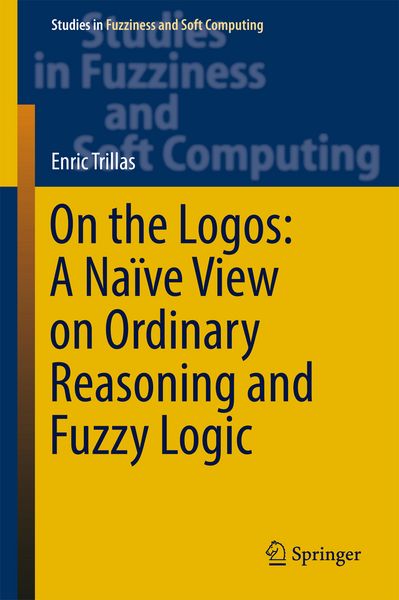
On the Logos: A Naïve View on Ordinary Reasoning and Fuzzy Logic

10% sparen

95,99 € UVP 106,99 €

inkl. gesetzl. MwSt., Versandkostenfrei


Beschreibung

This book offers an inspiring and naïve view on language and reasoning. It presents a new approach to ordinary reasoning that follows the author’s former work on fuzzy logic. Starting from a pragmatic scientific view on meaning as a quantity, and the common sense reasoning from a primitive notion of...

Beschreibung

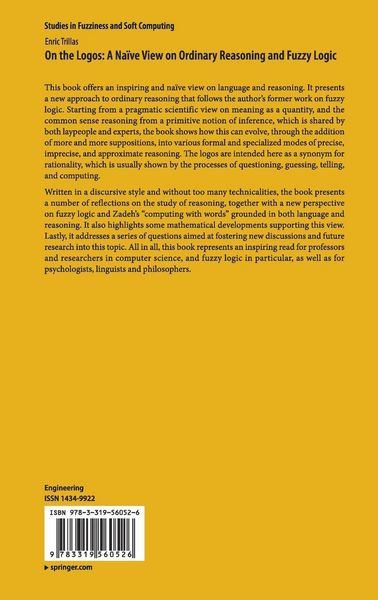
This book offers an inspiring and naïve view on language and reasoning. It presents a new approach to ordinary reasoning that follows the author’s former work on fuzzy logic. Starting from a pragmatic scientific view on meaning as a quantity, and the common sense reasoning from a primitive notion of inference, which is shared by both laypeople and experts, the book shows how this can evolve, through the addition of more and more suppositions, into various formal and specialized modes of precise, imprecise, and approximate reasoning. The logos are intended here as a synonym for rationality, which is usually shown by the processes of questioning, guessing, telling, and computing.

Written in a discursive style and without too many technicalities, the book presents a number of reflections on the study of reasoning, together with a new perspective on fuzzy logic and Zadeh’s “computing with words” grounded in both language and reasoning. It also highlights some mathematical developments supporting this view. Lastly, it addresses a series of questions aimed at fostering new discussions and future research into this topic. All in all, this book represents an inspiring read for professors and researchers in computer science, and fuzzy logic in particular, as well as for psychologists, linguists and philosophers.

Rezension

“It is more of a philosophical text that touches several issues that daily confront people involved in artificial intelligence, natural language understanding, and fuzzy modeling. Due to its thought-provoking nature, sometimes re-reading is necessary in order to fully understand the author’s thoughts. Reading this book may raise feelings of a disparate nature: excitement, perplexity, enlightenment, and incompleteness. In all cases, the ingenuous will surely find stimuli for further thinking and meditation.” (Corrado Mencar, Computing Reviews, April, 2018)


Produktdetails

Einband

Gebundene Ausgabe

Erscheinungsdatum

16.05.2017

Abbildungen

XIV, 213 p.

Verlag Springer

Produktdetails

Einband

Gebundene Ausgabe

Erscheinungsdatum

16.05.2017

Abbildungen

XIV, 213 p.

Verlag Springer
Seitenzahl

213

Maße (L/B/H)

24,1/16/1,8 cm

Gewicht

460 g

Auflage

1st ed. 2017

Sprache

Englisch

ISBN

978-3-319-56052-6

Herstelleradresse

Springer-Verlag GmbH
Europaplatz 3
69115 Heidelberg
DE

Email: ProductSafety@springernature.com

Noch keine Bewertungen vorhanden

Verfassen Sie die erste Bewertung zu diesem Artikel

Helfen Sie anderen Kundinnen und Kunden durch Ihre Meinung.

Kundinnen und Kunden meinen

Bewertungen (0)

  • Produktbild: On the Logos: A Naïve View on Ordinary Reasoning and Fuzzy Logic
  • Produktbild: On the Logos: A Naïve View on Ordinary Reasoning and Fuzzy Logic
  • Introduction.- Meaning as a Quantity.- Antonyms, Negation, and the Fuzzy Case.- ‘And’, and ‘Or’ in Language. The case with Fuzzy Sets.- A First Look at Conditional Statements.- Linguistic Qualification, and Synonymy.- Thinking, Analogy, and Reasoning.- A (Naïve) Symbolic Model of Ordinary Reasoning.- A Glance at Analogy.- A Glance at Creative Reasoning.- Formal Reasoning with Precise Words.- Formal Reasoning with Imprecise Words.- A Few Questions on the Reasoning of Quantum Physics.- Questions on Uncertain, Possible, and Probable.- Questions on Domesticating and Controlling Analogy.- Questions on the Classical Schemes of Inference.- Questions on the Fuzzy Schemes of Inference.- Questions on Monotony.- Questions on ‘Not Covered by P’.- Questions on ‘Sorites’ in Ordinary Reasoning.- A Few Questions on Naming Concepts.- Instead of a Conclusion.- To End Up.