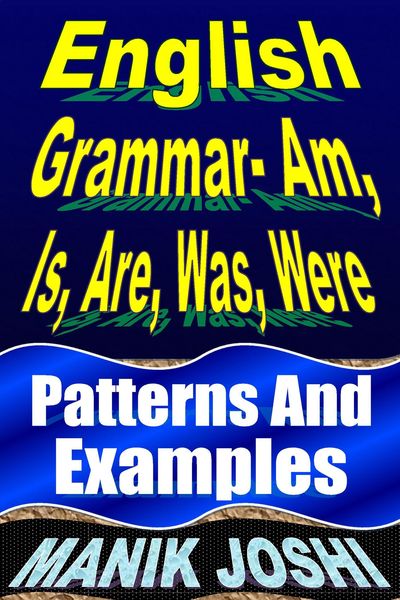
English Grammar- Am, Is, Are, Was, Were: Patterns and Examples (English Daily Use, #16)
-
- Einzelkauf Download ausgewählt
-
Sprache:Englisch
0,99 €
inkl. gesetzl. MwSt.Beschreibung
Produktdetails
Format
ePUB
Kopierschutz
Ja
Family Sharing
Ja
Text-to-Speech
Ja
Erscheinungsdatum
12.02.2013
Verlag
Manik JoshiSeitenzahl
40 (Printausgabe)
Dateigröße
282 KB
Sprache
Englisch
EAN
9781301608386
This Book Covers The Following Topics:
Verb 'To Be' Verb 'To Be' -- Negative Patterns Verb 'To Be' -- Interrogative Patterns 1A. English Grammar - 'Am' 1B. AM + -ING Form of Verb 1C. AM + Being + Past Participle 1D. AM + Past Participle 2A. English Grammar - 'Is' 2B. IS + -ING Form of Verb 2C. IS + Being + Past Participle 2D. IS + Past Participle 3A. English Grammar - 'Are' 3B. ARE + -ING Form of Verb 3C. ARE + Being + Past Participle 3D. ARE + Past Participle 4A. English Grammar - 'Was' 4B. WAS + -ING Form of Verb 4C. WAS + Being + Past Participle 4D. WAS + Past Participle 5A. English Grammar - 'Were' 5B. WERE + -ING Form of Verb 5C. WERE + Being + Past Participle 5D. WERE + Past Participle Useful Notes (1): Question Tags (2): Short Answers (Ellipsis] (3): Addition to Remarks (4): There Is/Was and There Are/Were (5): Subjunctive Mood - 'Were' (6): Be + Going To + Verb Word (7): 'Used to' Vs. 'Be + Used to' (8): Be + To + Verb Word (9): Be + 'Being"+ Adjective (10): Mixed Sentences Exercises: 1(A) and 1(B) Exercises: 2(A) to 2(E)
Sample This:
Verb 'To Be'
The Verb 'to be' is used to represent the following English verbs:
'Am', 'Is', 'Are', 'Was', 'Were' The verb 'to be' is used as both a linking verb and an auxiliary verb.
LINKING VERB: A verb that connects a subject with the complement (adjective or noun) that describes it. Example: He is an engineer. [In this sentence, the subject (he) and noun (engineer) are connected by linking verb 'is'. There is no main verb in this sentence.]
Some more examples: I am happy. [linking verb - am] Is he a good boy? [linking verb - is] We are very proud of ourselves. [linking verb - are] She was intelligent. [linking verb - was] They were not late by half an hour. [linking verb - were]
AUXILIARY VERB: A verb that is used with the main verb to show tenses, etc. Example: He is going to the office. [In this sentence, -ing form of the main verb 'go' has been used with the auxiliary verb 'is'.
Some more examples: I am studying a book. [auxiliary verb - am | main verb - study (-ing form)] He is working on his project [auxiliary verb - is | main verb - work (-ing form)] We are not expected to tell the secret. [auxiliary verb - are | main verb - expect (past participle form)] She was taught by me. [auxiliary verb - was | main verb - teach (past participle form)] Were they burdened by high taxation [auxiliary verb - were | main verb - burden (past participle form)]
IMPORTANT POINTS ABOUT THE VERB 'TO BE'
'AM' - Singular Verb Used In Present Tense Used with Subject 'I'
'IS' - Singular Verb Used In Present Tense Used with Subject 'He' 'She', 'It' and other Singular Subjects
'ARE' - Plural Verb Used In Present Tense Used with Subject 'We', 'You', 'They' and other Plural Subjects
'WAS' - Singular Verb Used In Past Tense Used with Subject 'I', 'He', She', 'It' and other Singular Subjects
'WERE' - Plural Verb Used In Past Tense Used with Subject 'We', 'You' and other Plural Subjects
Noch keine Bewertungen vorhanden
Verfassen Sie die erste Bewertung zu diesem Artikel
Helfen Sie anderen Kundinnen und Kunden durch Ihre Meinung.
Kurze Frage zu unserer Seite
Vielen Dank für dein Feedback
Wir nutzen dein Feedback, um unsere Produktseiten zu verbessern. Bitte habe Verständnis, dass wir dir keine Rückmeldung geben können. Falls du Kontakt mit uns aufnehmen möchtest, kannst du dich aber gerne an unseren Kund*innenservice wenden.
zum Kundenservice