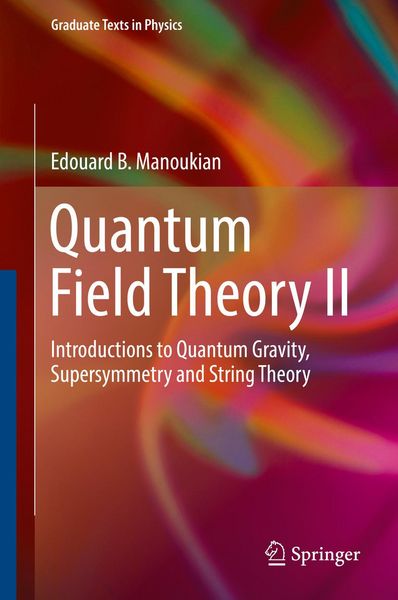
Quantum Field Theory II Introductions to Quantum Gravity, Supersymmetry and String Theory
-
- Hardcover
- Taschenbuch
- eBook ausgewählt
-
Form:Einzelkauf Download
-
Sprache:Englisch
69,54 €
inkl. gesetzl. MwSt.Beschreibung
Produktdetails
Format
Kopierschutz
Nein
Family Sharing
Nein
Text-to-Speech
Nein
Erscheinungsdatum
26.09.2016
Verlag
Springer Nature SwitzerlandSeitenzahl
364 (Printausgabe)
Dateigröße
4823 KB
Auflage
1st ed. 2016
Sprache
Englisch
EAN
9783319338521
This book takes a pedagogical approach to explaining quantum gravity, supersymmetry and string theory in a coherent way. It is aimed at graduate students and researchers in quantum field theory and high-energy physics. The first part of the book introduces quantum gravity, without requiring previous knowledge of general relativity (GR). The necessary geometrical aspects are derived afresh leading to explicit general Lagrangians for gravity, including that of general relativity. The quantum aspect of gravitation, as described by the graviton, is introduced and perturbative quantum GR is discussed. The Schwinger-DeWitt formalism is developed to compute the one-loop contribution to the theory and renormalizability aspects of the perturbative theory are also discussed. This follows by introducing only the very basics of a non-perturbative, background-independent, formulation of quantum gravity, referred to as "loop quantum gravity", which gives rise to a quantization of space.
In the second part the author introduces supersymmetry and its consequences. The generation of superfields is represented in detail. Supersymmetric generalizations of Maxwell's Theory as well as of Yang-Mills field theory, and of the standard model are worked out. Spontaneous symmetry breaking, improvement of the divergence problem in supersymmetric field theory, and its role in the hierarchy problem are covered. The unification of the fundamental constants in a supersymmetric version of the standard model are then studied. Geometrical aspects necessary to study supergravity are developed culminating in the derivation of its full action.
The third part introduces string theory and the analysis of the spectra of the mass (squared) operator associated with the oscillating strings. The properties of the underlying fields, associated with massless particles, encountered in string theory are studied in some detail. Elements of compactification, duality and D-branes are given, as well of the generation of vertices and interactions of strings. In the final sections, the author shows how to recover GR and the Yang-Mills field Theory from string theory.
Noch keine Bewertungen vorhanden
Verfassen Sie die erste Bewertung zu diesem Artikel
Helfen Sie anderen Kundinnen und Kunden durch Ihre Meinung.
Kurze Frage zu unserer Seite
Vielen Dank für dein Feedback
Wir nutzen dein Feedback, um unsere Produktseiten zu verbessern. Bitte habe Verständnis, dass wir dir keine Rückmeldung geben können. Falls du Kontakt mit uns aufnehmen möchtest, kannst du dich aber gerne an unseren Kund*innenservice wenden.
zum Kundenservice