• Produktbild: Institutionalization of State Policy
  • Produktbild: Institutionalization of State Policy

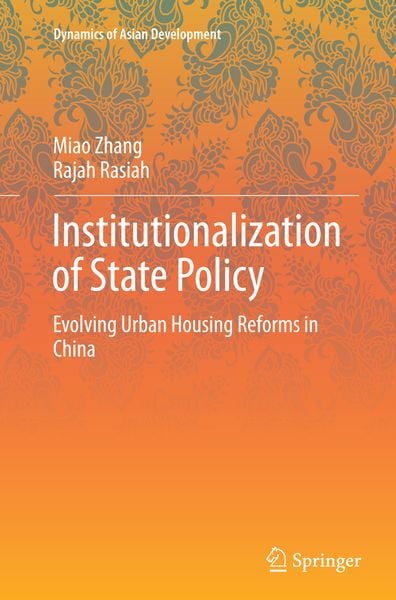
Institutionalization of State Policy Evolving Urban Housing Reforms in China

48,99 €

inkl. gesetzl. MwSt., Versandkostenfrei

Lieferung nach Hause

Beschreibung

Produktdetails

Einband

Taschenbuch

Erscheinungsdatum

23.10.2016

Abbildungen

XIII, 16 illus., schwarz-weiss Illustrationen

Verlag

Springer Singapore

Seitenzahl

133

Maße (L/B/H)

23,4/15,6/0,8 cm

Gewicht

219 g

Auflage

Softcover reprint of the original 1st ed. 2015

Sprache

Englisch

ISBN

978-981-10-1383-6

Beschreibung

Rezension

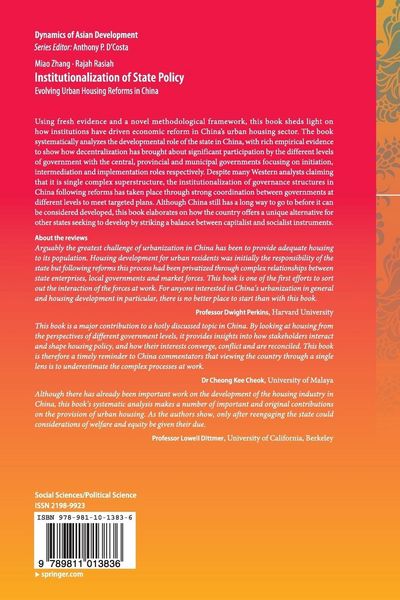
Over the past three plus decades China has undergone the largest growth in urban population in history. Arguably the greatest challenge of this urbanization process has been to provide adequate housing to this rapidly growing population.  This effort to provide adequate urban housing for hundreds of millions of old and new urban residents was initially entirely the responsibility of state owned enterprises that were expected to provide the housing for their employees but by the late 1990s most of this housing had been privatized and the development of housing since then has involved complex relationships between state enterprises, local governments and market forces.  The rapid rise in the market prices of housing further complicated the process particularly when it came to the issue of affordable housing for low income urban population.  This study by Zhang Miao and Rajah Rasiah is one of the first efforts to sort out the interaction of the various forces at work.  For anyone interested in the Chinese urbanization process in general and housing development issues in particular, there is no better place to start then with this book.

- Professor Dwight H. Perkins, Harvard University


This book is a major contribution to a hotly discussed topic in China.  By looking at housing from the perspectives of different levels of government, it provides in-depth insights of how stakeholders interact and shape housing policy and development at each level, and how their interests converge, conflict and are ultimately reconciled.  This book is therefore a timely reminder to China commentators that viewing the country through a single lens is to underestimate the complex processes behind rapidly changing China.

- Dr Cheong Kee Cheok, University of Malaya


Although there has already been important work on the development of the housing industry in China, Dr. Miao Zhang’s systematic analysis makes a number of important and originalcontributions.  She finds that although the commercialization and marketization of housing distribution greatly expanded available supply, it also generated overcapacity in certain income brackets while neglecting others.  Moreover, the leading role of state-owned enterprises was hardly a panacea, as housing became an avenue for financial speculation.  Only after reengaging the State, including its provincial and municipal levels, in housing construction could considerations of welfare and equity be given their due.

- Lowell Dittmer, Professor of Political Science, University of California at Berkeley and Visiting Research Professor, Institute of China Studies, University of Malaya


Produktdetails

Einband

Taschenbuch

Erscheinungsdatum

23.10.2016

Abbildungen

XIII, 16 illus., schwarz-weiss Illustrationen

Verlag

Springer Singapore

Seitenzahl

133

Maße (L/B/H)

23,4/15,6/0,8 cm

Gewicht

219 g

Auflage

Softcover reprint of the original 1st ed. 2015

Sprache

Englisch

ISBN

978-981-10-1383-6

Herstelleradresse

Libri GmbH
Europaallee 1
36244 Bad Hersfeld
DE

Email: GPSR Kontakt

Noch keine Bewertungen vorhanden

Verfassen Sie die erste Bewertung zu diesem Artikel

Helfen Sie anderen Kundinnen und Kunden durch Ihre Meinung.

Kundinnen und Kunden meinen

Bewertungen (0)

  • Produktbild: Institutionalization of State Policy
  • Produktbild: Institutionalization of State Policy
  • Chapter 1: Introduction.- 1.1 Introduction.- 1.2: Problematizing Urban Housing in China.- 1.3: Research Questions and Objectives.- 1.4: Key Concepts.- 1.5: Outline of Book.- Chapter 2: Literature Review.- 2.1: Introduction.- 2.2: Theory and Evidence.- 2.2.1: State.- 2.2.2: Institutions.- 2.2.3: A State in Transition.- 2.3: Chapter Summary.- Chapter 3: Methodology and Data.- 3.1: Introduction.-3.2: Institutional Methodology.- 3.3: Analytic Framework.- 3.4: Research Mode and Data.- 3.4.1: Qualitative Data.- 3.4.2: Quantitative Data.- 3.5: Chapter Summary.- Chapter 4: The Transformation of State-Owned Enterprises.- 4.1: Introduction.- 4.2: Theoretical Consideration.- 4.3: Market Reforms.- 4.3.1: Land Reforms.- 4.3.2: SOE Reforms.- 4.4: The Evolving Role of SOEs in Urban Housing Sector.- 4.4.1: Phase 1: Constructor, Distributor and Property Manager (1978--1988).- 4.4.2: Phase 2: Transformation Role (1988 – 1998).- 4.4.3: Phase 3: Developer, Investor and Speculator (1998 – 2013).- 4.5: Chapter Summary.- Chapter 5: Intermediary Role of Provincial Governments.- 5.1: Introduction.- 5.2: Theoretical and Methodological Considerations.- 5.3: Uneven Development.- 5.4: Contrasting Institutional Experiences.- 5.4.1: Leadership.- 5.4.2: Legislative.- 5.4.3: Land Use.- 5.4.4: Living Culture.- 5.5: Chapter Summary.