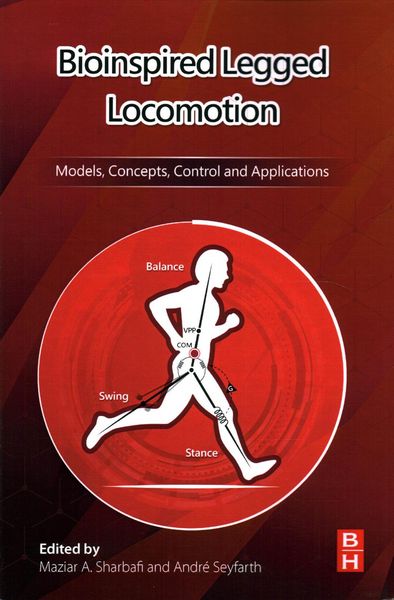
Bioinspired Legged Locomotion Models, Concepts, Control and Applications
-
- Taschenbuch ausgewählt
- eBook
-
Sprache:Englisch
139,99 €
inkl. gesetzl. MwSt.,
Lieferung nach Hause
Beschreibung
Produktdetails
Einband
Taschenbuch
Erscheinungsdatum
22.11.2017
Herausgeber
Maziar Ahmad Sharbafi + weitereVerlag
Elsevier Science & TechnologySeitenzahl
698
Maße (L/B/H)
22,6/14,9/3,8 cm
Gewicht
1081 g
Sprache
Englisch
ISBN
978-0-12-803766-9
Bioinspired Legged Locomotion: Models, Concepts, Control and Applications explores the universe of legged robots, bringing in perspectives from engineering, biology, motion science, and medicine to provide a comprehensive overview of the field. With comprehensive coverage, each chapter brings outlines, and an abstract, introduction, new developments, and a summary.
Beginning with bio-inspired locomotion concepts, the book's editors present a thorough review of current literature that is followed by a more detailed view of bouncing, swinging, and balancing, the three fundamental sub functions of locomotion. This part is closed with a presentation of conceptual models for locomotion.
Next, the book explores bio-inspired body design, discussing the concepts of motion control, stability, efficiency, and robustness. The morphology of legged robots follows this discussion, including biped and quadruped designs.
Finally, a section on high-level control and applications discusses neuromuscular models, closing the book with examples of applications and discussions of performance, efficiency, and robustness. At the end, the editors share their perspective on the future directions of each area, presenting state-of-the-art knowledge on the subject using a structured and consistent approach that will help researchers in both academia and industry formulate a better understanding of bioinspired legged robotic locomotion and quickly apply the concepts in research or products.
Kundinnen und Kunden meinen
Verfassen Sie die erste Bewertung zu diesem Artikel
Helfen Sie anderen Kund*innen durch Ihre Meinung
Kurze Frage zu unserer Seite
Vielen Dank für dein Feedback
Wir nutzen dein Feedback, um unsere Produktseiten zu verbessern. Bitte habe Verständnis, dass wir dir keine Rückmeldung geben können. Falls du Kontakt mit uns aufnehmen möchtest, kannst du dich aber gerne an unseren Kund*innenservice wenden.
zum Kundenservice