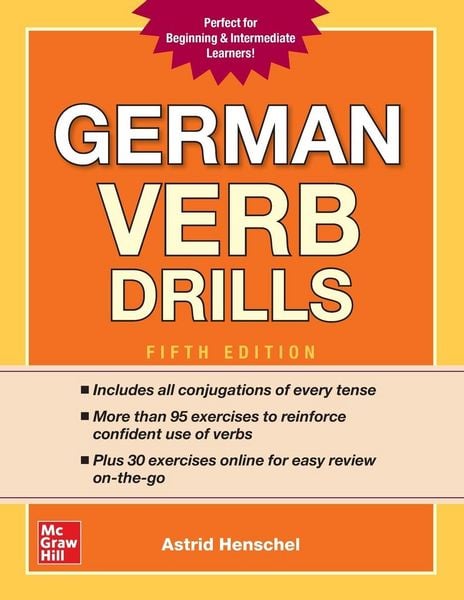
Produktbild: German Verb Drills, Fifth Edition

German Verb Drills, Fifth Edition

19,59 €

inkl. gesetzl. MwSt., Versandkostenfrei


Beschreibung

Produktdetails

Einband

Taschenbuch

Erscheinungsdatum

28.03.2017

Verlag

Mcgraw Hill Higher Education

Seitenzahl

160

Maße (L/B/H)

28/21,6/0,9 cm

Gewicht

421 g

Farbe

Orangerot / Vanille

Auflage

5. Auflage

Sprache

Englisch

ISBN

978-1-260-01060-2

Beschreibung

Produktdetails

Einband

Taschenbuch

Erscheinungsdatum

28.03.2017

Verlag

Mcgraw Hill Higher Education

Seitenzahl

160

Maße (L/B/H)

28/21,6/0,9 cm

Gewicht

421 g

Farbe

Orangerot / Vanille

Auflage

5. Auflage

Sprache

Englisch

ISBN

978-1-260-01060-2

Herstelleradresse

Libri GmbH
Europaallee 1
36244 Bad Hersfeld
DE

Email: gpsr@libri.de

Noch keine Bewertungen vorhanden

Verfassen Sie die erste Bewertung zu diesem Artikel

Helfen Sie anderen Kundinnen und Kunden durch Ihre Meinung.

Kundinnen und Kunden meinen

Bewertungen (0)

  • Produktbild: German Verb Drills, Fifth Edition
  • Introduction
    Part 1 The Present Tense of Regular, Irregular, and Modal Verbs
    1 Infinitive
    2 Present tense of regular verbs
    Interrogative
    3 Present tense of haben, sein, and werden
    4 Present tense of irregular verbs
    Vowel change from e to i
    Vowel change from e to ie
    Vowel change from a to ä
    5 Verbs with separable prefixes in the present tense
    Common separable prefixes
    6 Modal auxiliaries in the present tense
    Review of part 1
    Part 2 Imperative, Future Tense, and Present Perfect Tense
    7 Imperative
    Formal command
    Familiar command, singular
    Familiar command, plural
    Exhortations (mild commands)
    8 Future tense
    Adverb of time
    9 Present perfect tense of weak verbs
    Use of tense
    Formation of tense
    Formation of past participle of weak verbs
    10 Haben or sein as the auxiliary verb in perfect tenses
    11 Present perfect tense of strong verbs
    Formation of past participle
    12 Present perfect tense of mixed verbs
    13 Present perfect tense with separable prefixes
    14 Present perfect tense with inseparable prefixes and verb stems ending in -ier
    Inseparable prefixes
    Verb stems ending in -ier
    15 Present perfect tense with modal auxiliaries
    Review of part 2
    Part 3 The Past Tense
    16 Use of past tense
    17 Past tense of weak verbs
    Definition of weak and strong verbs
    Formation of weak verbs in the past tense
    18 Past tense of strong verbs
    19 Past tense of mixed verbs
    20 Past tense of haben, sein, and werden
    21 Past tense of modal auxiliaries
    Review of part 3
    Part 4 Perfect Tenses, Reflexive and Impersonal Verbs, Infinitive Constructions, and Passive Voice
    22 Past perfect tense
    Use of tense
    Formation of tense
    23 Future perfect tense
    Use of tense
    Formation of tense
    24 Reflexive verbs
    Use of the reflexive
    Formation of reflexive construction
    Perfect tenses of reflexive verbs
    Use of the dative with personal interest
    Reflexive commands
    25 Impersonal verbs
    Es gibt or es ist, es sind
    26 Infinitive constructions
    Verbal nouns
    Double infinitives with modals
    Double infinitives with lassen, helfen, sehen, etc.
    Infinitives without zu
    Infinitives with or without zu
    Infinitives with zu
    Prepositions and infinitives
    Infinitives and commands
    27 The passive voice
    Formation of the passive voice
    Von or durch
    Conjugation of passive voice
    Man as a substitute
    Passive with modal auxiliaries
    Review of part 4
    Part 5 The Subjunctive and Conditional Moods
    28 Formation of the subjunctive mood
    Simple tenses
    Compound tenses
    29 Use of the subjunctive-expressing a wish
    Use of the subjunctive
    Subjunctive in expressing a wish
    30 Subjunctive after als ob or als wenn
    Present
    Past
    Omission of ob or wenn
    31 Conditional
    Use of the conditional
    Formation of the conditional
    32 Unreal conditions (subjunctive or conditional)
    Present
    Past
    Omission of wenn
    33 Indirect discourse with the subjunctive and the indicative
    Indirect discourse with the subjunctive
    Indirect discourse with the indicative
    Review of part 5
    Appendix: Final Review
    Answer Key
    Index of Verbs
    German-English
    English-German