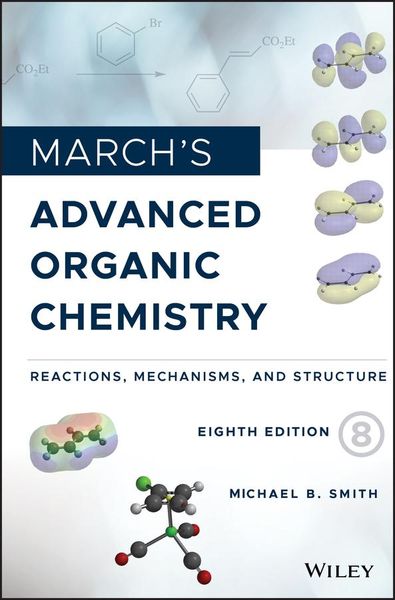
Beschreibung
Produktdetails
Einband
Gebundene Ausgabe
Erscheinungsdatum
13.04.2020
Verlag
John Wiley & Sons IncSeitenzahl
2144
Maße (L/B/H)
25,6/18,4/8,5 cm
Gewicht
3478 g
Auflage
8. Auflage
Sprache
Englisch
ISBN
978-1-119-37180-9
The completely revised and updated, definitive resource for students and professionals in organic chemistry
The revised and updated 8th edition of March's Advanced Organic Chemistry: Reactions, Mechanisms, and Structure explains the theories of organic chemistry with examples and reactions. This book is the most comprehensive resource about organic chemistry available. Readers are guided on the planning and execution of multi-step synthetic reactions, with detailed descriptions of all the reactions
The opening chapters of March's Advanced Organic Chemistry, 8th Edition deal with the structure of organic compounds and discuss important organic chemistry bonds, fundamental principles of conformation, and stereochemistry of organic molecules, and reactive intermediates in organic chemistry. Further coverage concerns general principles of mechanism in organic chemistry, including acids and bases, photochemistry, sonochemistry and microwave irradiation. The relationship between structure and reactivity is also covered. The final chapters cover the nature and scope of organic reactions and their mechanisms.
This edition:
* Provides revised examples and citations that reflect advances in areas of organic chemistry published between 2011 and 2017
* Includes appendices on the literature of organic chemistry and the classification of reactions according to the compounds prepared
* Instructs the reader on preparing and conducting multi-step synthetic reactions, and provides complete descriptions of each reaction
The 8th edition of March's Advanced Organic Chemistry proves once again that it is a must-have desktop reference and textbook for every student and professional working in organic chemistry or related fields.
The revised and updated 8th edition of March's Advanced Organic Chemistry: Reactions, Mechanisms, and Structure explains the theories of organic chemistry with examples and reactions. This book is the most comprehensive resource about organic chemistry available. Readers are guided on the planning and execution of multi-step synthetic reactions, with detailed descriptions of all the reactions
The opening chapters of March's Advanced Organic Chemistry, 8th Edition deal with the structure of organic compounds and discuss important organic chemistry bonds, fundamental principles of conformation, and stereochemistry of organic molecules, and reactive intermediates in organic chemistry. Further coverage concerns general principles of mechanism in organic chemistry, including acids and bases, photochemistry, sonochemistry and microwave irradiation. The relationship between structure and reactivity is also covered. The final chapters cover the nature and scope of organic reactions and their mechanisms.
This edition:
* Provides revised examples and citations that reflect advances in areas of organic chemistry published between 2011 and 2017
* Includes appendices on the literature of organic chemistry and the classification of reactions according to the compounds prepared
* Instructs the reader on preparing and conducting multi-step synthetic reactions, and provides complete descriptions of each reaction
The 8th edition of March's Advanced Organic Chemistry proves once again that it is a must-have desktop reference and textbook for every student and professional working in organic chemistry or related fields.
Noch keine Bewertungen vorhanden
Verfassen Sie die erste Bewertung zu diesem Artikel
Helfen Sie anderen Kundinnen und Kunden durch Ihre Meinung.
Kurze Frage zu unserer Seite
Vielen Dank für dein Feedback
Wir nutzen dein Feedback, um unsere Produktseiten zu verbessern. Bitte habe Verständnis, dass wir dir keine Rückmeldung geben können. Falls du Kontakt mit uns aufnehmen möchtest, kannst du dich aber gerne an unseren Kund*innenservice wenden.
zum Kundenservice