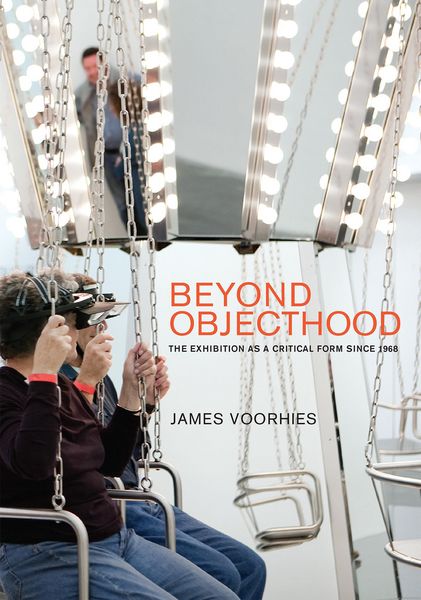
Beyond Objecthood The Exhibition as a Critical Form since 1968
-
- Englisch ausgewählt
37,99 €
inkl. gesetzl. MwSt.,
Lieferung nach Hause
Beschreibung
Produktdetails
Einband
Gebundene Ausgabe
Erscheinungsdatum
24.02.2017
Abbildungen
farbige Abbildungen
Verlag
MIT PressSeitenzahl
288
Maße (L/B/H)
24,9/17,9/3 cm
Gewicht
846 g
Sprache
Englisch
ISBN
978-0-262-03552-1
In 1968, Robert Smithson reacted to Michael Fried's influential essay “Art and Objecthood” with a series of works called non-sites. While Fried described the spectator's connection with a work of art as a momentary visual engagement, Smithson's non-sites asked spectators to do something more: to take time looking, walking, seeing, reading, and thinking about the combination of objects, images, and texts installed in a gallery. In Beyond Objecthood, James Voorhies traces a genealogy of spectatorship through the rise of the exhibition as a critical form—and artistic medium. Artists like Smithson, Group Material, and Michael Asher sought to reconfigure and expand the exhibition and the museum into something more active, open, and democratic, by inviting spectators into new and unexpected encounters with works of art and institutions. This practice was sharply critical of the ingrained characteristics long associated with art institutions and conventional exhibition-making; and yet, Voorhies finds, over time the critique has been diluted by efforts of the very institutions that now gravitate to the “participatory.”
Beyond Objecthood focuses on innovative figures, artworks, and institutions that pioneered the exhibition as a critical form, tracing its evolution through the activities of curator Harald Szeemann, relational art, and New Institutionalism. Voorhies examines recent artistic and curatorial work by Liam Gillick, Thomas Hirschhorn, Carsten Höller, Maria Lind, Apolonija Šušteršič, and others, at such institutions as Documenta, e-flux, Manifesta, and Office for Contemporary Art Norway, and he considers the continued potential of the exhibition as a critical form in a time when the differences between art and entertainment increasingly blur.
Noch keine Bewertungen vorhanden
Verfassen Sie die erste Bewertung zu diesem Artikel
Helfen Sie anderen Kundinnen und Kunden durch Ihre Meinung.
Kurze Frage zu unserer Seite
Vielen Dank für dein Feedback
Wir nutzen dein Feedback, um unsere Produktseiten zu verbessern. Bitte habe Verständnis, dass wir dir keine Rückmeldung geben können. Falls du Kontakt mit uns aufnehmen möchtest, kannst du dich aber gerne an unseren Kund*innenservice wenden.
zum Kundenservice