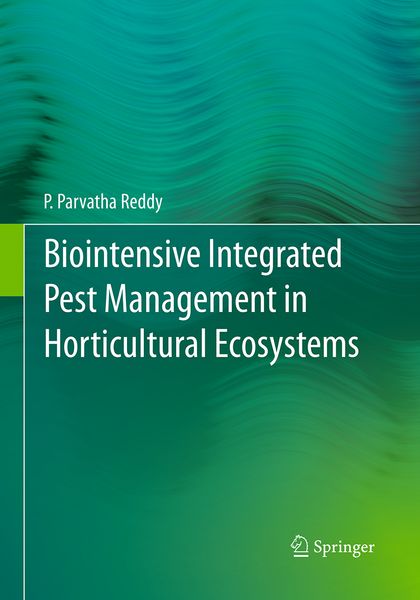
Biointensive Integrated Pest Management in Horticultural Ecosystems
-
- Hardcover
- Taschenbuch ausgewählt
- eBook
-
Sprache:Englisch
185,99 €
inkl. gesetzl. MwSt.,
Beschreibung
Produktdetails
Einband
Taschenbuch
Erscheinungsdatum
03.09.2016
Abbildungen
XVI, 277 p. 147 illus., 142 illus. in color.
Verlag
Springer IndiaSeitenzahl
277
Maße (L/B/H)
25,4/17,8/1,7 cm
Gewicht
561 g
Auflage
Softcover reprint of the original 1st ed. 2014
Sprache
Englisch
ISBN
978-81-322-2945-2
Through ‘Green Revolution’ in late 1960s, India achieved self-sufficiency in food production, but still the country has not achieved self-sufficiency in production of horticultural crops. Most of the growth in food production during the green revolution period is attributed to the use of higher levels of fertilizers and pesticides which are continuing to destroy stable traditional ecosystems. The challenge before the crop protection scientist is to increase yields from the existing land without harming the environment and resource base. This can be achieved by adopting eco-friendly Biointensive Integrated Pest Management (BIPM) strategy.
BIPM incorporates ecological and economic factors into agricultural system design and decision making, and addresses public concerns about environmental quality and food safety. The benefits of implementing BIPM can include reduced chemical input costs, reduced on-farm and off-farm environmental impacts, and more effective and sustainable pestmanagement. An ecology-based IPM has the potential of decreasing inputs of fuel, machinery, and synthetic chemicals-all of which are energy intensive and increasingly costly in terms of financial and environmental impact. Such reductions will benefit the grower and society.
The present book deals with the most recent biointensive integrated approaches for pest management utilizing components such as bioagents [predators, parasitoids and pathogens (bacteria, fungi, viruses)], botanicals (biofumigation, oil cakes, FYM, compost, crop residues, green manuring and other organic amendments), arbuscular mycorrhizal fungi, physical methods (hot water treatment of planting material, soil solarization), cultural methods (crop rotation, summer ploughing, fallowing, intercropping, pruning, mulching, spacing, planting date, trap cropping,
etc
.), biorational chemicals (pheromones) and resistant cultivars. This book can serve as a useful reference to policy makers, research and extension workers, practicing farmers and students. The material can also be used for teaching post-graduate courses.
Noch keine Bewertungen vorhanden
Verfassen Sie die erste Bewertung zu diesem Artikel
Helfen Sie anderen Kundinnen und Kunden durch Ihre Meinung.
Kurze Frage zu unserer Seite
Vielen Dank für dein Feedback
Wir nutzen dein Feedback, um unsere Produktseiten zu verbessern. Bitte habe Verständnis, dass wir dir keine Rückmeldung geben können. Falls du Kontakt mit uns aufnehmen möchtest, kannst du dich aber gerne an unseren Kund*innenservice wenden.
zum Kundenservice