
Dimensional Analysis Beyond the Pi Theorem
-
- Hardcover ausgewählt
- Taschenbuch
- eBook
-
Sprache:Englisch
124,99 €
UVP
139,09 €
inkl. gesetzl. MwSt.,
Lieferung nach Hause
Beschreibung
Produktdetails
Einband
Gebundene Ausgabe
Erscheinungsdatum
09.12.2016
Abbildungen
XIX, 78 illus., 36 illus. in color., schwarz-weiss Illustrationen, farbige Illustrationen
Verlag
SpringerSeitenzahl
266
Maße (L/B/H)
24,1/16/2,2 cm
Gewicht
600 g
Auflage
1st edition 2017
Sprache
Englisch
ISBN
978-3-319-45725-3
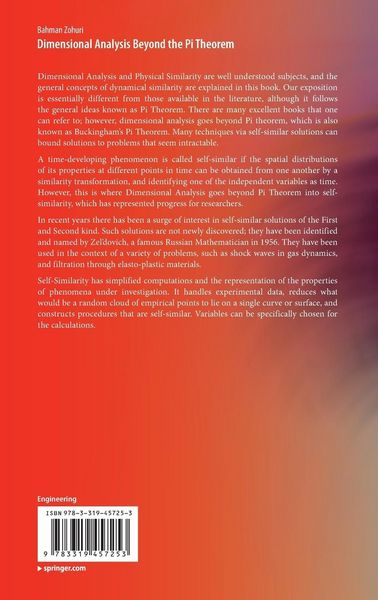
Dimensional Analysis and Physical Similarity are well understood subjects, and the general concepts of dynamical similarity are explained in this book. Our exposition is essentially different from those available in the literature, although it follows the general ideas known as Pi Theorem. There are many excellent books that one can refer to; however, dimensional analysis goes beyond Pi theorem, which is also known as Buckingham’s Pi Theorem. Many techniques via self-similar solutions can bound solutions to problems that seem intractable.
A time-developing phenomenon is called self-similar if the spatial distributions of its properties at different points in time can be obtained from one another by a similarity transformation, and identifying one of the independent variables as time. However, this is where Dimensional Analysis goes beyond Pi Theorem into self-similarity, which has represented progress for researchers.
In recent years there has been a surge of interest in self-similar solutions of the First and Second kind. Such solutions are not newly discovered; they have been identified and named by Zel’dovich, a famous Russian Mathematician in 1956. They have been used in the context of a variety of problems, such as shock waves in gas dynamics, and filtration through elasto-plastic materials.
Self-Similarity has simplified computations and the representation of the properties of phenomena under investigation. It handles experimental data, reduces what would be a random cloud of empirical points to lie on a single curve or surface, and constructs procedures that are self-similar. Variables can be specifically chosen for the calculations.
Noch keine Bewertungen vorhanden
Verfassen Sie die erste Bewertung zu diesem Artikel
Helfen Sie anderen Kundinnen und Kunden durch Ihre Meinung.
Kurze Frage zu unserer Seite
Vielen Dank für dein Feedback
Wir nutzen dein Feedback, um unsere Produktseiten zu verbessern. Bitte habe Verständnis, dass wir dir keine Rückmeldung geben können. Falls du Kontakt mit uns aufnehmen möchtest, kannst du dich aber gerne an unseren Kund*innenservice wenden.
zum Kundenservice