• Produktbild: Difficult Decisions in Thoracic Surgery
  • Produktbild: Difficult Decisions in Thoracic Surgery
Band 1 - 12%

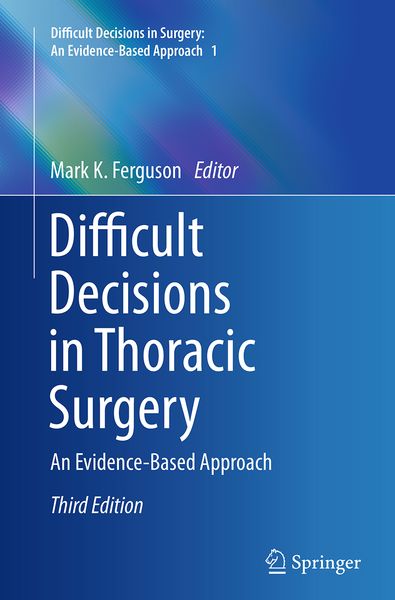
Difficult Decisions in Thoracic Surgery An Evidence-Based Approach

12% sparen

148,99 € UVP 171,19 €

inkl. gesetzl. MwSt., Versandkostenfrei

Lieferung nach Hause

Beschreibung

Produktdetails

Einband

Taschenbuch

Erscheinungsdatum

23.08.2016

Abbildungen

XXI, 18 illus., 10 illus. in color., farbige Illustrationen, schwarz-weiss Illustrationen

Herausgeber

Mark K. Ferguson

Verlag

Springer London

Seitenzahl

787

Maße (L/B/H)

23,5/15,5/4,4 cm

Gewicht

1206 g

Auflage

Third Edition 2014

Sprache

Englisch

ISBN

978-1-4471-7124-9

Beschreibung

Rezension

From the book reviews:

“This is the third edition of a book on difficult and controversial topics in general thoracic surgery that presents practical and evidence-based advice. … It is written for practitioners and trainees in the area of general thoracic surgery. The editor is a recognized authority and has assembled an impressive list of authors to contribute on a comprehensive list of topics.” (Michael Bates, Doody’s Book Reviews, October, 2014)

Portrait

Mark K. Ferguson, MD is Professor of Surgery at University of Chicago Medical Center. He specializes in the surgical management of diseases of the lungs and esophagus. He is experienced in all techniques of lung and esophageal resection and is skilled in surgical methods to relieve airway obstruction and malignant pleural effusions. He has served on the boards and committees of numerous national societies and institutions including the Food and Drug Administration (FDA) and the National Institutes of Health. Dr. Ferguson is the author of more than 75 chapters in medical textbooks. He has edited or written books on esophageal reconstructive surgery, failed anti-reflux therapy, and decision-making in thoracic surgery. He recently authored an atlas of general thoracic surgery. Dr. Ferguson has also written more than 175 papers in medical journals, and serves as an editor or associate editor for three cardiothoracic surgery journals. His research interests include risk analysis and long-term outcomes after lung resection and esophageal resection.

Produktdetails

Einband

Taschenbuch

Erscheinungsdatum

23.08.2016

Abbildungen

XXI, 18 illus., 10 illus. in color., farbige Illustrationen, schwarz-weiss Illustrationen

Herausgeber

Mark K. Ferguson

Verlag

Springer London

Seitenzahl

787

Maße (L/B/H)

23,5/15,5/4,4 cm

Gewicht

1206 g

Auflage

Third Edition 2014

Sprache

Englisch

ISBN

978-1-4471-7124-9

Herstelleradresse

Springer-Verlag KG
Sachsenplatz 4-6
1201 Wien
AT

Email: GPSR Kontakt

Kundinnen und Kunden meinen

0 Bewertungen

Informationen zu Bewertungen

Zur Abgabe einer Bewertung ist eine Anmeldung im Konto notwendig. Die Authentizität der Bewertungen wird von uns nicht überprüft. Wir behalten uns vor, Bewertungstexte, die unseren Richtlinien widersprechen, entsprechend zu kürzen oder zu löschen.

Die Bewertungen sind nach Format, Anzahl Sterne und Datum sortiert.

Verfassen Sie die erste Bewertung zu diesem Artikel

Helfen Sie anderen Kund*innen durch Ihre Meinung

Kundinnen und Kunden meinen

0 Bewertungen filtern

  • Produktbild: Difficult Decisions in Thoracic Surgery
  • Produktbild: Difficult Decisions in Thoracic Surgery
  • 1. Introduction.- Part 1. Evaluations and Decisions.- 2. Evidence based medicine: quality of evidence and evaluation systems.- 3. Decision analytic techniques and other decision processes.- 4. Decision making: the surgeon's perspective.- 5. Decision making: the patient's perspective.- Part 2. Lung.- 6. Indications for pretreatment pathologic mediastinal staging in Non-small Cell Lung Cancer (NSCLC).- 7. Preoperative Smoking Cessation for Lung Resection Patients.- 8. High tech exercise testing in assessing candidates for lung resection.- 9. Management of perioperative anticoagulation during lung resection.- 10. Perioperative arrhythmia prophylaxis for major lung resection.- 11. VATS vs open lobectomy for stage I or II NSCLC.- 12. Robotic-assisted thoracoscopic surgery (RATS) versus video-assisted thoracoscopic surgery (VATS) lobectomy for Stage I or II non-small cell lung cancer (NSCLC).- 13. Lobectomy after induction therapy for non-small cell lung cancer  in the presence of persistent N2 disease.- 14. Pneumonectomy after induction therapy for non-small cell lung cancer .- 15. Resection vs SBRT for stage I NSCLC in patients with good pulmonary function.- 16. Digital drainage systems after major lung resection.- 17. Management of Persistent Post-operative Alveolar Air Leak.- 18. Surveillance after resection of stage I non small cell lung cancer.- 19. Support therapy for lung failure: The utility of device therapy.- 20. Extracorporeal support for lung grafts prior to transplantation.- 21. Pulmonary Metastasectomy.- Part 3. Esophagus.- 22. Optimal therapy for Barrett High Grade Dysplasia.- 23. Preoperative chemo versus chemoradiotherapy for regionally advanced esophageal adenocarcinoma.- 24. The role of surgery in the management of regionally advanced esophageal squamous cell cancer.- 25. Optimal surgical approach to esophagectomy for distal esophageal adenocarcinoma.- 26. Regional extent of lymphadenectomy for esophageal cancer.- 27. Optimal number of lymph nodes to resect for esophageal cancer.- 28. Salvage esophagectomy for persistent disease after definitive chemoradiotherapy.- 29. Gastric emptying procedure after esophagectomy.- 30. Postoperative adjuvant therapy after resection of regionally advanced esophageal cancer.- 31. Prophylactic antireflux surgery in lung transplantation.- 32. Surgical versus Endoscopic Management for esophageal perforations.- 33. Stent for esophageal anastomotic leak.- 34. Management of small esophageal GIST tumors.- 35. Surgery for minimally symptomatic pulsion diverticula of the thoracic esophagus.- 36. Partial versus total fundoplication for GERD in patients with normal esophageal motility.- Part 4. Diaphragm.- 37. Diaphragm pacing for paralysis.- 38. Minimally invasive versus open repair of giant paraesophageal hernia.- 39. Synthetic reinforcement of diaphragm closure for large hiatal hernia repair.- 40. Diaphragmatic plication for eventration.- 41. Management of recurrent minimally symptomatic paraesophageal hernia.- Part 5. Airway.- 42. Stenting for benign airway obstruction.- 43. Bioengineered tissues for tracheal reconstruction.- 44. Percutaneous versus standard tracheostomy in the critically ill adult.- 45. Carinal resection for Non Small Cell Lung Cancer.- Part 6. Pleura and Pleural Spaces.- 46. Management of Persistent Postoperative Air Leaks.- 47. Fibrinolytics for managing pleural empyema.- 48. VATS versus open management of pleural empyema.- 49. Optimal management of symptomatic malignant pleural effusion.- 50. Pleurectomy versus radical pleuropneumonectomy for malignant pleural mesothelioma.- 51. Surgery and medical therapy for malignant pleural mesothelioma.- Part 7. Mediastinum.- 52. Extended versus standard thymectomy for myasthenia gravis.- 53. Optimal approach for resection of encapsulated thymoma: open versus VATS.- 54. Robotic versus VATS thymectomy for encapsulated thymoma.- 55. Video mediastinoscopy versus standard mediastinoscopy.- 56. Debulking for extensive thymoma.- 57. Surgery for palmar hyperhidrosis: patient selection and extent of surgery.- Part 8. Chest Wall.- 58. Synthetic versus biologic reconstruction of bony chest wall defects.- 59. Management of flail chest.- 60. Management of pectus deformities in adults.