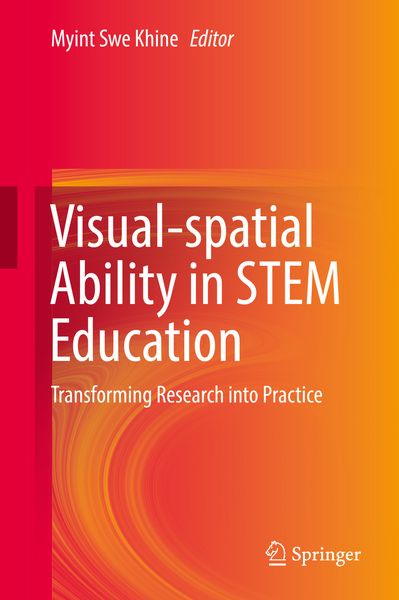
Visual-spatial Ability in STEM Education Transforming Research into Practice
-
- Hardcover ausgewählt
- Taschenbuch
- eBook
-
Sprache:Englisch
134,99 €
inkl. gesetzl. MwSt.,
Beschreibung
Produktdetails
Einband
Gebundene Ausgabe
Erscheinungsdatum
21.10.2016
Abbildungen
VI, 263 p. 72 illus.
Herausgeber
Myint Swe KhineVerlag
SpringerSeitenzahl
263
Maße (L/B/H)
24,1/16/2,1 cm
Gewicht
576 g
Auflage
1st ed. 2017
Sprache
Englisch
ISBN
978-3-319-44384-3
Each chapter in this book makes a unique contribution to the body of the literature and enhances the understanding of spatial ability and its influence on learning in the STEM disciplines. It addresses spatial abilities, ways to measure them as well as their impact and how they can affect learning subjects in scientific, technology and engineering domains. The volume deliberately covers a wide range perspectives from cognitive psychology, educational psychology, science, technology, engineering and mathematics, computer science, information technology disciplines to human development. Taking a broad view on the topic, chapters in the book discuss how to define spatial ability and its factors, the measurement of spatial ability and psychometric analyses, and educational strategies to improve spatial skills and their implications for science and technology education. The book thus provides an overview of current thinking about visual-spatial ability, spatial reasoning, and spatial skills.
Noch keine Bewertungen vorhanden
Verfassen Sie die erste Bewertung zu diesem Artikel
Helfen Sie anderen Kundinnen und Kunden durch Ihre Meinung.
Kurze Frage zu unserer Seite
Vielen Dank für dein Feedback
Wir nutzen dein Feedback, um unsere Produktseiten zu verbessern. Bitte habe Verständnis, dass wir dir keine Rückmeldung geben können. Falls du Kontakt mit uns aufnehmen möchtest, kannst du dich aber gerne an unseren Kund*innenservice wenden.
zum Kundenservice