Beschreibung
Produktdetails
Einband
Taschenbuch
Erscheinungsdatum
01.06.2017
Verlag
Oxford AcademicSeitenzahl
270
Maße (L/B/H)
23,4/15,6/1,6 cm
Gewicht
465 g
Sprache
Englisch
ISBN
978-0-19-062108-7
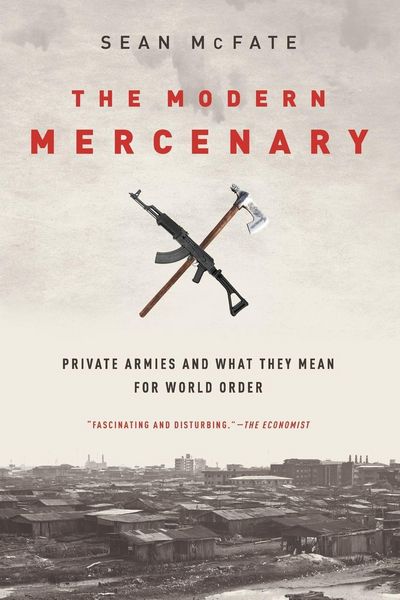
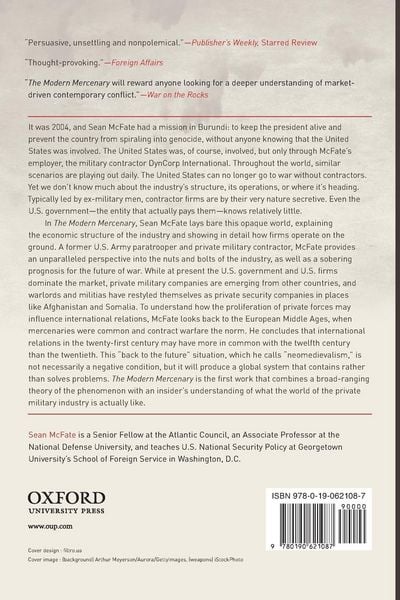
It was 2004, and Sean McFate had a mission in Burundi: to keep the president alive and prevent the country from spiraling into genocide without anyone knowing that the United States was involved. The United States was, of course, involved, but only through McFate's employer, the military contractor DynCorp International. Throughout Africa, Latin America, and the Middle East, similar scenarios are playing out daily. The United States can no longer go to war or carry out covert operations without contractors. In 2010, the Pentagon's budget for private contractors was seven times the entire U.K. defense budget. How did this state of affairs come to be? How does the shadowy world of military contracting actually operate? And what do trends suggest about the future of war and international relations? We simply don't know much about the structure of the industry, how private military companies operate, and where this industry is heading. Typically led by ex-military men, such firms are by their very nature secretive. Even the US government--the entity that actually pays them--knows relatively little. In The Modern Mercenary, former industry insider Sean McFate lays bare the opaque world of private military contractors, explaining the economic structure of the industry and showing in detail how firms operate on the ground. As a former paratrooper and private military contractor, McFate provides an unparalleled perspective into the nuts and bolts of the industry, as well as a sobering prognosis for the future of war. While at present the U.S. government and U.S. firms dominate the market, private military companies are emerging from other countries, and warlords and militias have restyled themselves as private security companies in places like Afghanistan and Somalia. To understand how the proliferation of private forces may influence international relations, McFate looks back to the European Middle Ages, when mercenaries were common and contract warfare the norm. He concludes that international relations in the twenty-first century may have more in common with the twelfth century than the twentieth. This "back to the future" situation, which he calls neomedievalism, is not necessarily a negative condition, but it will produce a global system that contains rather than solves problems. A decidedly non-polemical account (a rarity in this field), The Modern Mercenary is the first work that combines a broad-ranging theory of the phenomenon with an insider's understanding of what the world of the private military industry is actually like.
Noch keine Bewertungen vorhanden
Verfassen Sie die erste Bewertung zu diesem Artikel
Helfen Sie anderen Kundinnen und Kunden durch Ihre Meinung.
Kurze Frage zu unserer Seite
Vielen Dank für dein Feedback
Wir nutzen dein Feedback, um unsere Produktseiten zu verbessern. Bitte habe Verständnis, dass wir dir keine Rückmeldung geben können. Falls du Kontakt mit uns aufnehmen möchtest, kannst du dich aber gerne an unseren Kund*innenservice wenden.
zum Kundenservice