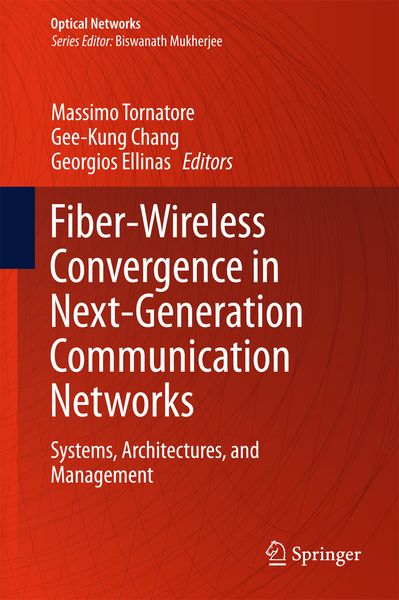
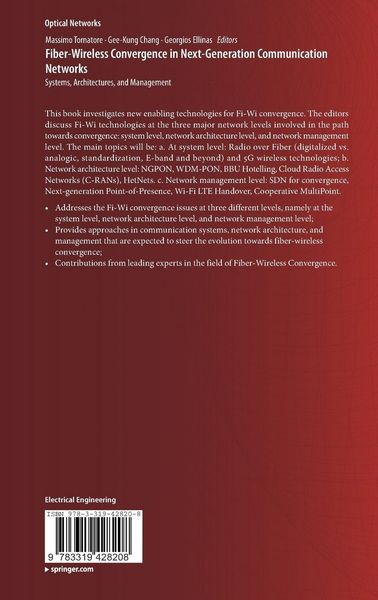
• Produktbild: Fiber-Wireless Convergence in Next-Generation Communication Networks
  • Produktbild: Fiber-Wireless Convergence in Next-Generation Communication Networks
- 10%

Fiber-Wireless Convergence in Next-Generation Communication Networks Systems, Architectures, and Management

Aus der Reihe Optical Networks
10% sparen

153,99 € UVP 171,19 €

inkl. gesetzl. MwSt., Versandkostenfrei

Lieferung nach Hause

Beschreibung

Produktdetails

Einband

Gebundene Ausgabe

Erscheinungsdatum

24.01.2017

Abbildungen

XXVII, 205 illus., 167 illus. in color., farbige Illustrationen, schwarz-weiss Illustrationen

Herausgeber

Massimo Tornatore + weitere

Verlag

Springer

Seitenzahl

406

Maße (L/B/H)

24,1/16/2,9 cm

Gewicht

816 g

Auflage

1st edition 2017

Sprache

Englisch

ISBN

978-3-319-42820-8

Beschreibung

Portrait

Dr. Massimo Tornatore is an  Associate Professor in the Department of Electronics and Information in Politecnico di Milano, Italy and an Adjunct Associate Professor in the Computer Science Department at the University of California, Davis. Since late 2000, member of the Broadband Optical Networks, Security & Advanced Internet Lab (Bonsai Group) in Politecnico di Milano. In 2002, I was a research associate in Corecom, and I worked in collaboration with PSTS (Pirelly Submarine Telecom Systems) and TILAB (Telecom Italia Labs). I received a Ph.D. in Information Engineering in May 2006. From 2007 to 2009, I was a post-doc researcher in the Computer Science Department at the University of California, Davis. In January 2010, I started my career as a faculty in Politecnico di Milano. I co-authored about 190 conference and journal papers and my research interests include design, energy efficiency, and survivability in optical networks and group communication security. You can find moreinformation in my research page or by reading one of my papers.

Dr. Gee-Kung Chang is a Professor at the Georgia Institute of Technology 

Dr. Georgios Ellinas is an Associate Professor at the University of Cyprus

Produktdetails

Einband

Gebundene Ausgabe

Erscheinungsdatum

24.01.2017

Abbildungen

XXVII, 205 illus., 167 illus. in color., farbige Illustrationen, schwarz-weiss Illustrationen

Herausgeber

Verlag

Springer

Seitenzahl

406

Maße (L/B/H)

24,1/16/2,9 cm

Gewicht

816 g

Auflage

1st edition 2017

Sprache

Englisch

ISBN

978-3-319-42820-8

Herstelleradresse

Springer-Verlag KG
Sachsenplatz 4-6
1201 Wien
AT

Email: GPSR Kontakt

Kundinnen und Kunden meinen

0 Bewertungen

Informationen zu Bewertungen

Zur Abgabe einer Bewertung ist eine Anmeldung im Konto notwendig. Die Authentizität der Bewertungen wird von uns nicht überprüft. Wir behalten uns vor, Bewertungstexte, die unseren Richtlinien widersprechen, entsprechend zu kürzen oder zu löschen.

Die Bewertungen sind nach Format, Anzahl Sterne und Datum sortiert.

Verfassen Sie die erste Bewertung zu diesem Artikel

Helfen Sie anderen Kund*innen durch Ihre Meinung

Kundinnen und Kunden meinen

0 Bewertungen filtern

  • Produktbild: Fiber-Wireless Convergence in Next-Generation Communication Networks
  • Produktbild: Fiber-Wireless Convergence in Next-Generation Communication Networks
  • Introduction.- Future Radio Access, WiFi-LTE, LTE advanced:the path to 5G.- Evolution and Trends of Broadband Access Technologies and Fiber-Wireless Systems.- The Benefits of Convergence through Fiber Wireless Integration and Networking.- Analog and Digitized Radio-over-Fiber.- Overview of standardization for D-RoF.- Wireless delivery of over 100Gb/s mm-wave signal in the W-band.- Systems Challenges for SDN in Fiber Wireless Networks.- Architectural Evolution and Novel Design of Fiber-Wireless Access Networks.- Advanced architectures for PON supporting Fi-Wi convergence.- BBU Hotelling in Centralized Radio Access Networks.- Rethink Ring and Young: Green and Soft RAN for 5G.- Next Generation PoP with functional convergence re-distributions.- Coordinated Multi-Point (CoMP) Systems.- Converged Wireless Access/Optical Metro Networks in Support of Cloud and Mobile Cloud Services deploying SDN Principles.- Conclusion and Future Topics.