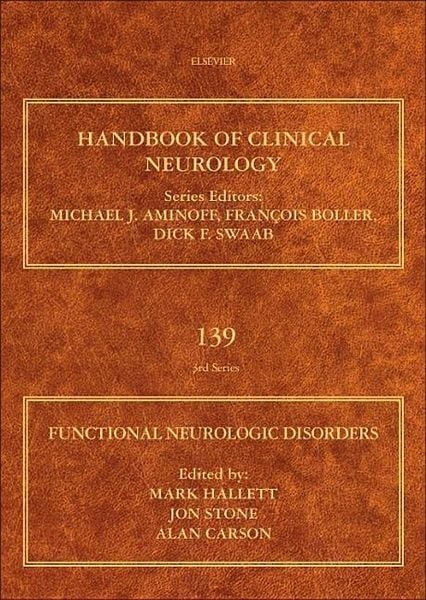
Produktbild: Functional Neurologic Disorders
Band 139 - 24%

Functional Neurologic Disorders Volume 139

24% sparen

192,99 € UVP 255,50 €

inkl. gesetzl. MwSt., Versandkostenfrei


Beschreibung

Produktdetails

Einband

Gebundene Ausgabe

Erscheinungsdatum

17.10.2016

Herausgeber

Mark Hallett + weitere

Verlag

Academic Press

Seitenzahl

680

Maße (L/B/H)

26,1/19,4/4 cm

Gewicht

1756 g

Sprache

Englisch

ISBN

978-0-12-801772-2

Beschreibung

Portrait

Dr. Hallett is the President of the International Federation of Clinical Neurophysiology. He also serves as the Chief of the Human Motor Control Section, National Institute of Neurological Disorders and Stroke, National Institutes of Health, Bethesda, Maryland. Dr. Hallett obtained his M.D. at Harvard University, interned at the Peter Bent Brigham Hospital and trained in Neurology at Massachusetts General Hospital. He had fellowships in Neurophysiology at the National Institutes of Health and at the Institute of Psychiatry in London. From 1976 to 1984, Dr. Hallett was the Chief of the Clinical Neurophysiology Laboratory at the Brigham and Women's Hospital and worked up to Associate Professor of Neurology at Harvard Medical School. From 1984, he has been at the National Institute of Neurological Disorders and Stroke where he also served as Clinical Director of NINDS until July 2000. He is past President of the American Association of Neuromuscular and Electrodiagnostic Medicine and the International Parkinson and Movement Disorder Society and also served as Vice-President of the American Academy of Neurology. He has served as Editor of many journals and books and has had many honors. His work mainly deals with principles of motor control and the pathophysiology of movement disorders. Dr. Hallett's interests in motor control are wide-ranging, and include brain plasticity and its relevance to neurological disorders and the pathophysiology of dystonia, parkinsonism, and myoclonus. In recent years, he has become interested in disorders of volition, including tic and functional movement disorders.
Dr. Jon Stone FRCP PhD is a Consultant Neurologist and Honorary Reader in Neurology in Edinburgh.

He has had a research interest in functional disorders in neurology since 1999 and completed his PhD thesis on a case control study of patients with functional limb weakness. He has published widely in the area including systematic reviews, large cohort studies, imaging studies and treatment studies. He has contributed to new diagnostic criteria for DSM-5 and ICD-11 and the development of professional organisations in this area.

As of August 2012 is a National Research Strategy (NHS Scotland) Career Fellow. His work has been recognised with plenary sessions at the World Congress of Neurology, American Academy of Neurology, Movement Disorders World Congress and Association of British Neurologists as well as the Jean Hunter Award for Nervous Diseases (Royal College of Physicians).

Alan John Carson, MBCHB, MPHIL, MD, FRCPSYCH, FRCP is Consultant Neuropsychiatrist in Edinburgh, U.K. His interest in neuropsychiatry began during a spell working in Kenya, as a Wellcome Research Registrar, conducting a study on the psychiatric and cognitive effects of HIV infection. He then completed his higher training in Edinburgh, under the guidance of Professors Michael Sharpe and Charles Warlow, where he developed an interest in functional neurological symptoms. Dr. Carson currently works as a Consultant Neuropsychiatrist in Edinburgh, split between the brain injury units at the Astley Ainslie Hospital and the Regional Neurosciences Unit at the Western General Hospital, where along with Dr. Jon Stone, he is engaged in a series of studies on functional neurological symptoms. He has led a number of epidemiological studies on functional disorders, most notably the Scottish Neurological Symptoms Study. He has a particular interest in development of treatment strategies for functional disorders and has led development of novel brief psychotherapies for functional symptoms, and is one of the lead investigators for the CODES trial of CBT for dissociative seizures. Dr. Carson holds a number of advisory posts in neuropsychiatry and he is the chair of the National MCN for acquired brain injury. He is the associate editor of Journal of Neurology, Neurosurgery and Psychiatry and the President of the British Neuropsychiatry Association.

Produktdetails

Einband

Gebundene Ausgabe

Erscheinungsdatum

17.10.2016

Herausgeber

Verlag

Academic Press

Seitenzahl

680

Maße (L/B/H)

26,1/19,4/4 cm

Gewicht

1756 g

Sprache

Englisch

ISBN

978-0-12-801772-2

Herstelleradresse

Libri GmbH
Europaallee 1
36244 Bad Hersfeld
DE

Email: gpsr@libri.de

Noch keine Bewertungen vorhanden

Verfassen Sie die erste Bewertung zu diesem Artikel

Helfen Sie anderen Kundinnen und Kunden durch Ihre Meinung.

Kundinnen und Kunden meinen

Bewertungen (0)

Die Leseprobe wird geladen.
  • Produktbild: Functional Neurologic Disorders
  • Section 1: History

    Chapter 1: A brief history of hysteria: From the ancient to the modern

    Chapter 2: Charcot, hysteria, and simulated disorders

    Chapter 3: Neurologic approaches to hysteria, psychogenic and functional disorders from the late 19th century onwards

    Chapter 4: Freud's hysteria and its legacy

    Section 2: Epidemiology, etiology, and mechanism

    Chapter 5: Epidemiology

    Chapter 6: Neurophysiologic studies of functional neurologic disorders

    Chapter 7: Imaging studies of functional neurologic disorders

    Chapter 8: Dissociation and functional neurologic disorders

    Chapter 9: Hypnosis as a model of functional neurologic disorders

    Chapter 10: Psychologic theories in functional neurologic disorders

    Chapter 11: Voluntary or involuntary? A neurophysiologic approach to functional movement disorders

    Chapter 12: Neurobiologic theories of functional neurologic disorders

    Chapter 13: Stress, childhood trauma, and cognitive functions in functional neurologic disorders

    Chapter 14: Do (epi)genetics impact the brain in functional neurologic disorders?

    Section 3: Symptoms (including signs and investigations)

    Chapter 15: Assessment of patients with functional neurologic disorders

    Chapter 16: The classification of conversion disorder (functional neurologic symptom disorder) in ICD and DSM

    Chapter 17: Neurologic diagnostic criteria for functional neurologic disorders

    Chapter 18: Functional limb weakness and paralysis

    Chapter 19: Functional tremor

    Chapter 20: Functional dystonia

    Chapter 21: Functional jerks, tics, and paroxysmal movement disorders

    Chapter 22: Psychogenic (functional) parkinsonism

    Chapter 23: Functional gait disorder

    Chapter 24: Functional sensory symptoms

    Chapter 25: Nonepileptic seizures - subjective phenomena

    Chapter 26: Nonepileptic seizures - objective phenomena

    Chapter 27: Psychogenic nonepileptic seizures: EEG and investigation

    Chapter 28: Functional coma

    Chapter 29: Functional and simulated visual loss

    Chapter 30: Functional eye movement disorders

    Chapter 31: Functional facial and tongue movement disorders

    Chapter 32: Functional auditory disorders

    Chapter 33: Functional speech disorders: clinical manifestations, diagnosis, and management

    Chapter 34: Functional voice disorders: Clinical presentations and differential diagnosis

    Chapter 35: Psychologic/functional forms of memory disorder

    Chapter 36: Functional (dissociative) retrograde amnesia

    Chapter 37: Functional (psychogenic) dizziness

    Chapter 38: Urologic symptoms and functional neurologic disorders

    Chapter 39: Functional disorders of swallowing

    Chapter 40: Pediatric functional neurologic symptoms

    Chapter 41: Posttraumatic functional movement disorders

    Chapter 42: Factitious disorders and malingering in relation to functional neurologic disorders

    Section 4: Treatment

    Chapter 43: Prognosis of functional neurologic disorders

    Chapter 44: Explanation as treatment for functional neurologic disorders

    Chapter 45: Physical treatment of functional neurologic disorders

    Chapter 46: Psychologic treatment of functional neurologic disorders

    Chapter 47: Hypnosis as therapy for functional neurologic disorders

    Chapter 48: Nature of the placebo and nocebo effect in relation to functional neurologic disorders

    Chapter 49: The role of placebo in the diagnosis and treatment of functional neurologic disorders

    Chapter 50: Transcranial magnetic stimulation and sedation as treatment for functional neurologic disorders

    Chapter 51: Inpatient treatment for functional neurologic disorders

    Index