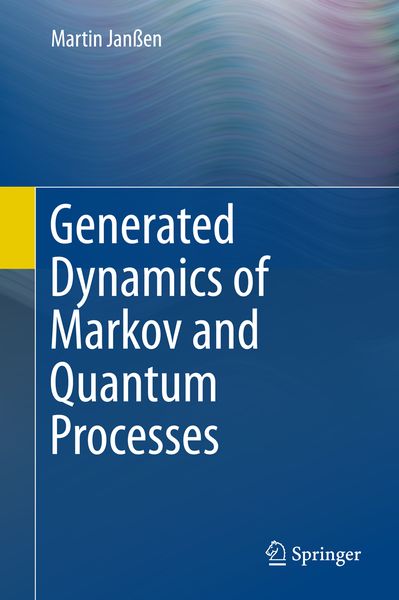
Generated Dynamics of Markov and Quantum Processes
-
- Hardcover ausgewählt
- Taschenbuch
- eBook
-
Sprache:Englisch
49,99 €
inkl. gesetzl. MwSt.,
Lieferung nach Hause
Beschreibung
Produktdetails
Einband
Gebundene Ausgabe
Erscheinungsdatum
09.05.2016
Verlag
Springer BerlinSeitenzahl
226
Maße (L/B/H)
24,1/16/1,9 cm
Gewicht
535 g
Auflage
1st edition 2016
Sprache
Englisch
ISBN
978-3-662-49694-7
This book presents Markov and quantum processes as two sides of a coin called generated stochastic processes. It deals with quantum processes as reversible stochastic processes generated by one-step unitary operators, while Markov processes are irreversible stochastic processes generated by one-step stochastic operators. The characteristic feature of quantum processes are oscillations, interference, lots of stationary states in bounded systems and possible asymptotic stationary scattering states in open systems, while the characteristic feature of Markov processes are relaxations to a single stationary state. Quantum processes apply to systems where all variables, that control reversibility, are taken as relevant variables, while Markov processes emerge when some of those variables cannot be followed and are thus irrelevant for the dynamic description. Their absence renders the dynamic irreversible.
A further aim is to demonstrate that almost any subdiscipline of theoretical physics can conceptually be put into the context of generated stochastic processes. Classical mechanics and classical field theory are deterministic processes which emerge when fluctuations in relevant variables are negligible. Quantum mechanics and quantum field theory consider genuine quantum processes. Equilibrium and non-equilibrium statistics apply to the regime where relaxing Markov processes emerge from quantum processes by omission of a large number of uncontrollable variables. Systems with many variables often self-organize in such a way that only a few slow variables can serve as relevant variables. Symmetries and topological classes are essential in identifying such relevant variables.
The third aim of this book is to provide conceptually general methods of solutions which can serve as starting points to find relevant variables as to apply best-practice approximation methods. Such methods are available through generating functionals.
The potential reader is a graduate student who has heard already a course in quantum theory and equilibrium statistical physics including the mathematics of spectral analysis (eigenvalues, eigenvectors, Fourier and Laplace transformation). The reader should be open for a unifying look on several topics.Noch keine Bewertungen vorhanden
Verfassen Sie die erste Bewertung zu diesem Artikel
Helfen Sie anderen Kundinnen und Kunden durch Ihre Meinung.
Kurze Frage zu unserer Seite
Vielen Dank für dein Feedback
Wir nutzen dein Feedback, um unsere Produktseiten zu verbessern. Bitte habe Verständnis, dass wir dir keine Rückmeldung geben können. Falls du Kontakt mit uns aufnehmen möchtest, kannst du dich aber gerne an unseren Kund*innenservice wenden.
zum Kundenservice