KI-Beratung Beta

Gutscheinbedingungen

**Gültig vom 23.11. bis 30.11.2026 | Gültig für nicht preisgebundene fremdsprachige Bücher | Einzelne Artikel können ausgeschlossen sein | Online auf www.bücher.de einlösbar | Click & Collect nur mit Online-Zahlung (Paypal/Kreditkarte) vorab | Nicht kombinierbar mit anderen Gutscheinen oder Preisaktionen | Nur einmal pro Einkauf einlösbar | Gutschein wird auf max. 500€ Bestellwert angerechnet | Keine Barauszahlung | Nicht gültig für Versandkosten und Services

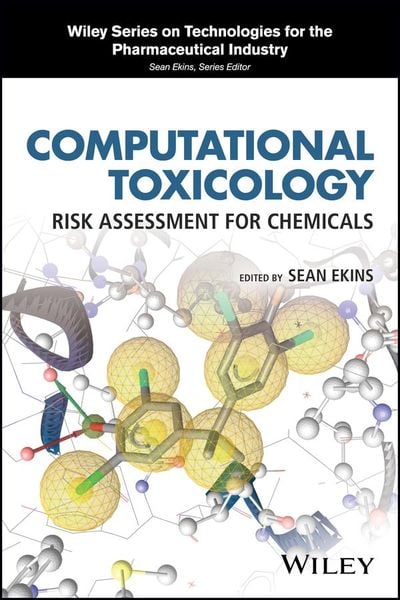
Produktbild: Computational Toxicology
Band 1

Computational Toxicology Risk Assessment for Chemicals

212,99 €

inkl. gesetzl. MwSt., Versandkostenfrei


Beschreibung

A key resource for toxicologists across a broad spectrum of fields, this book offers a comprehensive analysis of molecular modelling approaches and strategies applied to risk assessment for pharmaceutical and environmental chemicals.   * Provides a perspective of what is currently achievable with computational...

Beschreibung

A key resource for toxicologists across a broad spectrum of fields, this book offers a comprehensive analysis of molecular modelling approaches and strategies applied to risk assessment for pharmaceutical and environmental chemicals.
 
* Provides a perspective of what is currently achievable with computational toxicology and a view to future developments
* Helps readers overcome questions of data sources, curation, treatment, and how to model / interpret critical endpoints that support 21st century hazard assessment
* Assembles cutting-edge concepts and leading authors into a unique and powerful single-source reference
* Includes in-depth looks at QSAR models, physicochemical drug properties, structure-based drug targeting, chemical mixture assessments, and environmental modeling
* Features coverage about consumer product safety assessment and chemical defense along with chapters on open source toxicology and big data

Produktdetails

Einband

Gebundene Ausgabe

Erscheinungsdatum

27.03.2018

Herausgeber Sean Ekins
Verlag John Wiley & Sons

Produktdetails

Einband

Gebundene Ausgabe

Erscheinungsdatum

27.03.2018

Herausgeber Sean Ekins
Verlag John Wiley & Sons
Seitenzahl

432

Maße (L/B/H)

15,7/23,4/2,6 cm

Gewicht

736 g

Auflage

1. Auflage

Sprache

Englisch

ISBN

978-1-119-28256-3

Herstelleradresse

Libri GmbH
Europaallee 1
36244 Bad Hersfeld
DE

Email: gpsr@libri.de

Noch keine Bewertungen vorhanden

Verfassen Sie die erste Bewertung zu diesem Artikel

Helfen Sie anderen Kundinnen und Kunden durch Ihre Meinung.

Kundinnen und Kunden meinen

Bewertungen (0)

Die Leseprobe wird geladen.
  • Produktbild: Computational Toxicology
  • List of Contributors xvii
     
    Preface xxi
     
    Acknowledgments xxiii
     
    Part I Computational Methods 1
     
    1 AccessibleMachine Learning Approaches for Toxicology 3
    Sean Ekins, Alex M. Clark, Alexander L. Perryman, Joel S. Freundlich, Alexandru Korotcov, and Valery Tkachenko
     
    1.1 Introduction 3
     
    1.2 Bayesian Models 5
     
    1.2.1 CDD Models 7
     
    1.3 Deep LearningModels 13
     
    1.4 Comparison of Different Machine LearningMethods 16
     
    1.4.1 Classic Machine LearningMethods 17
     
    1.4.1.1 Bernoulli Naive Bayes 17
     
    1.4.1.2 Linear Logistic Regression with Regularization 18
     
    1.4.1.3 AdaBoost Decision Tree 18
     
    1.4.1.4 Random Forest 18
     
    1.4.1.5 Support Vector Machine 19
     
    1.4.2 Deep Neural Networks 19
     
    1.4.3 Comparing Models 20
     
    1.5 FutureWork 21
     
    Acknowledgments 21
     
    References 21
     
    2 Quantum Mechanics Approaches in Computational Toxicology 31
    Jakub Kostal
     
    2.1 Translating Computational Chemistry to Predictive Toxicology 31
     
    2.2 Levels of Theory in Quantum Mechanical Calculations 33
     
    2.3 Representing Molecular Orbitals 38
     
    2.4 Hybrid Quantum and Molecular Mechanical Calculations 39
     
    2.5 Representing System Dynamics 40
     
    2.6 Developing QM Descriptors 42
     
    2.6.1 Global Electronic Parameters 42
     
    2.6.1.1 Electrostatic Potential, Dipole, and Polarizability 43
     
    2.6.1.2 Global Electronic Parameters Derived from Frontier Molecular Orbitals (FMOs) 45
     
    2.6.2 Local (Atom-Based) Electronic Parameters 47
     
    2.6.2.1 Parameters Derived from Frontier Molecular Orbitals (FMOs) 48
     
    2.6.2.2 Partial Atomic Charges 51
     
    2.6.2.3 Hydrogen-Bonding Interactions 51
     
    2.6.2.4 Bond Enthalpies 53
     
    2.6.3 Modeling Chemical Reactions 53
     
    2.6.4 QM/MM Calculations of Covalent Host-Guest Interactions 56
     
    2.6.5 Medium Effects and Hydration Models 59
     
    2.7 Rational Design of Safer Chemicals 61
     
    References 64
     
    Part II Applying Computers to Toxicology Assessment: Pharmaceutical, Industrial and Clinical 69
     
    3 Computational Approaches for Predicting hERG Activity 71
    Vinicius M. Alves, Rodolpho C. Braga, and Carolina Horta Andrade
     
    3.1 Introduction 71
     
    3.2 Computational Approaches 73
     
    3.3 Ligand-Based Approaches 73
     
    3.4 Structure-Based Approaches 77
     
    3.5 Applications to Predict hERG Blockage 77
     
    3.5.1 Pred-hERGWeb App 79
     
    3.6 Other Computational Approaches Related to hERG Liability 82
     
    3.7 Final Remarks 83
     
    References 83
     
    4 Computational Toxicology for Traditional Chinese Medicine 93
    Ni Ai and Xiaohui Fan
     
    4.1 Background, Current Status, and Challenges 93
     
    4.2 Case Study: Large-Scale Prediction on Involvement of Organic Anion Transporter 1 in Traditional Chinese Medicine-Drug Interactions 99
     
    4.2.1 Introduction to OAT1 and TCM 99
     
    4.2.2 Construction of TCM Compound Database 101
     
    4.2.3 OAT1 Inhibitor Pharmacophore Development 101
     
    4.2.4 External Test Set Evaluation 102
     
    4.2.5 Database Searching 102
     
    4.2.6 Results: OAT1 Inhibitor Pharmacophore 103
     
    4.2.7 Results: OAT1 Inhibitor Pharmacophore Evaluation 104
     
    4.2.8 Results: TCM Compound Database Searching Using OAT1 Inhibitor Pharmacophore 104
     
    4.2.9 Discussion 110
     
    4.3 Conclusion 114
     
    Acknowledgment 114
     
    References 114
     
    5 PharmacophoreModels for Toxicology Prediction 121
    Daniela Schuster
     
    5.1 Introduction 121
     
    5.2 Antitarget Screening 125