
KI-Beratung Beta

Gutscheinbedingungen

**Gültig vom 23.11. bis 30.11.2026 | Gültig für nicht preisgebundene fremdsprachige Bücher | Einzelne Artikel können ausgeschlossen sein | Online auf www.bücher.de einlösbar | Click & Collect nur mit Online-Zahlung (Paypal/Kreditkarte) vorab | Nicht kombinierbar mit anderen Gutscheinen oder Preisaktionen | Nur einmal pro Einkauf einlösbar | Gutschein wird auf max. 500€ Bestellwert angerechnet | Keine Barauszahlung | Nicht gültig für Versandkosten und Services

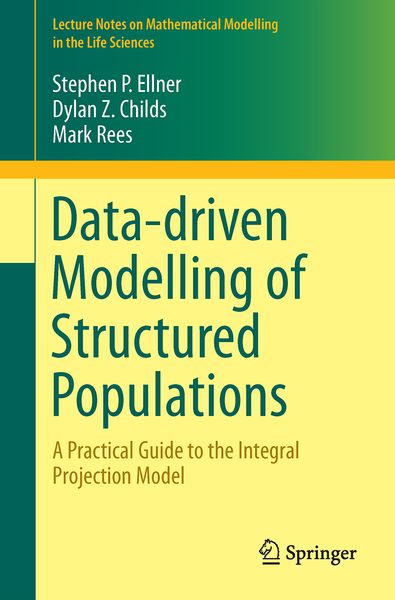
  • Produktbild: Data-driven Modelling of Structured Populations
  • Produktbild: Data-driven Modelling of Structured Populations

Data-driven Modelling of Structured Populations A Practical Guide to the Integral Projection Model

67,99 €

inkl. gesetzl. MwSt., Versandkostenfrei


Beschreibung

This book is a “How To” guide for modeling population dynamics using Integral Projection Models (IPM) starting from observational data. It is written by a leading research team in this area and includes code in the R language (in the text and online) to carry out all computations. The intended audience...

Beschreibung

This book is a “How To” guide for modeling population dynamics using Integral Projection Models (IPM) starting from observational data. It is written by a leading research team in this area and includes code in the R language (in the text and online) to carry out all computations. The intended audience are ecologists, evolutionary biologists, and mathematical biologists interested in developing data-driven models for animal and plant populations. IPMs may seem hard as they involve integrals. The aim of this book is to demystify IPMs, so they become the model of choice for populations structured by size or other continuously varying traits. The book uses real examples of increasing complexity to show how the life-cycle of the study organism naturally leads to the appropriate statistical analysis, which leads directly to the IPM itself. A wide range of model types and analyses are presented, including model construction, computational methods, and the underlying theory, with the more technical material in Boxes and Appendices. Self-contained R code which replicates all of the figures and calculations within the text is available to readers on GitHub.

Stephen P. Ellner is Horace White Professor of Ecology and Evolutionary Biology at Cornell University, USA; Dylan Z. Childs is Lecturer and NERC Postdoctoral Fellow in the Department of Animal and Plant Sciences at The University of Sheffield, UK; Mark Rees is Professor in the Department of Animal and Plant Sciences at The University of Sheffield, UK.


Produktdetails

Einband

Taschenbuch

Erscheinungsdatum

24.05.2016

Abbildungen

XIII, 329 p. 67 illus., 29 illus. in color.

Verlag Springer

Produktdetails

Einband

Taschenbuch

Erscheinungsdatum

24.05.2016

Abbildungen

XIII, 329 p. 67 illus., 29 illus. in color.

Verlag Springer
Seitenzahl

329

Maße (L/B/H)

23,5/15,5/1,9 cm

Gewicht

522 g

Auflage

1st ed. 2016

Sprache

Englisch

ISBN

978-3-319-28891-8

Herstelleradresse

Springer-Verlag KG
Sachsenplatz 4-6
1201 Wien
AT

Email: ProductSafety@springernature.com

Noch keine Bewertungen vorhanden

Verfassen Sie die erste Bewertung zu diesem Artikel

Helfen Sie anderen Kundinnen und Kunden durch Ihre Meinung.

Kundinnen und Kunden meinen

Bewertungen (0)

  • Produktbild: Data-driven Modelling of Structured Populations
  • Produktbild: Data-driven Modelling of Structured Populations
  • Introduction.- Simple Deterministic IPM.- Basic Analysis 1: Demographic Measures and Events in the Life Cycle.- Basic Analysis 2: Prospective Perturbation Analysis.- Density Dependence.- General Deterministic IPM.- Environmental Stochasticity.- Spatial Models.- Evolutionary Demography.- Future Directions and Advanced Topics.