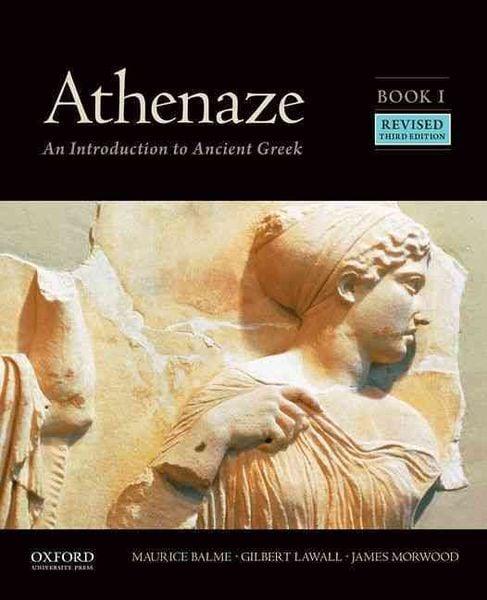
Produktbild: Athenaze, Book I

Athenaze, Book I An Introduction to Ancient Greek

105,99 €

inkl. gesetzl. MwSt., Versandkostenfrei

Lieferung nach Hause

Beschreibung

Produktdetails

Einband

Taschenbuch

Erscheinungsdatum

14.01.2016

Verlag

Oxford Academic

Seitenzahl

464

Maße (L/B/H)

23,3/19,2/2,2 cm

Gewicht

736 g

Auflage

3 Revised edition

Sprache

Englisch

ISBN

978-0-19-060766-1

Beschreibung

Produktdetails

Einband

Taschenbuch

Erscheinungsdatum

14.01.2016

Verlag

Oxford Academic

Seitenzahl

464

Maße (L/B/H)

23,3/19,2/2,2 cm

Gewicht

736 g

Auflage

3 Revised edition

Sprache

Englisch

ISBN

978-0-19-060766-1

Herstelleradresse

Libri GmbH
Europaallee 1
36244 Bad Hersfeld
DE

Email: gpsr@libri.de

Noch keine Bewertungen vorhanden

Verfassen Sie die erste Bewertung zu diesem Artikel

Helfen Sie anderen Kundinnen und Kunden durch Ihre Meinung.

Kundinnen und Kunden meinen

Bewertungen (0)

  • Produktbild: Athenaze, Book I
    • Preface

    • List of Historical Essays

    • List of Maps

    • List of Color Plates

    • About the Authors

    • Introduction

    • Map of Greece and the Aegean Sea

    • 1. O ¿IKAIO¿O¿I¿ (a)

    • Grammar

    • 1. Verb Forms: Stems and Endings

    • 2. Nouns: Genders, Stems, Endings, Cases, and Agreement

    • 3. U se of the Definite Article

    • Reading

    • The Athenian Farmer

    • O ¿IKAIO¿O¿I¿ (ß)

    • Grammar

    • 4. Accents

    • Readings

    • O K¿HPO¿

    • Classical Greek: Heraclitus

    • New Testament Greek: Title page of the Gospel of Luke

    • 2. O ¿AN¿IA¿ (a)

    • Grammar

    • 1. Verb Forms: Indicative Mood; 1st, 2nd, and 3rd Persons Singular

    • 2. Proclitics

    • 3. The Imperative

    • Readings

    • Slavery

    • Greek Wisdom: Cleobulus of Lindos

    • O ¿AN¿IA¿ (ß)

    • Grammar

    • 4. Articles, Adjectives, and Nouns; Singular, All Cases

    • 5. U ses of the Cases

    • 6. Persistent Accent of Nouns and Adjectives

    • 7. Recessive Accent of Verbs

    • Readings

    • O ¿O¿¿O¿

    • Classical Greek: Callimachus

    • New Testament Greek: Luke 3.22

    • 3. O APOTO¿ (a)

    • Grammar

    • 1. Verb Forms: 3rd Person Plural, Imperatives, and Infinitives

    • Reading

    • The Deme and the Polis

    • O APOTO¿ (ß)

    • Grammar

    • 2. Articles, Adjectives, and Nouns; Singular and Plural, All Cases

    • 3. Accent Shifting

    • Readings

    • OI ßOE¿

    • Classical Greek: Menander

    • New Testament Greek: Luke 6.46

    • 4. ¿PO¿ THI KPHNHI (a)

    • Grammar

    • 1. Verb Forms: All Persons, Singular and Plural

    • 2. Declensions of Nouns and Adjectives

    • 3. Feminine Nouns and Adjectives of the 1st Declension

    • Readings

    • Women

    • Greek Wisdom: Pittacus (of Mitylene)

    • ¿PO¿ THI KPHNHI (ß)

    • Grammar

    • 4. Masculine Nouns of the 1st Declension

    • 5. Feminine Nouns of the 2nd Declension

    • 6. 1st and 2nd Declension Adjectives

    • 7. Two Irregular Adjectives

    • 8. Formation of Adverbs

    • 9. The Definite Article as Case Indicator

    • Readings

    • AI ¿¿NAIKE¿ TO¿¿ AN¿PA¿ ¿EI¿O¿¿IN

    • Classical Greek: Callimachus

    • New Testament Greek: Luke 6.45

    • 5. O ¿¿KO¿ (a)

    • Grammar

    • 1. Contract Verbs in -a-

    • 2. Recessive Accent of Finite Verbs

    • 3. Article at the Beginning of a Clause

    • 4. Elision

    • Readings

    • Gods and Men

    • Greek Wisdom: Chilon of Sparta

    • O ¿¿KO¿ (ß)

    • Grammar

    • 5. Agreement of Subject and Verb

    • 6. Personal Pronouns

    • 7. Attributive and Predicate Position

    • 8. Possessives

    • 9. The Adjective ä¿¿¿, -¿, -¿

    • Readings

    • O AP¿O¿ TA ¿POßATA ¿¿IZEI

    • Greek Wisdom: The Seven Wise Men

    • Classical Greek: Anacreon

    • New Testament Greek: Luke 4.22 and 24

    • 6. O M¿¿O¿ (a)

    • Grammar

    • 1. Verb Forms: ¿¿¿¿

    • 2. Verbs: Voice

    • 3. Verb Forms: Middle Voice

    • 4. Deponent Verbs

    • Reading

    • Myth

    • O M¿¿O¿ (ß)

    • Grammar

    • 5. Middle Voice: Meaning

    • 6. Some Uses of the Dative Case

    • 7. Prepositions

    • Readings

    • O ¿H¿E¿¿ THN APIA¿NHN KATA¿EI¿EI

    • Classical Greek: Marriage

    • New Testament Greek: Luke 13.10-16

    • 7. O K¿K¿¿¿ (a)

    • Grammar

    • 1. Substantive Use of Adjectives

    • 2. Nouns: Declensions

    • 3. 3rd Declension Consonant Stem Nouns: Velar and Dental Stems

    • 4. Reflexive Pronouns

    • Reading

    • Homer

    • O K¿K¿¿¿ (ß)

    • Grammar

    • 5. 3rd Declension Consonant Stem Nouns: Nasal Stems

    • 6. 3rd Declension Consonant Stem Nouns: ß, ¿, ¿ (Labial) and ¿, p

    • (Liquid) Stems

    • 7. A 3rd Declension Adjective: ¿¿¿p¿v, ¿¿.¿pov, of sound mind;

    • prudent; self-controlled

    • 8. The Interrogative Pronoun and Adjective

    • 9. The Indefinite Pronoun and Adjective

    • Readings

    • O TO¿ ¿H¿E¿¿ ¿ATHP A¿O¿NHI¿KEI

    • Classical Greek: Sophocles

    • Greek Wisdom: Thales of Miletus

    • 8. ¿PO¿ TO A¿T¿ (a)

    • Grammar

    • 1. Participles: "Present" or Progressive: Middle Voice

    • Readings

    • Athens: A Historical Outline

    • Classical Greek: Archilochus

    • New Testament Greek: Luke 5.20-21

    • ¿PO¿ TO A¿T¿ (ß)

    • Grammar

    • 2. 3rd Declension Consonant Stem Nouns: Stems in -p-

    • 3. Two Important Irregular Nouns: ¿ ¿¿v¿, ¿H.¿ ¿¿väK¿¿, woman; wife,

    • and ¿ ¿¿¿p, ¿H.¿ ¿¿¿p¿¿, hand

    • 4. 1st/3rd Declension Adjective: ¿a.¿, ¿a.¿a, ¿a.v, all; every; whole

    • Reading

    • Greek Wisdom: Periander of Corinth

    • Grammar

    • 5. Numbers

    • 6. Expressions of Time When, Duration of Time, and Time Within Which

    • Readings

    • O O¿¿¿¿E¿¿ KAI O AIO¿O¿

    • Classical Greek: Sappho: The Deserted Lover: A Girl's Lament

    • 9. H ¿ANH¿¿PI¿ (a)

    • Grammar

    • 1. Participles: Present or Progressive: Active Voice

    • Reading

    • The City of Athens

    • H ¿ANH¿¿PI¿ (ß)

    • Grammar

    • 2. 3rd Declension Nouns with Stems Ending in -v¿-

    • 3. 3rd Declension Nouns with Stems Ending in a Vowel: ¿ ¿¿¿¿¿ and ¿¿ ¿¿¿¿

    • 4. 3rd Declension Nouns with Stems Ending in Diphthongs or Vowels:

    • ¿ ßä¿¿¿¿¿ and the Irregular Nouns ¿ vä.¿ and ¿ ßo¿.¿

    • 5. U ses of the Genitive Case

    • 6. Some Uses of the Article

    • Readings

    • O O¿¿¿¿E¿¿ KAI H KIPKH

    • Classical Greek: Simonides

    • New Testament Greek: Luke 6.31-33: The Sermon on the Mount

    • REVIEW OF VERB FORMS

    • PREVIEW OF NEW VERB FORMS

    • 10. H ¿¿M¿OPA (a)

    • Grammar

    • 1. Verb Forms: Verbs with Sigmatic Futures

    • 2. Verb Forms: The Asigmatic Contract Future of Verbs in -¿¿¿

    • 3. Verb Forms: The Sigmatic Future of Contract Verbs

    • 4. Verb Forms: Verbs with Deponent Futures

    • Readings

    • Festivals

    • Classical Greek: Theognis

    • New Testament Greek: Luke 6.35-36: The Sermon on the Mount

    • H ¿¿M¿OPA (ß)

    • Grammar

    • 5. Verb Forms: The Asigmatic Contract Future of Verbs with

    • Liquid and Nasal Stems

    • 6. The Irregular Verb ¿¿¥¿¿

    • 7. Future Participle to Express Purpose

    • 8. Impersonal Verbs

    • 9. Review of Questions

    • Readings

    • O O¿¿¿¿E¿¿ TO¿¿ ETAIPO¿¿ A¿O¿¿¿¿IN

    • Classical Greek: Menander and Archilochus

    • New Testament Greek: Luke 5.30-32

    • 11. O IATPO¿ (a)

    • Grammar

    • 1. Verb Forms: Past Tense: The Aorist

    • 2. Verb Forms: The Thematic 2nd Aorist

    • 3. Aspect

    • 4. Thematic 2nd Aorist Active and Middle Participles

    • 5. Verb Forms: Common Verbs with Thematic 2nd Aorists

    • Readings

    • Greek Science and Medicine

    • Classical Greek: Theognis

    • New Testament Greek: Luke 6.20-21: The Beatitudes

    • O IATPO¿ (ß)

    • Grammar

    • 6. Verbs with Thematic 2nd Aorists from Unrelated Stems

    • 7. Accents on Thematic 2nd Aorist Active Imperatives

    • 8. Augment

    • Readings

    • O ¿HMOKH¿H¿ TON ßA¿I¿EA IATPE¿EI

    • New Testament Greek: Luke 6.27-29: The Sermon on the Mount

    • 12. ¿PO¿ TON ¿EIPAIA (a)

    • Grammar

    • 1. Verb Forms: Past Tense: The Sigmatic 1st Aorist

    • 2. Sigmatic 1st Aorist Active and Middle Participles

    • Readings

    • Trade and Travel

    • Classical Greek: Scolion: The Four Best Things in Life

    • New Testament Greek: Luke 15.3-7: The Parable of the Lost Sheep

    • ¿PO¿ TON ¿EIPAIA (ß)

    • Grammar

    • 3. Verb Forms: The Asigmatic 1st Aorist of Verbs with Liquid and Nasal Stems

    • 4. Irregular Sigmatic 1st Aorists

    • 5. Verb Forms: Augment of Compound Verbs

    • Readings

    • O K¿¿AIO¿ TON TAPTH¿¿ON E¿PI¿KEI

    • Greek Wisdom: Bias of Priene

    • 13. ¿PO¿ THN ¿A¿AMINA (a)

    • Grammar

    • 1. Verb Forms: The Imperfect or Past Progressive Tense

    • 2. Aspect

    • Reading

    • The Rise of Persia

    • ¿PO¿ THN ¿A¿AMINA (ß)

    • Grammar

    • 3. Relative Clauses

    • 4. 3rd Declension Nouns and Adjectives with Stems in -¿¿-

    • 5. 1st/3rd Declension Adjective with 3rd Declension Stems in -¿- and -¿-

    • Readings

    • O ¿EP¿H¿ TON E¿¿H¿¿ONTON ¿IAßAINEI

    • Greek Wisdom: Solon of Athens

    • Classical Greek: Archilochus

    • New Testament Greek: Luke 21.1-4: The Widow's Mite

    • 14. H EN TAI¿ ¿EPMO¿¿¿AI¿ MA¿H (a)

    • Grammar

    • 1. Comparison of Adjectives

    • 2. Irregular Comparison of Adjectives

    • 3. Comparison of Adverbs

    • 4. U ses of Comparatives and Superlatives

    • Readings

    • The Rise of Athens

    • Classical Greek: Archilochus

    • New Testament Greek: Luke 10.25-29: The Good Samaritan (concluded 14 (B))

    • H EN TAI¿ ¿EPMO¿¿¿AI¿ MA¿H (ß)

    • Grammar

    • 5. Demonstrative Adjectives

    • 6. Interrogative and Indefinite Pronouns, Adjectives, and Adverbs

    • Readings

    • OI ¿EP¿AI TA ¿¿EP ¿EPMO¿¿¿¿N ¿TENA AIPO¿¿IN

    • Classical Greek: Theognis

    • New Testament Greek: Luke 10.30-37: The Good Samaritan (concluded)

    • 15. H EN THI ¿A¿AMINI MA¿H (a)

    • Grammar

    • 1. Athematic 2nd Aorists

    • 2. More 3rd Declension Nouns with Stems in -¿¿-

    • Readings

    • Aeschylus's Persae

    • New Testament Greek: Luke 2.1-14: The Birth of Jesus

    • H EN THI ¿A¿AMINI MA¿H (ß)

    • Grammar

    • 3. Contract Verbs in -o-

    • 4. Contract Nouns of the 2nd Declension

    • 5. More Numbers

    • 6. U ses of ¿¿ and Its Compounds

    • Reading

    • OI ¿EP¿AI TA¿ A¿HNA¿ AIPO¿¿IN

    • 16. META THN EN THI ¿A¿AMINI MA¿HN (a)

    • Grammar

    • 1. The Passive Voice

    • Reading

    • The Athenian Empire

    • META THN EN THI ¿A¿AMINI MA¿HN (ß)

    • Grammar

    • 2. Verbs with Athematic Presents and Imperfects: ¿¿vää, K¿¿.¿ä,

    • and ¿¿¿¿¿ää

    • Readings

    • O ¿EP¿H¿ ¿PO¿ THN A¿IAN ANA¿¿PEI

    • Classical Greek: Sappho: Love's Power

    • Classical Greek: Simonides

    • New Testament Greek: Luke 2.15-20: The Birth of Jesus (concluded)

    • Verb Charts

    • Syllables and Accents

    • Enclitics and Proclitics

    • Forms

    • Forms of Definite Article, Nouns, Adjectives, and Pronouns Laid Out in

    • Case Order N, V, A, G, D

    • Index of Language and Grammar

    • Greek to English Vocabulary

    • English to Greek Vocabulary

    • General Index

    • Acknowledgments

    • Credits