
Data Envelopment Analysis A Handbook of Empirical Studies and Applications
-
- Hardcover ausgewählt
- Taschenbuch
- eBook
-
Sprache:Englisch
-
Auflage:1st edition 2016
- 2015 138,99 €
- 2014 138,99 €
- 1st edition 2016 142,99 € ausgewählt
142,99 €
UVP
267,49 €
inkl. gesetzl. MwSt.,
Lieferung nach Hause
Beschreibung
Produktdetails
Einband
Gebundene Ausgabe
Erscheinungsdatum
23.03.2016
Abbildungen
XIII, 97 illus., 56 illus. in color., farbige Illustrationen, schwarz-weiss Illustrationen
Herausgeber
Joe ZhuVerlag
Springer UsSeitenzahl
587
Maße (L/B/H)
24,1/16/3,8 cm
Gewicht
10225 g
Auflage
1st edition 2016
Sprache
Englisch
ISBN
978-1-4899-7682-6
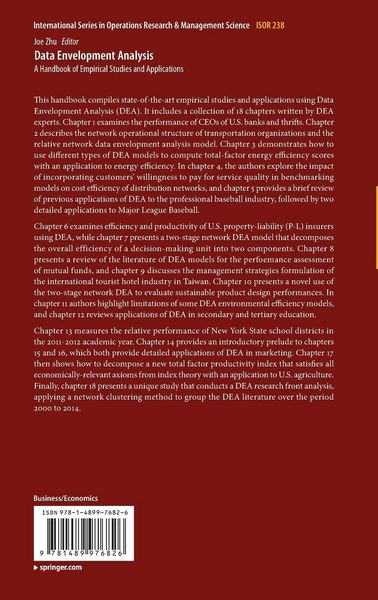
This handbook compiles state-of-the-art empirical studies and applications using Data Envelopment Analysis (DEA). It includes a collection of 18 chapters written by DEA experts. Chapter 1 examines the performance of CEOs of U.S. banks and thrifts. Chapter 2 describes the network operational structure of transportation organizations and the relative network data envelopment analysis model. Chapter 3 demonstrates how to use different types of DEA models to compute total-factor energy efficiency scores with an application to energy efficiency. In chapter 4, the authors explore the impact of incorporating customers' willingness to pay for service quality in benchmarking models on cost efficiency of distribution networks, and chapter 5 provides a brief review of previous applications of DEA to the professional baseball industry, followed by two detailed applications to Major League Baseball.
Chapter 6 examines efficiency and productivity of U.S. property-liability (P-L) insurers using DEA, while chapter 7 presents a two-stage network DEA model that decomposes the overall efficiency of a decision-making unit into two components. Chapter 8 presents a review of the literature of DEA models for the perfoemance assessment of mutual funds, and chapter 9 discusses the management strategies formulation of the international tourist hotel industry in Taiwan. Chapter 10 presents a novel use of the two-stage network DEA to evaluate sustainable product design performances. In chapter 11 authors highlight limitations of some DEA environmental efficiency models, and chapter 12 reviews applications of DEA in secondary and tertiary education.
Chapter 13 measures the relative performance of New York State school districts in the 2011-2012 academic year. Chapter 14 provides an introductory prelude to chapters 15 and 16, which both provide detailed applications of DEA in marketing. Chapter 17 then shows how to decompose a new total factor productivity index that satisfies alleconomically-relevant axioms from index theory with an application to U.S. agriculture. Finally, chapter 18 presents a unique study that conducts a DEA research front analysis, applying a network clustering method to group the DEA literature over the period 2000 to 2014.
Kundinnen und Kunden meinen
Verfassen Sie die erste Bewertung zu diesem Artikel
Helfen Sie anderen Kund*innen durch Ihre Meinung
Kurze Frage zu unserer Seite
Vielen Dank für dein Feedback
Wir nutzen dein Feedback, um unsere Produktseiten zu verbessern. Bitte habe Verständnis, dass wir dir keine Rückmeldung geben können. Falls du Kontakt mit uns aufnehmen möchtest, kannst du dich aber gerne an unseren Kund*innenservice wenden.
zum Kundenservice