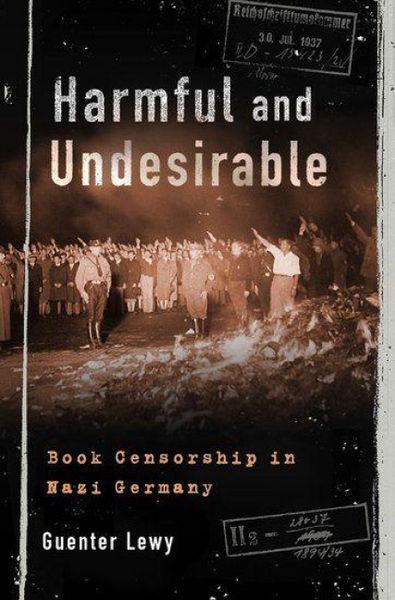
Harmful and Undesirable Book Censorship in Nazi Germany
-
- Hardcover ausgewählt
- Taschenbuch
- eBook
-
Sprache:Englisch
58,99 €
inkl. gesetzl. MwSt.,
Beschreibung
Produktdetails
Einband
Gebundene Ausgabe
Erscheinungsdatum
01.07.2016
Abbildungen
23 photographs
Verlag
Oxford University PressSeitenzahl
282
Maße (L/B/H)
24,1/15,8/2,5 cm
Gewicht
560 g
Sprache
Englisch
ISBN
978-0-19-027528-0
Like every authoritarian regime in history, Nazi Germany tried to inhibit ideological freedom through book censorship. Between 1933 and 1945, Hitler's party orchestrated a massive campaign to take control of all forms of communication in the nation. Although Nazi propaganda has been widely studied, modern historians have decidedly neglected book censorship. In this book, noted scholar Guenter Lewy offers the first comprehensive analysis in English language of the ways in which the Nazis exerted control over the creation, publication, and distribution of books by authors, publishers, bookstores, and libraries.
While Goebbels' Propaganda Ministry played a leading role, other entities engaged in censorship, including the Ministry of Science, Education and Popular Culture, Rosenberg's Office for the Advancement of German Literature, and Bouhler's Party Commission for the Protection of National Socialist Literature. The Gestapo and the Security Service were also involved in the process of enforcement. All of these organizations often acted on their own initiative both on the state and on the local level. As a result of these overlapping jurisdictions, the process of control was disorderly. This illustrates once again that the Third Reich was monolithic in theory but polycratic in practice.
This book explores not only how the Nazis implemented book censorship, but also the ways in which this process affected German intellectuals. It deals with the controversial issue of the so-called "inner immigrants" -- authors who were opposed to National Socialism but chose to remain in Germany and concealed the true meaning of their writings by way of allegories or parables, such as Gottfried Benn, Gerhart Hauptmann, Ernst Jünger, Jochen Klepper, and Ernst Wiechert. Describing the fate of writers and publishers who came into conflict with the organs of censorship, Lewy provides a disconcerting and realistic portrait of intellectual life under the Nazi dictatorship.
Noch keine Bewertungen vorhanden
Verfassen Sie die erste Bewertung zu diesem Artikel
Helfen Sie anderen Kundinnen und Kunden durch Ihre Meinung.
Kurze Frage zu unserer Seite
Vielen Dank für dein Feedback
Wir nutzen dein Feedback, um unsere Produktseiten zu verbessern. Bitte habe Verständnis, dass wir dir keine Rückmeldung geben können. Falls du Kontakt mit uns aufnehmen möchtest, kannst du dich aber gerne an unseren Kund*innenservice wenden.
zum Kundenservice