KI-Beratung Beta

Produktbild: Feature-Oriented Software Product Lines

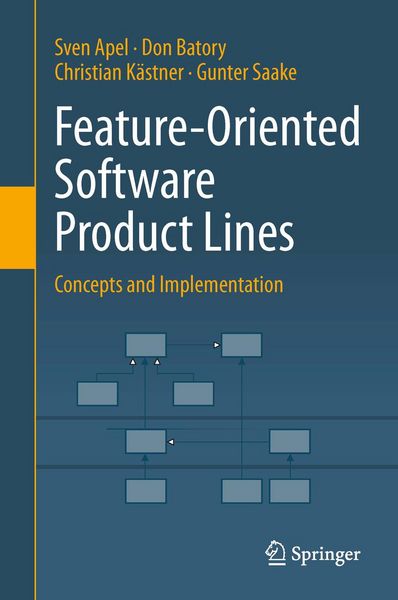
Feature-Oriented Software Product Lines Concepts and Implementation

69,54 €

inkl. gesetzl. MwSt.

Beschreibung

While standardization has empowered the software industry to substantially scale software development and to provide affordable software to a broad market, it often does not address smaller market segments, nor the needs and wishes of individual customers.  Software product lines reconcile mass production...

Beschreibung

While standardization has empowered the software industry to substantially scale software development and to provide affordable software to a broad market, it often does not address smaller market segments, nor the needs and wishes of individual customers.  Software product lines reconcile mass production and standardization with mass customization in software engineering. Ideally, based on a set of reusable parts, a software manufacturer can generate a software product based on the requirements of its customer. The concept of features is central to achieving this level of automation, because features bridge the gap between the requirements the customer has and the functionality a product provides. Thus features are a central concept in all phases of product-line development.


The authors take a developer's viewpoint, focus on the development, maintenance, and implementation of product-line variability, and especially concentrate on automated product derivation based on a user's feature selection. The book consists of three parts. Part I provides a general introduction to feature-oriented software product lines, describing the product-line approach and introducing the product-line development process with its two elements of domain and application engineering. The pivotal part II covers a wide variety of implementation techniques including design patterns, frameworks, components, feature-oriented programming, and aspect-oriented programming, as well as tool-based approaches including preprocessors, build systems, version-control systems, and virtual separation of concerns. Finally, part III is devoted to advanced topics related to feature-oriented product lines like refactoring, feature interaction, and analysis tools specific to product lines. In addition, an appendix listsvarious helpful tools for software product-line development, along with a description of how they relate to the topics covered in this book.


To tie the book together, the authors use two running examples that are well documented in the product-line literature: data management for embedded systems, and variations of graph data structures. They start every chapter by explicitly stating the respective learning goals and finish it with a set of exercises; additional teaching material is also available online. All these features make the book ideally suited for teaching - both for academic classes and for professionals interested in self-study.

Rezension

“The book provides a systematic introduction to feature-oriented software product lines, and leads the reader to more advanced topics in its second half. The authors distill the concepts and principles underlying the field with remarkable clarity, providing a much-needed foundation for the field. They also illustrate these concepts and principles using concrete examples, showcasing

languages, tools, and systems from both industrial practice and latest research. (…) There is no better team than these four authors to write about feature-oriented software product lines. The authors have made fundamental scientific and engineering contributions to the field.” from the foreword by Krzysztof Czarnecki, University of Waterloo, Canada

Produktdetails

Format

PDF

Kopierschutz

Nein

Family Sharing

Nein

Text-to-Speech

Nein

Produktdetails

Format

PDF

Format

eBooks im PDF-Format haben eine festgelegte Seitengröße und eignen sich daher nur bedingt zum Lesen auf einem tolino eReader oder Smartphone. Für den vollen Lesegenuss empfehlen wir Ihnen bei PDF-eBooks die Verwendung eines Tablets oder Computers.

Kopierschutz

Nein

Kopierschutz

Dieses eBook können Sie uneingeschränkt auf allen Geräten der tolino Familie, allen sonstigen eReadern und am PC lesen. Das eBook ist nicht kopiergeschützt und kann ein personalisiertes Wasserzeichen enthalten. Weitere Hinweise zum Lesen von eBooks mit einem personalisierten Wasserzeichen finden Sie unter Hilfe/Downloads.

Family Sharing

Nein

Family Sharing

Mit Family Sharing können Sie eBooks innerhalb Ihrer Familie (max. sechs Mitglieder im gleichen Haushalt) teilen. Sie entscheiden selbst, welches Buch Sie mit welchem Familienmitglied teilen möchten. Auch das parallele Lesen durch verschiedene Familienmitglieder ist durch Family Sharing möglich. Um eBooks zu teilen oder geteilt zu bekommen, muss jedes Familienmitglied ein Konto bei Thalia oder einem anderen tolino-Buchhändler haben. Weitere Informationen finden Sie unter Hilfe/Family-Sharing.

Text-to-Speech

Nein

Text-to-Speech

Bedeutet Ihnen Stimme mehr als Text? Mit der Funktion Text-to-Speech können Sie sich im tolino webReader und in der aktuellen Thalia – Lesen & Hören App das eBook vorlesen lassen. Weitere Informationen finden Sie unter Hilfe/Text-to-Speech.

Erscheinungsdatum

04.10.2013

Verlag Springer
Seitenzahl

315 (Printausgabe)

Dateigröße

12572 KB

Sprache

Englisch

EAN

9783642375217

Barrierefreiheit
  • keine Information zur Barrierefreiheit bekannt

Noch keine Bewertungen vorhanden

Verfassen Sie die erste Bewertung zu diesem Artikel

Helfen Sie anderen Kundinnen und Kunden durch Ihre Meinung.

Kundinnen und Kunden meinen

Bewertungen (0)

Weitere Artikel findest du in

  • Produktbild: Feature-Oriented Software Product Lines