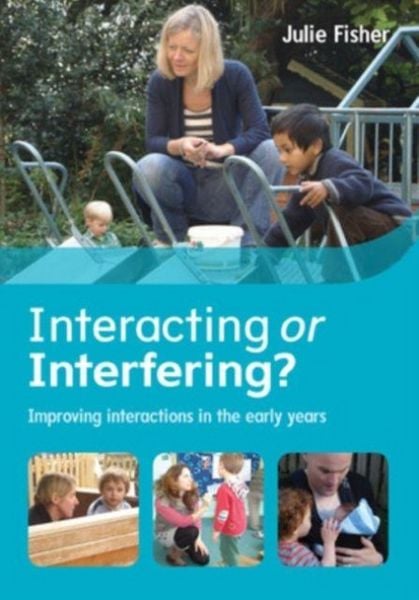
Interacting or Interfering? Improving Interactions in the Early Years
-
- Englisch ausgewählt
37,99 €
inkl. gesetzl. MwSt.,
Beschreibung
Produktdetails
Einband
Taschenbuch
Erscheinungsdatum
16.01.2016
Verlag
Open University PressSeitenzahl
248
Maße (L/B/H)
23,8/16,7/1,7 cm
Gewicht
390 g
Sprache
Englisch
ISBN
978-0-335-26256-4
High quality interactions are recognised as fundamental to the achievement of outstanding teaching and learning in the early years. If you are working with children from six months to six years this authoritative new book from leading author Julie Fisher encourages you to reflect deeply on the quality and impact of interactions in your setting.
Drawing on research undertaken in baby rooms, nurseries and classrooms over four years the book challenges prevailing orthodoxies and offers specific practical guidance on how to improve the quality of interactions on a day-to-day basis. With its illuminating examples, the book shows how you can best tune into and respond effectively to young children's conversations. It exemplifies how interactions are most effectively sustained and how developing high quality interactions can better scaffold and support children's learning and development.
'Interacting or Interfering?' . Identifies the key components of effective interactions and how implementing these can improve the quality of children's learning . Contains transcripts of interactions from baby rooms through to Year 2 classes which exemplify key messages . Provides prompts you can use to analyse and improve your own practice
Written in the author's exceptionally clear and accessible style, this book is indispensable reading for all students and practitioners working and studying in the early years.
"There is a tendency for adult talk to dominate nurseries and schools in an attempt to manage, organise and interrogate children's learning; this closes down children's own investigation and capacity for thought. Fisher points out how 'the very act of "being an educator" can sometimes distort the nature of an interaction so much that it inhibits the very learning it is trying to promote'. In this timely, thought-provoking and very readable book she prompts us to think more deeply about interactions and adapt new strategies to encourage all young children to engage in meaningful and enriching talk." TACTYC, March, 2016
"The prompts and points for reflection encourage practitioners to critically consider their role and function, noting where their work is affirmed and where there is scope for further development ... This book is both relevant, though provoking and extremely useful for all involved in early childhood - an excellent tool for professional development." Marion Dowling, Early Education Journal, No 79/ Summer 2016
Noch keine Bewertungen vorhanden
Verfassen Sie die erste Bewertung zu diesem Artikel
Helfen Sie anderen Kundinnen und Kunden durch Ihre Meinung.
Kurze Frage zu unserer Seite
Vielen Dank für dein Feedback
Wir nutzen dein Feedback, um unsere Produktseiten zu verbessern. Bitte habe Verständnis, dass wir dir keine Rückmeldung geben können. Falls du Kontakt mit uns aufnehmen möchtest, kannst du dich aber gerne an unseren Kund*innenservice wenden.
zum Kundenservice