KI-Beratung Beta

Produktbild: Galileo and the Equations of Motion

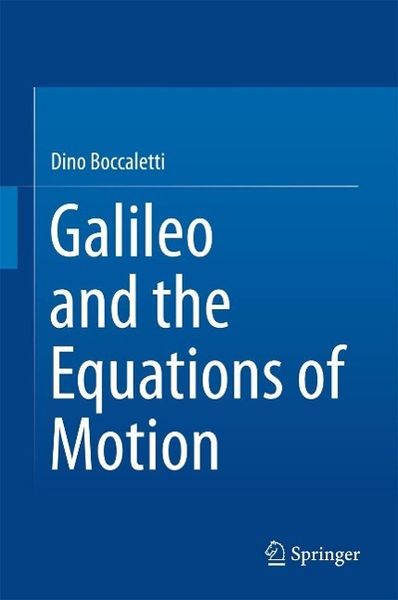
Galileo and the Equations of Motion

53,49 €

inkl. gesetzl. MwSt.

Beschreibung

This book is intended as a historical and critical study on the origin of the equations of motion as established in Newton's Principia. The central question that it aims to answer is whether it is indeed correct to ascribe to Galileo the inertia principle and the law of falling bodies. In order to accomplish...

Beschreibung

This book is intended as a historical and critical study on the origin of the equations of motion as established in Newton's Principia. The central question that it aims to answer is whether it is indeed correct to ascribe to Galileo the inertia principle and the law of falling bodies. In order to accomplish this task, the study begins by considering theories on the motion of bodies from classical antiquity, and especially those of Aristotle. The theories developed during the Middle Ages and the Renaissance are then reviewed, with careful analysis of the contributions of, for example, the Merton and Parisian Schools and Galileo's immediate predecessors, Tartaglia and Benedetti. Finally, Galileo's work is examined in detail, starting from the early writings. Excerpts from individual works are presented, to allow the texts to speak for themselves, and then commented upon. The book provides historical evidence both for Galileo's dependence on his forerunners and for the major breakthroughs that he achieved. It will satisfy the curiosity of all who wish to know when and why certain laws have been credited to Galileo.

Rezension

“The purpose of this book is to explain how Galileo gradually transformed from a believer in the Archimedian approach to eventually arrive at the new insights of these laws of motion. Boccaletti carefully analyses the available texts to understand this transformation. This is a study mainly addressing the professional historian.” (Adhemar Bultheel, EMS European Mathematical Society, eruo-math-soc.eu, November, 2015)

Produktdetails

Format

PDF

Kopierschutz

Nein

Family Sharing

Nein

Text-to-Speech

Nein

Produktdetails

Format

PDF

Format

eBooks im PDF-Format haben eine festgelegte Seitengröße und eignen sich daher nur bedingt zum Lesen auf einem tolino eReader oder Smartphone. Für den vollen Lesegenuss empfehlen wir Ihnen bei PDF-eBooks die Verwendung eines Tablets oder Computers.

Kopierschutz

Nein

Kopierschutz

Dieses eBook können Sie uneingeschränkt auf allen Geräten der tolino Familie, allen sonstigen eReadern und am PC lesen. Das eBook ist nicht kopiergeschützt und kann ein personalisiertes Wasserzeichen enthalten. Weitere Hinweise zum Lesen von eBooks mit einem personalisierten Wasserzeichen finden Sie unter Hilfe/Downloads.

Family Sharing

Nein

Family Sharing

Mit Family Sharing können Sie eBooks innerhalb Ihrer Familie (max. sechs Mitglieder im gleichen Haushalt) teilen. Sie entscheiden selbst, welches Buch Sie mit welchem Familienmitglied teilen möchten. Auch das parallele Lesen durch verschiedene Familienmitglieder ist durch Family Sharing möglich. Um eBooks zu teilen oder geteilt zu bekommen, muss jedes Familienmitglied ein Konto bei Thalia oder einem anderen tolino-Buchhändler haben. Weitere Informationen finden Sie unter Hilfe/Family-Sharing.

Text-to-Speech

Nein

Text-to-Speech

Bedeutet Ihnen Stimme mehr als Text? Mit der Funktion Text-to-Speech können Sie sich im tolino webReader und in der aktuellen Thalia – Lesen & Hören App das eBook vorlesen lassen. Weitere Informationen finden Sie unter Hilfe/Text-to-Speech.

Erscheinungsdatum

17.08.2015

Verlag Springer
Seitenzahl

175 (Printausgabe)

Dateigröße

2202 KB

Auflage

1st ed. 2016

Sprache

Englisch

EAN

9783319201344

Barrierefreiheit
  • keine Information zur Barrierefreiheit bekannt

Noch keine Bewertungen vorhanden

Verfassen Sie die erste Bewertung zu diesem Artikel

Helfen Sie anderen Kundinnen und Kunden durch Ihre Meinung.

Kundinnen und Kunden meinen

Bewertungen (0)

Weitere Artikel findest du in

  • Produktbild: Galileo and the Equations of Motion
  • Part I The Theories on the Motion of Bodies in the Classical Antiquity.- Kinematics among the Greeks.- Dynamics in the Opinion of Aristotle and his Continuators.- The Theories of Motion in the Middle Ages and in the Renaissance.- The first substantial Criticisms to Aristotelian Mechanics - Philoponus and Avempace.- The medieval Kinematics.- Part II A brief Chronology of Galileo's Life.- The young Galileo and the De Motu.- The Inertia Principle.-The Law of Fall and the Motion of Projectiles.- The Principle of Relativity.