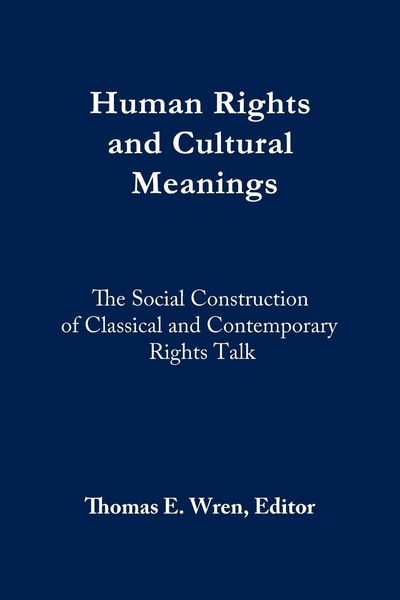
Human Rights and Cultural Meanings
-
- Englisch ausgewählt
34,99 €
inkl. gesetzl. MwSt.,
Lieferung nach Hause
Beschreibung
Produktdetails
Einband
Taschenbuch
Erscheinungsdatum
01.08.2015
Herausgeber
Thomas E. WrenVerlag
New University Press LLCSeitenzahl
178
Maße (L/B/H)
22,9/15,2/1 cm
Gewicht
268 g
Sprache
Englisch
ISBN
978-0-9829219-6-8
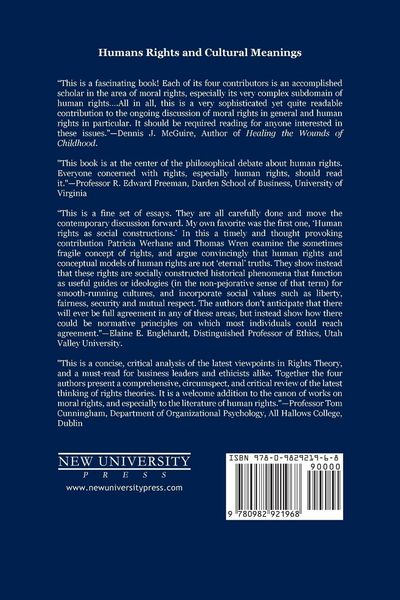
Each of the four contributors to Human Rights and Cultural Meanings is a scholar in the area of moral rights, especially its very complex subdomain of human rights. From their different perspectives they clarify the ongoing, socially constructed character of rights theory in general as well as its specific contemporary version, "human rights." The first chapter, "Human rights as social constructions" by Patricia Werhane and Thomas Wren, focuses directly on the socially constructed character of the concept of rights, especially the contemporary notion of human rights. Abstract models of human rights are not eternal truths but rather historical phenomena that provide more or less useful conceptual schemes for generating general principles of fairness, liberty, mutual respect, and security. In the next chapter, "Educating for human rights consciousness," education scholar Michelle Bellino demonstrates the inherently unfinished character of human rights discourse. She presents a remarkable ethnographic study of the reception by Guatemalan students of a human rights-based educational program established in the aftermath of their country's 36-year civil war. Her study includes a rich typology in which young people exhibit denial of the normative claims of human rights, skepticism about whether it can be effectively practiced in their own country, and a sense of empowerment. In contrast, David Ozar's "Human rights and the rest of us" uses the surgical tools of contemporary analytical philosophy to reconstruct the claim that human rights claims are only "manifestos" addressed to everyone in principle and no one in particular. He demonstrates that the human rights claims of distant others are addressed to all of us, albeit in many different ways. The final chapter, Wren's "The birth of rights talk," traces the transition from the ancient notion of objective rightness to the modern notion of rights as powers. He argues that the transformation took place in the high Middle Ages, as part of a larger social transformation that included new person-centered modes of discourse for interpreting sacred and classical texts as well as for rough and ready litigating.
Noch keine Bewertungen vorhanden
Verfassen Sie die erste Bewertung zu diesem Artikel
Helfen Sie anderen Kundinnen und Kunden durch Ihre Meinung.
Kurze Frage zu unserer Seite
Vielen Dank für dein Feedback
Wir nutzen dein Feedback, um unsere Produktseiten zu verbessern. Bitte habe Verständnis, dass wir dir keine Rückmeldung geben können. Falls du Kontakt mit uns aufnehmen möchtest, kannst du dich aber gerne an unseren Kund*innenservice wenden.
zum Kundenservice