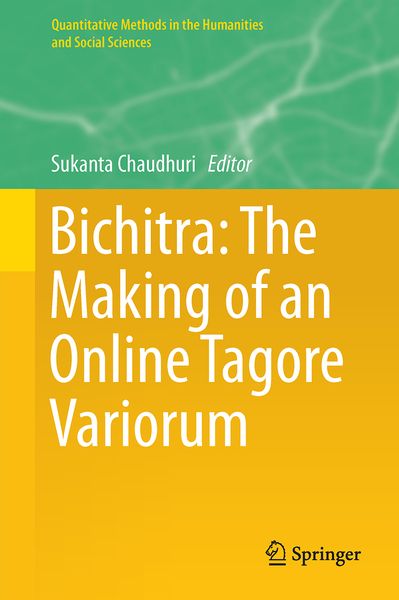
Bichitra: The Making of an Online Tagore Variorum
-
- Hardcover ausgewählt
- Taschenbuch
- eBook
-
Sprache:Englisch
48,99 €
inkl. gesetzl. MwSt.,
Beschreibung
Produktdetails
Einband
Gebundene Ausgabe
Erscheinungsdatum
25.02.2016
Abbildungen
XV, 159 p. 88 illus., 64 illus. in color.
Herausgeber
Sukanta ChaudhuriVerlag
SpringerSeitenzahl
159
Maße (L/B/H)
24,1/16/1,6 cm
Gewicht
436 g
Auflage
1st ed. 2015
Sprache
Englisch
ISBN
978-3-319-23677-3
This book documents the creation of the Bichitra Online Tagore Variorum, a publicly accessible database of Rabindranath Tagore's complete works in Bengali and English totaling some 140,000 pages of primary material. Chapters cover innovative aspects of the site, all replicable in other projects: a hyperbibliography; a search engine and hyperconcordance working across the database; and a unique collation program comparing variant texts at three levels. There are also chapters on the special problems of processing manuscripts, and on planning the website. Early chapters take readers through the history of the project, an overview of Tagore’s works, and the Bengali writing system with the challenges of adapting it to electronic form.
The name Bichitra, meaning "various" in Bengali, alludes both to the great variety of Tagore’s works and to their various stages of composition. Beyond their literary excellence, they are notable for their sheer quantity, the number of variant forms of a great many items, and their afterlife in translation, often the poet’s own. Seldom if ever has the same writer revised his material and recast it across genres on such a scale. Tagore won the Nobel Prize in 1913.
By its value-added presentation of this range of material, Bichitra can be a model for future databases covering an author’s complete works or other major corpus of texts. It offers vastly expanded access to Tagore’s writings, and enables new kinds of research including computational text analysis. The “book of the website” shows in technical and human terms how researchers with interests in art, literature and technology can collaborate on cultural informatics projects.
Noch keine Bewertungen vorhanden
Verfassen Sie die erste Bewertung zu diesem Artikel
Helfen Sie anderen Kundinnen und Kunden durch Ihre Meinung.
Kurze Frage zu unserer Seite
Vielen Dank für dein Feedback
Wir nutzen dein Feedback, um unsere Produktseiten zu verbessern. Bitte habe Verständnis, dass wir dir keine Rückmeldung geben können. Falls du Kontakt mit uns aufnehmen möchtest, kannst du dich aber gerne an unseren Kund*innenservice wenden.
zum Kundenservice